
How Hair Thickness Changes Stress Distribution on the Scalp
Published on Fri Apr 03 2026
Quick Summary
Hair thickness determines how mechanical stress from daily combing, tying, and styling distributes across your scalp and as individual strands become finer through miniaturisation, each follicle bears proportionally more traction force with every styling session.
This is why thinning hair seems to worsen faster than it should: the hair is not just becoming less visible, it is becoming less capable of absorbing the daily physical load it used to handle, and that load gets redirected straight to already-vulnerable follicles. Most people only notice this when density has already reduced significantly, because the process of strand thinning happens gradually over months to years before a bald patch or visible recession appears.
A Story of Subtle Change
Rohan, 34, from Pune, noticed his hair felt "lighter" while styling. He did not see bald patches, but his crown looked less dense under bright light. He had a demanding job and tied his hair tightly during workouts.
Over two years, he experienced gradual thinning. He tried changing shampoos and oils, assuming dryness was the cause. However, the issue continued because the real shift was in strand thickness and follicle miniaturisation.
After proper scalp and follicle assessment, he understood that reduced hair shaft diameter was increasing stress on already sensitive follicles. With early intervention and lifestyle changes, further progression was slowed.
What Does Hair Thickness Have to Do With Scalp Stress?
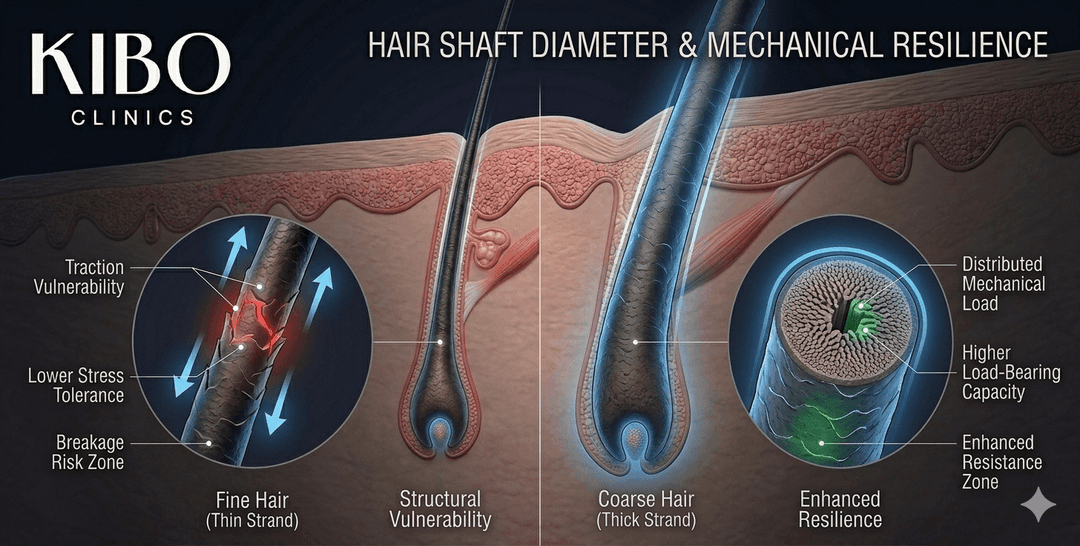
Hair thickness refers to the diameter of individual strands. Thicker strands distribute physical forces more evenly across the scalp surface. Thinner strands concentrate that force closer to the follicle root.
Scalp health forms the base — A healthy scalp has balanced oil production, good blood flow, and minimal inflammation. When the scalp is inflamed or dry, follicles become more vulnerable to the tension that daily styling creates.
Follicle function determines strand thickness — Each follicle produces hair based on genetics, nutrition, and hormonal signals. When follicles miniaturise under DHT influence or nutritional deficiency, strands become finer — and each finer strand distributes less force, sending more of it directly to the follicle anchor.
Stress hormones influence follicle cycles — Cortisol can shorten the growth phase, leading to thinner regrowth across successive hair cycles. This is why people under chronic work pressure often notice their hair "not growing back the same" after a shed.
Lifestyle and environment add mechanical load — Tight ponytails, helmets, harsh brushing, and chemical treatments increase traction. When hair is already thin, this load becomes proportionally more damaging because each remaining strand must absorb more total force.
How Mechanical Load Impacts Follicles
Every time you comb or tie your hair, small forces act on the strand. Thick hair absorbs and distributes this force along its length. Thin hair transfers more of that force directly to the follicle anchoring system.
Over time, repeated traction on miniaturising hair may contribute to traction alopecia or worsen pattern thinning in genetically prone individuals. The change is gradual, which is why most people notice it only after density has already reduced significantly — the early warning was the strands feeling "lighter," not any visible patch.
How Hair Thickness Changes Over Time — Key Causes
| Factor | Effect on Thickness | Scalp Stress Impact | Reversibility |
|---|---|---|---|
| Genetic pattern hair loss (DHT) | Progressive follicle miniaturisation — each cycle produces finer, shorter hair | Highest — thinning zones experience concentrated traction as fewer strands share the load | Progressive without treatment — requires ongoing medical management |
| Nutritional deficiency (iron, protein, vitamin D) | Temporary reduction in strand diameter; hair grows back thinner until levels are corrected | Medium — finer strands from deficiency compound traction stress from daily styling | Reversible with dietary correction within 3–6 months |
| Tight hairstyles (traction) | Shaft breakage creates the appearance of thinning; sustained tension weakens follicle anchoring | Localised — temples, hairline, and nape most affected | Early stages reversible; advanced traction alopecia may be permanent |
| Post-pregnancy hormonal shift | Oestrogen withdrawal pushes follicles into telogen; regrowth may initially be finer | Diffuse — overall density reduces before normalising | Usually self-resolves in 6–12 months |
| Chronic stress (cortisol) | Shortens anagen phase; finer hair in successive cycles; shedding increases | Systemic — no specific zone, but amplifies genetic sensitivity in prone individuals | Partially reversible depending on stress duration and genetic baseline |
| Age-related changes | Natural follicle activity reduces with age; strand diameter decreases gradually | Cumulative — worsens mechanical stress tolerance of scalp over time | Manageable with medical support; not fully reversible |
How Does Hair Thickness Show in Men and Women?
In men, thinning usually starts at the temples or crown. As strands become finer, stress concentrates in these regions, accelerating visible recession. Men typically experience more DHT-driven miniaturisation — each successive hair cycle produces a shorter, finer strand until the follicle eventually stops producing terminal hair altogether.
In women, thinning is often diffuse across the top of the scalp. The part line widens gradually. Because women often style or tie hair tightly, mechanical stress can worsen diffuse thinning — particularly when combined with the hormonal fluctuations of PCOS, thyroid disorders, or menopause.
Both genders can experience traction-related thinning if hair care habits are aggressive, and the risk is higher when underlying strand diameter is already reducing from any other cause.
What Daily Habits Make It Better or Worse?
Habits that worsen the problem:
- Frequent tight ponytails or buns — increase tension on already thin strands; over time this weakens follicles that are already stressed from miniaturisation
- Excessive heat styling — reduces hair shaft strength, making strands more prone to breakage and appearing even finer
- Harsh brushing on wet hair — stretches fragile strands beyond their reduced elastic capacity when hair is structurally weaker; the same risk as explained in wet hair root vulnerability
- Ignoring dandruff or scalp inflammation — allows chronic irritation to weaken the follicle base progressively
- Switching products too frequently without identifying the root cause — the problem almost always lies deeper than shampoo choice
Habits that help:
- Balanced nutrition with adequate protein intake — hair is made of keratin, and protein is the primary structural input for strand diameter
- Gentle scalp massage with fingertip pads — may improve blood circulation; use pads, not nails, to avoid creating inflammation
- Managing psychological stress through consistent sleep and exercise — helps regulate the hormonal fluctuations that directly affect hair cycle timing
- Mild cleansing with products suited to your scalp type — keeps follicles free from buildup that compounds existing miniaturisation stress
What Helps First — Practical Relief Steps
Reduce mechanical tension immediately. Avoid tight hairstyles and aggressive combing — this is the fastest single intervention and costs nothing. Understanding best hairstyles to minimise follicle stress provides specific low-tension alternatives for daily styling.
Improve nutrition with adequate protein, iron, and essential micronutrients after medical guidance. A ferritin blood test (not just haemoglobin) often reveals iron deficiency that standard tests miss, and correcting it improves strand diameter within 3 to 4 months.
Address visible scalp conditions early. Dandruff, seborrheic dermatitis, and scalp inflammation compound follicle vulnerability when strands are already thinning. Treating these removes one contributing stress before it compounds the primary cause.
Track shedding patterns for 3 months. If thickness stabilises or improves, the cause may be temporary and correctable through lifestyle alone. If thinning continues to progress despite habit changes, medical evaluation is the appropriate next step — not another shampoo change.
Most people see early stabilisation within 8 to 12 weeks if the cause is lifestyle-related. Genetic thinning requires structured long-term planning that includes DHT management and pattern hair loss treatment.
When to See a Hair Specialist
Do not wait if you notice:
- Thinning that is progressive over 6 months despite lifestyle correction
- Widening part line, receding temples, or crown visibility
- Sudden heavy shedding after illness or stress lasting more than 3 months
- Scalp itching, redness, pain, or burning sensation alongside thinning
- Family history of pattern baldness combined with visible thinning beginning before 35
Early intervention planning matters because miniaturisation progresses silently — by the time density loss is obvious, a significant proportion of follicles may already be in advanced miniaturisation stages that are harder to treat.
Common Myths About Hair Thickness and Scalp Stress
Myth 1: Shaving hair makes it thicker. Hair may feel coarser after shaving due to blunt tips, but follicle size does not change. Strand diameter is determined by the follicle, not the cutting point.
Myth 2: Oiling alone increases hair diameter permanently. Oil improves shaft lubrication and surface condition but does not change follicle genetics or correct nutritional deficiencies that cause thinning.
Myth 3: Only aging causes thinning. Stress, nutritional deficiency, hormones, and traction all influence strand thickness — sometimes creating thinning visible in people in their 20s and 30s with no genetic pattern loss.
Myth 4: If there is no bald patch, there is no problem. Follicle miniaturisation begins before bald patches appear. The early stage — strands feeling lighter or finer — is the optimal intervention window, not the visible patch stage.
Why Kibo Clinics
Many patients choose Kibo Clinics for hair thinning concerns because our approach addresses both current density and long-term follicle planning. We begin with comprehensive scalp assessment, hair and follicle analysis, and thorough lifestyle and environmental review — identifying whether the strand thinning is temporary and correctable or represents progressive genetic miniaturisation requiring ongoing management.
Our No Ghost Surgery pledge ensures the consulting surgeon personally performs your entire procedure, maintaining consistent quality throughout the session. We do not delegate critical steps to technicians.
The Kibo Hair Analysis (scalp and follicle assessment) is the first step in understanding your specific condition. We provide education, guidance, and support without guarantees, exaggerated claims, or miracle cure promises.
For patients requiring procedural support, options may include PRP therapy, GFC therapy, medical management, or advanced FUE techniques depending on candidacy. We also provide structured 12-month monitoring to track thickness changes, response to treatment, and necessary adjustments.
If you notice your hair feeling finer or your scalp becoming more visible, early assessment can help you understand whether it is temporary thinning or pattern miniaturisation.
Frequently Asked Questions
Q: Can thin hair handle normal daily styling? Thin hair can handle gentle styling, but repeated tight pulling or heat exposure increases breakage risk significantly because each strand distributes less force — meaning more of the styling stress goes directly to the follicle. Protective habits can slow further thinning, but genetic miniaturisation may continue without medical support.
Q: Does stress directly reduce hair thickness? Chronic stress can push hair into the resting phase, leading to shedding followed by finer regrowth over successive cycles. It usually acts alongside hormonal and genetic factors. Stress management helps but may not fully reverse pattern hair loss if genetic sensitivity is present.
Q: Can improving diet increase strand diameter? Correcting nutritional deficiencies — particularly iron (ferritin), protein, and vitamin D — may improve hair quality and strand diameter within 3 to 6 months if nutrition was the primary cause. Genetic thinning does not fully reverse with diet alone, but nutritional support reduces the compounding effect.
Q: How long does it take to notice thickness changes? Temporary thinning may improve in 3 to 4 months after correcting nutritional or stress triggers. Pattern-related miniaturisation progresses gradually over years if untreated and typically requires 6 to 12 months of consistent medical management before thickness stabilisation becomes measurable.
Q: Do hair serums increase thickness permanently? Most serums improve shaft coating and provide temporary fullness by swelling the cuticle. They do not permanently enlarge follicles or reverse miniaturisation. Medical treatments targeting DHT or improving follicle function are needed for structural change.
Q: Is hair transplant the only solution for severe thinning? Not always. Early thinning may respond to non-surgical therapies including PRP, GFC, or medical management with DHT blockers. Transplant is considered when follicles are permanently miniaturised and the donor area has adequate density. Suitability depends on detailed evaluation and donor reserve assessment.
Key Takeaways
- Hair thickness determines how mechanical stress from daily styling distributes across the scalp — as strands thin, each follicle bears more traction force from the same combing or tying actions
- Hair getting thinner causes include DHT-driven miniaturisation, iron deficiency, cortisol elevation, hormonal shifts, and sustained traction — often multiple factors operating simultaneously
- Miniaturisation begins before bald patches appear — the early warning is hair feeling "lighter" or finer, not a visible recession
- How to make hair thicker naturally — correct ferritin, vitamin D, and protein levels; reduce tight hairstyles; manage stress; address scalp inflammation; all before considering medical intervention
- Food for hair growth and thickness — protein from eggs, lentils, paneer, and lean meat; iron from spinach and legumes; vitamin D from sunlight and supplements after testing
- Thickness changes tracked over 3 months indicate whether the cause is temporary and correctable or progressive and requiring clinical management
Disclaimer
This content is for informational purposes only and does not substitute personalized medical advice. Hair thickness changes vary based on genetics, hormones, medical conditions, and lifestyle factors. Treatment responses differ between individuals. No procedure or therapy guarantees uniform results. Professional consultation is necessary for accurate diagnosis and appropriate care planning.
Hair Transplant
FUE Hair Transplant | Sapphire FUE Hair Transplant | Bio FUE Hair Transplant | Realtime FUE Hair Transplant | Direct Hair Transplant (DHT)
Hair Regrowth
PRP Therapy | GFC Therapy | IV Hair Boosters | Mesotherapy for Hair Regrowth | Microneedling for Hair Regrowth
Must Read
Hair Loss Types Symptoms Causes | Hair Breakage Causes Treatments | DHT Blockers Hair Loss Guide | Hair Transplant Good Or Bad | Understanding The Language Of Natural Hairline
Relevant Blogs
Hair Brushes Combs Scalp Stress | Hair Dryer Heat Follicle Safety | Straighteners and Curling Irons Hair Stress | Pollution Build Up Weakening Hair Roots | Scalp Oil Reducing Hair Friction