
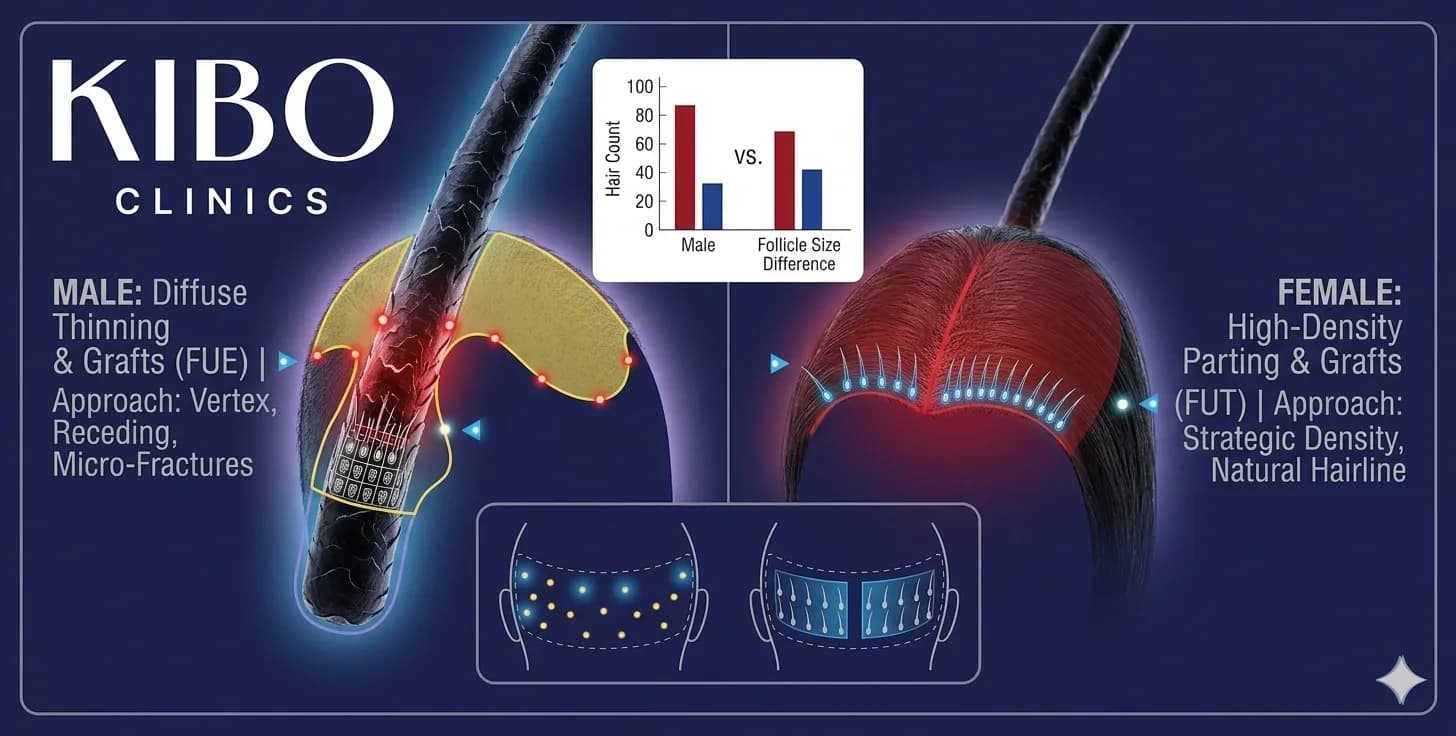
Hair Transplant for Men vs. Women: Key Differences in Technique
You look in the mirror and see thinning that wasn’t there a few years ago. The pattern, the pace, and even the cause of hair loss can differ between men and women. Hair transplant techniques are adapted based on hairline design, donor area stability, and the type of hair thinning each gender typically experiences.
Hair loss is not “one pattern fits all.” Men often lose hair in defined areas like the temples and crown, while women usually notice overall thinning without a receding hairline. Because of this, the planning, graft placement, and even expectations from surgery are different. Understanding these differences helps you decide if and when a transplant is suitable.
Why Do Men and Women Experience Hair Loss Differently?
Hair loss starts at the scalp level. Healthy follicles depend on good blood supply, balanced hormones, and a stable growth cycle. When hormones like DHT increase sensitivity in follicles, they gradually shrink. Stress, nutrition gaps, thyroid imbalance, and environmental exposure can further weaken hair roots.
In men, androgenetic alopecia usually follows a clear pattern. The hairline recedes, temples thin, and crown develops a bald spot. The donor area at the back and sides often remains strong, making transplantation more predictable.
In women, hair loss is often diffuse. Instead of bald patches, there is overall reduction in density, especially along the parting line. The hairline is usually preserved. Because thinning can also affect the donor area in some women, careful assessment becomes critical.
How Do Hormones Influence These Differences?
Men are more sensitive to DHT at the frontal scalp and crown. This is why male pattern baldness follows a defined Norwood scale.
Women also have androgens, but their hair loss is influenced by estrogen balance, thyroid health, PCOS, pregnancy changes, and menopause. The pattern is assessed using the Ludwig scale. Hormonal fluctuations make female hair loss more variable.
How Does Hair Transplant Technique Differ for Men and Women?
The core methods like FUE or Sapphire FUE remain similar. However, planning and execution vary significantly.
Hairline Design
For men, the surgeon often reconstructs a receding hairline or lowers a high forehead. The design must look age-appropriate and natural.
For women, the focus is rarely on creating a masculine-style sharp hairline. Instead, density is increased behind the existing hairline or used to correct a broad forehead while maintaining softness.
Donor Area Evaluation
Men typically have a stable donor zone at the back of the scalp.
Women may have diffuse thinning even in donor areas. If donor density is weak, overharvesting can cause visible gaps. This is why not every woman with hair loss is an immediate transplant candidate.
Graft Placement Density
Men often need coverage in bald areas.
Women usually need density enhancement between existing hairs. This requires precise angle control to avoid shock loss and protect surrounding follicles.
Shaving Requirements
Many men are comfortable with complete shaving for surgery.
Women often prefer minimal or no shaving techniques. Selective trimming methods are used to preserve appearance during recovery.
What Results Can Men and Women Expect?
Results depend on cause, donor stability, and realistic planning.
Men with stable male pattern baldness and strong donor areas often see well-defined coverage in 8–12 months.
Women with localized thinning or traction alopecia may see significant density improvement. However, women with ongoing diffuse thinning may require medical management along with surgery.
| Aspect | Men | Women |
|---|---|---|
| Common Pattern | Receding hairline, crown baldness | Diffuse thinning, widened parting |
| Donor Stability | Usually strong and stable | May also be thinned |
| Hairline Work | Reconstruction or lowering | Soft density enhancement |
| Primary Goal | Cover bald patches | Increase thickness |
How Does Hair Transplant Show in Men and Women?
In men, transplanted grafts create a defined frontal frame. Beard growth and facial structure often complement the new hairline.
In women, results are more about volume than shape. Improved density allows flexible styling and reduces scalp visibility under light.
Women are more sensitive to visible scarring. Hence, micro-incision techniques and careful extraction are essential.
What Daily Habits Make It Better or Worse?
Frequent heat styling weakens existing hair.
Crash dieting reduces protein supply to follicles.
Smoking reduces scalp blood flow, affecting graft survival.
Uncontrolled stress disrupts the hair growth cycle.
On the positive side, balanced nutrition, adequate iron levels, gentle hair care, and following post-surgery instructions improve outcomes.
Avoid scratching or rubbing the scalp during early healing. Avoid tight hairstyles that create traction.
What Helps First? (Relief Steps)
First, confirm the type of hair loss. Blood tests may be needed for women to rule out anemia or thyroid issues.
Medical therapy may stabilize ongoing thinning before surgery.
PRP therapy or growth factor treatments can improve scalp quality.
After transplant, initial shedding occurs in 2–4 weeks. Visible regrowth usually starts at 3–4 months. Final density develops between 9–12 months.
When to Meet a Hair Specialist
Meet a specialist if hair loss is rapid or sudden.
Consult early if there is family history of baldness.
Women with irregular periods, acne, or sudden thinning need hormonal evaluation.
If scalp itching, redness, or patchy hair loss appears, rule out inflammatory or autoimmune causes before considering transplant.
Common Myths About Hair Transplant in Men and Women
Myth 1: Women cannot undergo hair transplant.
Fact: Selected women with stable donor areas can benefit significantly.
Myth 2: Hair transplant stops future hair loss.
Fact: It restores lost hair but does not stop ongoing thinning in non-transplanted areas.
Myth 3: The same technique works identically for everyone.
Fact: Planning differs based on gender, pattern, and scalp condition.
Myth 4: Shaving is always compulsory.
Fact: Modified techniques allow minimal trimming, especially for women.
Why Kibo Clinics for Hair Transplant Planning
Many patients choose Kibo Clinics for hair restoration because our approach addresses both aesthetic design and long-term planning. We begin with comprehensive scalp assessment, hair and follicle analysis, and thorough lifestyle and environmental review.
Our No Ghost Surgery pledge ensures the consulting surgeon personally performs your entire procedure, maintaining consistent quality throughout the session. We don't delegate critical steps to technicians.
The Kibo Hair Analysis (scalp and follicle assessment) is the first step in understanding your specific condition. We provide education, guidance, and support without guarantees, exaggerated claims, or miracle cure promises.
After the procedure, we offer structured 12-month monitoring to track growth stages, manage shedding phases, and guide supportive treatments if required.
---
If you are unsure whether your hair loss pattern suits transplant, a detailed scalp evaluation can clarify your options and timing.
---
Frequently Asked Questions
Is hair transplant more successful in men than women?
Success depends on donor stability and pattern type. Men often have predictable donor zones, which makes planning easier. Women can also have successful results if thinning is localized. Diffuse hair loss may limit graft availability. Proper evaluation determines suitability.
Do women need to shave their head for transplant?
Not always. Selective trimming techniques can be used. However, limited shaving may increase surgery time. Complete shaving allows easier access and faster graft placement. The decision is based on comfort and technical feasibility.
Can hair transplant fix diffuse thinning in women?
It can improve density in selected areas. However, if thinning is widespread including donor area, surgery alone may not be enough. Medical stabilization is often needed first. Results vary depending on follicle health.
Is recovery different for men and women?
Healing timelines are similar. Mild swelling and scabbing resolve in about 7–10 days. Women may take extra care in styling during recovery. Shedding phase is common in both genders before regrowth starts.
Does hormone imbalance affect transplant results?
Yes. Ongoing hormonal imbalance can affect native hair. Transplanted hair is usually resistant if taken from stable donor zones. Addressing hormonal issues improves long-term outcomes.
How many grafts are usually required?
Men with advanced baldness may need 2500–4000 grafts. Women often need fewer grafts for density enhancement. Exact numbers depend on area size and donor capacity.
Can future hair loss continue after transplant?
Yes. Transplant does not stop progression in untreated areas. Maintenance therapies may be recommended. Planning considers future loss patterns.
Is PRP necessary with hair transplant?
PRP can improve scalp environment and support healing. It is not compulsory for everyone. It may benefit patients with weak existing hair. Results vary individually.
Disclaimer
This content is for informational purposes only and does not substitute personalized medical advice. Hair loss patterns, donor stability, hormonal influences, and treatment responses vary between individuals. Surgical suitability and results differ based on scalp health and medical factors. Professional consultation is essential before making treatment decisions.
Hair Transplant
Direct Hair Transplant | Bio FUE | Corrective Transplant
Hair Regrowth
GFC Therapy | Mesotherapy | Microneedling | IV Hair Boosters
Must Read
Hair Transplant Guide | FUE Complete Guide | Procedure Steps | Results Timeline
Relevant Blogs
Hair Myths Busted | Hair Breakage Guide | DHT Blockers | Kibo Experience
---
Medical Disclaimer : Information from Kibo Hair Clinics is for educational purposes only. It does not replace diagnosis, trichoscopy, blood test interpretation, prescription treatment, procedure advice, or side-effect counselling from a qualified dermatologist or hair restoration doctor.