
Who This Is For: Men and women with early-to-moderate pattern thinning who are considering a laser helmet, laser cap, LED/red-light device or clinic-based LLLT; people comparing LLLT with Minoxidil, PRP or a hair transplant; users deciding whether an FDA-cleared home device is worth buying; and anyone who wants realistic evidence on wavelengths, treatment schedules, side effects, telogen effluvium, post-transplant use and long-term maintenance before spending on photobiomodulation.
Yes, Low-Level Laser/Light Therapy can improve hair density in some people with androgenetic alopecia, but a “hair helmet” is not a universal regrowth device. Randomised sham-controlled trials of laser combs, caps and helmets, along with systematic reviews, show a real average benefit for pattern hair loss when follicles are still present. The effect is usually gradual and modest rather than dramatic, and it depends on the exact device, wavelength, dose, scalp coverage, treatment schedule and consistency.
Also, “FDA-cleared” is not the same as “FDA-approved.” Hair-growth LLLT devices in the United States are generally Class II devices cleared through the 510(k) pathway for specific pattern-hair-loss indications. Clearance means the FDA accepted the device for marketing based on substantial equivalence and the submitted safety/performance evidence; it does not guarantee that every user will regrow hair, and it does not mean every red-light cap sold online has equivalent evidence.
| Question | Evidence-Based Answer |
|---|---|
| Does a laser hair helmet work? | Some well-studied LLLT devices increase hair density in pattern hair loss compared with sham treatment. |
| Does it create new follicles? | No. It acts on existing follicles and is unlikely to restore smooth long-standing bald areas where viable follicles are absent. |
| Is 650 nm automatically best? | No single wavelength proves device quality. Many studied/cleared devices use red light around 630-680 nm, commonly about 650-655 nm, but dose and coverage matter too. |
| Is every FDA-cleared cap equally effective? | No. Clearance is device-specific; clinical data, optical output, design and protocol still vary. |
| How long before results? | Most controlled studies assess change after roughly 4-6 months. Longer-term maintenance data are less standardised. |
What Is LLLT Hair Helmet Therapy?
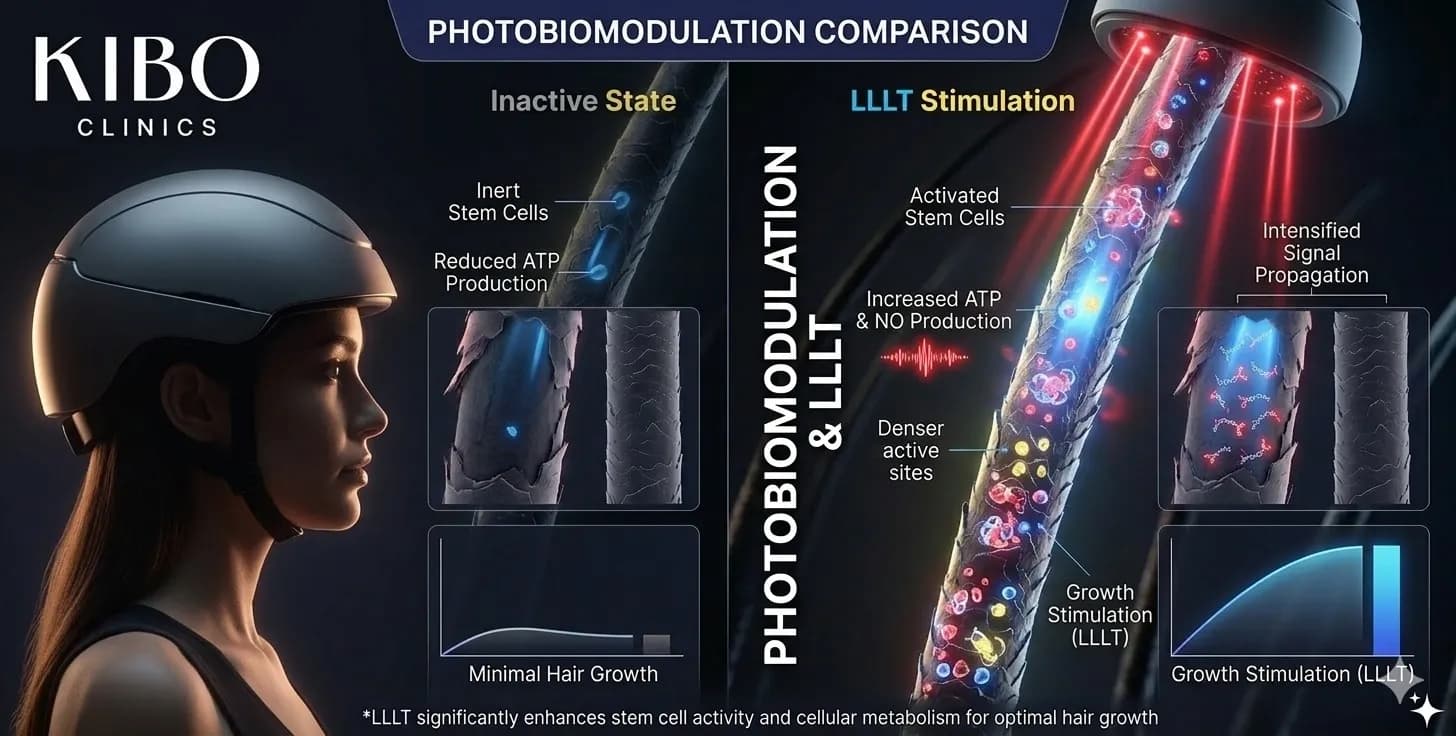
Low-Level Laser/Light Therapy (LLLT) is a form of photobiomodulation: low-intensity red or near-infrared light is delivered to tissue to trigger biological responses without the cutting, ablation or high heat used by surgical lasers. Hair-growth devices include combs, bands, caps, helmets and clinic hoods.
The strongest hair-loss evidence is for androgenetic alopecia, the common hereditary pattern of follicular miniaturisation in men and women. If you are not sure your thinning is genetic, first review the broader hair loss types and causes. A light device cannot diagnose iron deficiency, thyroid disease, alopecia areata, scarring alopecia or a medication-related shed.
Does Low-Level Laser Therapy Actually Regrow Hair?
On average, selected LLLT devices outperform sham devices for pattern hair loss. That is more convincing than testimonials or before-and-after marketing. Multiple randomised controlled trials have measured terminal hair count or density after several months of treatment, and later meta-analyses have found a statistically significant increase in hair density compared with sham treatment.
The important qualifier is that LLLT is a device category, not one standardised treatment. Trials vary in wavelength, laser versus LED source, number of diodes, irradiance, fluence, coverage, distance from scalp, session duration and weekly schedule. A positive trial for one system cannot automatically validate every cheap red-light cap that looks similar.
What Does the Clinical Evidence Actually Show?
| Evidence | Main Finding | What It Does Not Prove |
|---|---|---|
| HairMax 510(k) / sham-controlled trial | Three-times-weekly treatment over 26 weeks produced greater regrowth than a sham device in the indicated male AGA population. | That every laser cap or LED helmet performs the same. |
| 650 nm female cap RCT | Every-other-day treatment over 17 weeks significantly increased hair counts versus sham in selected women with AGA. | That all women with diffuse shedding have AGA or should use LLLT. |
| 24-week helmet RCT | A laser helmet increased hair density and diameter versus sham in men and women with AGA. | Long-term durability; the trial was small and had no long follow-up. |
| Systematic reviews / meta-analyses | Overall hair-density outcomes favour LLLT over sham/placebo in pattern hair loss. | A universal success rate, one best device, or one ideal schedule. |
| 2025 laser/LED meta-analysis | Hair density increased significantly in AGA across included studies. | Uniform response: statistical heterogeneity remained high. |
How Does Photobiomodulation Work in Hair Follicles?
The mechanism is still being refined. The leading model is that photons are absorbed by cellular chromophores, including cytochrome-c oxidase in mitochondria, influencing ATP production, nitric-oxide signalling, reactive-oxygen signalling and downstream pathways involved in cell activity. Experimental work also points to effects on anagen maintenance, inflammation and Wnt/beta-catenin signalling.
It is therefore too simplistic to say LLLT works only because it “increases blood circulation.” Vascular effects may contribute, but clinical hair growth is likely the result of several photobiological pathways. The practical implication is more important: LLLT needs a living follicle capable of responding. It cannot manufacture a follicular unit where one has been permanently lost.
What Wavelength Is Best for Hair Growth?
Many established hair-growth devices use red light in roughly the 630-680 nm range, with 650-655 nm common in trials and FDA-cleared devices. But buying a device because the box says “650 nm” is not enough.
Dose depends on more than wavelength. Irradiance (power delivered per area), fluence (energy per area), number and position of diodes, distance from scalp, treatment time, scalp coverage and the amount of hair blocking or scattering the light all affect delivery. There is also a photobiomodulation principle sometimes described as a biphasic dose response: more light is not automatically better. Follow the device-specific tested protocol rather than doubling session length.
Laser Cap vs LED Red-Light Helmet: Is One Better?
The label “laser” or “LED” alone does not tell you whether a device will work. Coherent laser diodes and LEDs differ optically, but real-world efficacy also depends on dose, scalp coverage, device geometry and clinical validation. Some published hair-growth systems use lasers, some use LEDs, and some combine both.
A better buying question is: Has this exact model, or a clearly equivalent device, been clinically tested for the hair-loss pattern I have? A reputable manufacturer should disclose wavelength, treatment time, intended-use population, regulatory status and supporting clinical data rather than relying on “medical-grade red light” as a marketing phrase.
How to Evaluate a Hair-Growth Helmet Before Buying It
| Check | What You Want to See | Red Flag |
|---|---|---|
| Regulatory claim | A verifiable FDA 510(k) number if “FDA-cleared” is claimed | “FDA approved technology” with no device-specific clearance |
| Clinical evidence | Sham-controlled or prospective data on the device/model or close predicate | Only testimonials, influencer photos or generic red-light studies |
| Optical specifications | Wavelength plus transparent dose/output information | Only diode count or “high power” with no useful specification |
| Scalp coverage | Even exposure of the thinning areas and a fit that reaches the scalp | Large gaps, poor fit, or dense hair preventing meaningful scalp exposure |
| Protocol | Clear frequency and duration backed by device instructions | “Use as much as possible” or constantly changing instructions |
| Claims | Modest density support in appropriate candidates | Guaranteed regrowth, new follicles, permanent cure or reversal of advanced baldness |
Is LLLT FDA-Approved or FDA-Cleared?
Most hair-growth LLLT devices are FDA-cleared, not FDA-approved. The HairMax LaserComb received 510(k) clearance in 2007 for promoting hair growth in selected men with androgenetic alopecia, and later devices expanded indications to selected women and additional cap/helmet designs. FDA-cleared helmet systems such as NutraStim have used 650 +/- 5 nm laser diodes and pattern-hair-loss indications.
A 510(k) clearance is meaningful, but it is not the same regulatory pathway as premarket approval for a high-risk device or approval of a new drug. The correct consumer question is not “Is red light FDA approved?” but “Is this exact device FDA-cleared for the indication and population I am considering?”
Who Is Most Likely to Benefit from LLLT?
- Men and women with confirmed androgenetic alopecia and miniaturised follicles that are still active.
- Early-to-moderate thinning, where preserving and thickening existing hair is more realistic than recreating a completely bald zone.
- People who want a non-invasive adjunct and can follow a repetitive device protocol for several months.
- People who cannot tolerate a specific topical formulation, after a clinician has reviewed alternative evidence-based options.
- Patients using a broader pattern-hair-loss plan, where LLLT is added for a defined reason rather than used as a substitute for diagnosis.
Pattern loss is driven by follicular miniaturisation, so LLLT should be interpreted within a broader androgenetic alopecia treatment strategy, not as a stand-alone “energy boost” for every form of shedding.
When Is a Hair Laser Helmet Unlikely to Be Enough?
- Smooth long-standing bald scalp: LLLT cannot replace follicles that are no longer present.
- Scarring alopecia: treatment must target the inflammatory/scarring disease first.
- Round or rapidly appearing patches: alopecia areata, fungal infection and other local disorders require diagnosis.
- Acute heavy shedding: identify the trigger before assuming a light device is the primary treatment.
- Untreated androgen-driven progression: in eligible men, LLLT does not replace a discussion about DHT blockers for hair loss.
Does LLLT Work Differently in Men and Women?
Controlled studies support LLLT in both male and female pattern hair loss. There is not enough evidence to claim that men inherently respond faster simply because male thinning is more localised. Response depends on diagnosis, stage, follicle viability, device, adherence and coexisting causes of hair loss.
Women with diffuse thinning especially need a diagnosis-first approach because iron deficiency, thyroid disease, PCOS, postpartum shedding and medications can overlap with female pattern hair loss. LLLT can support diagnosed female pattern loss, but it should not delay investigation of another cause.
Does LLLT Help Telogen Effluvium?
The evidence is emerging, not as established as it is for androgenetic alopecia. Small studies, including red-LED work in selected telogen-effluvium populations, suggest reduced shedding and improved density may be possible, and a 2025 review describes LLLT as promising. But telogen effluvium is primarily managed by identifying and correcting the trigger when possible.
For fever, surgery, rapid weight loss, iron deficiency, thyroid dysfunction, postpartum change or medication-related shedding, a helmet cannot replace cause-directed care. Use LLLT as an adjunct only when the diagnosis and treatment objective are clear.
How Long Does LLLT Take to Show Hair-Growth Results?
| Time | What Is Reasonable to Expect | What Not to Assume |
|---|---|---|
| 0-8 weeks | Too early for a reliable density verdict; scalp tolerance and routine adherence can be assessed. | No visible change means permanent non-response. |
| 3-4 months | Some users may notice reduced shedding or early photographic change. | Every device should show dramatic regrowth by week 12. |
| 4-6 months | This is the main assessment window used by many controlled hair-growth trials. | One before/after photo proves new follicles. |
| 6-12 months | Useful for judging whether a modest early response is sustained and whether the routine is worth continuing. | There is one universal maintenance schedule for every device. |
Because hair cycles are slow, standardised photographs, part-width measurements and trichoscopy are more useful than daily mirror checks. See Kibo's guide to the hair growth cycle for why meaningful density changes take months.
How Often Should You Use an LLLT Helmet?
There is no universal “2-3 times a week” rule that applies to every device. That schedule appears in several established protocols, while other trials used every-other-day treatment or different session lengths. A HairMax pivotal study used three non-consecutive sessions per week for 26 weeks; a female cap trial used every-other-day treatment for 17 weeks.
Use the protocol tested for the specific device. More frequent or longer exposure is not automatically more effective and can take you outside the evidence used for that system.
Home Laser Cap vs Clinic LLLT: Which Is Better?
Clinic-based does not automatically mean optically superior, and home-use does not automatically mean weak. Several home devices have controlled clinical data and FDA clearance. The real advantage of clinical oversight is diagnosis, treatment selection, objective photography/trichoscopy and the ability to adjust a broader plan if hair loss keeps progressing.
Home devices may be more convenient and can reduce the cost of repeated travel, but only if the exact device has credible evidence and the user is consistent. Clinic sessions may make adherence easier for some people but can become expensive when multiplied over months.
LLLT vs Minoxidil: Which Has Better Evidence?
Topical Minoxidil has a longer and broader evidence base for androgenetic alopecia. LLLT also has controlled evidence and is useful as a non-invasive adjunct, but the device literature is more heterogeneous. The treatments work through different pathways, so they do not have to be framed as mutually exclusive.
Recent combination evidence is mixed. A 2025 meta-analysis found greater hair-density improvement for LLLT plus topical Minoxidil than Minoxidil alone, while another 2025 comparative meta-analysis reported no statistically significant advantage for the combination. The safest conclusion is: combination therapy may help some patients, but an additive benefit is not guaranteed across all protocols.
LLLT vs Minoxidil vs PRP vs Hair Transplant
| Option | Best Role | Main Trade-Off |
|---|---|---|
| LLLT | Non-invasive adjunct for existing miniaturised follicles in pattern loss | Device/protocol variability, months of adherence, modest average effect |
| Topical Minoxidil | Evidence-based growth stimulation in male/female pattern loss | Daily use, irritation/unwanted hair in some users, gains depend on continuation |
| PRP | Procedure-based adjunct in selected non-scarring pattern loss | Injections, cost, protocol heterogeneity and maintenance |
| Hair transplant | Redistribution of donor follicles into established bald/thin areas | Surgery, finite donor supply, cost and recovery |
If a diagnosis is established and an adjunctive procedure is being considered, Kibo's PRP therapy for hair loss page explains a different non-surgical pathway. The important question is not which treatment is “most advanced,” but which mechanism matches the diagnosed problem.
Considering a hair helmet? Confirm the diagnosis and stage first, then decide whether LLLT is a useful adjunct rather than buying a device from the label alone.
What Are the Side Effects and Safety Risks of LLLT?
LLLT is generally well tolerated when an appropriate device is used as directed. Trials and reviews have reported mild effects such as scalp itching, warmth, tenderness, erythema, headache, skin discomfort and temporary shedding. Serious device-related adverse events have been uncommon in controlled hair-growth studies.
Photosensitivity matters. DermNet advises against using laser therapy together with photosensitising medicines or products. People with known photosensitivity disorders, active scalp disease, new unexplained redness or a medicine that increases light sensitivity should check with a clinician and follow the device labelling before treatment.
Does the Scalp Need to Be Clean for LLLT?
A clean, product-light scalp is practical because thick styling products, hair fibres or heavy residue can affect how light reaches the scalp. But the common phrase “poor scalp hygiene blocks follicles” is misleading: hair follicles are not pores that become physically sealed by ordinary dirt.
Follow the device's instructions for dry or damp hair, product use and positioning. Dense hair can itself scatter or block light, which is why comb designs use teeth to part hair and why cap fit/coverage matter.
Does LLLT Improve Hair-Transplant Graft Survival?
Direct clinical evidence that LLLT materially increases graft survival is limited. A small study evaluating one LLLT session after transplantation found no significant improvement in transplanted-follicle outcomes, and modern transplant-clinic reviews acknowledge that strong controlled graft-survival evidence is lacking.
Photobiomodulation may still be used by some surgeons as a postoperative adjunct for inflammation, wound recovery or early growth, but it should not be sold as a guaranteed graft-survival booster. Timing also matters: do not place a home cap on fresh grafts until the operating surgeon says pressure, friction and device use are safe.
What Happens If You Stop LLLT?
Long-term discontinuation data are much less standardised than for Minoxidil. Most device protocols and clinical programmes treat LLLT as an ongoing or maintenance therapy because androgenetic alopecia itself continues over time. However, there is no single evidence-based post-stop shedding timeline that applies to every laser cap or helmet.
That means the live-page claim that “stopping early can reverse progress” should be softened. The more defensible message is: if LLLT is helping, continued maintenance may be needed, but the exact frequency and durability of benefit depend on the device and the underlying disease.
How Much Does LLLT Hair Treatment Cost in India?
There is no standard national price. Current Indian clinic pages advertise very different per-session ranges, and home-use devices vary from relatively inexpensive consumer LED products to premium FDA-cleared laser caps costing many times more. A low per-session price can also be misleading if the plan requires months of frequent visits.
Compare total-course cost rather than one session. Ask how many sessions are planned, what exact device is used, whether the device has clinical evidence, what objective measurements are included, whether medical treatment is extra, and what happens after the initial course. Do not buy a multi-month package before the type of hair loss is confirmed.
Where Does Kibo's LLLT Service Fit?
For someone with confirmed early-to-moderate non-scarring pattern hair loss, Low-Level Laser Therapy can be discussed as one adjunct among medication, injection-based treatments, microneedling and surgical restoration. The value of a clinic is not that every clinic helmet is automatically stronger than every home device; it is that the diagnosis, baseline photography, treatment objective and response can be monitored.
A useful consultation should answer: What type of hair loss do I have? Are the follicles still miniaturised or already absent? What is the exact LLLT device and protocol? What outcome will be measured at month 4-6? What other treatment addresses the underlying cause? What is the total cost if I continue for a year?
Frequently Asked Questions
Does a hair laser helmet really work?
Some clinically studied LLLT helmets, caps and combs increase hair density in androgenetic alopecia compared with sham devices. Results are usually gradual and modest, and evidence for one device cannot be automatically applied to every red-light helmet sold online.
Is LLLT FDA-approved?
Hair-growth LLLT devices are generally FDA-cleared through the 510(k) pathway for specific indications, not FDA-approved like a new drug. Check the exact model and 510(k) number rather than relying on a generic “FDA approved technology” claim.
What wavelength is best for hair growth?
Many studied hair-growth devices use red light around 630-680 nm, commonly near 650-655 nm. Wavelength alone is not enough; dose, coverage, treatment time and device-specific evidence also matter.
How often should I use a laser cap?
Follow the tested protocol for your exact device. Some trials used three non-consecutive sessions a week, while others used every-other-day treatment. More frequent use is not automatically better.
How long does LLLT take to work?
Most controlled hair-growth studies assess results after roughly four to six months. Some users notice earlier shedding changes, but objective density assessment is more meaningful after several months of consistent use.
Is a laser cap better than an LED cap?
Not automatically. Laser and LED sources differ, but real efficacy depends on wavelength, irradiance, fluence, coverage and the evidence for the exact device. Do not choose only by diode count or the word “laser.”
Can I use LLLT with Minoxidil?
Yes, they are often combined in pattern-hair-loss plans. Some studies and a 2025 meta-analysis suggest an additive benefit, but other comparative evidence is less convincing, so combination therapy does not guarantee a better response for every patient.
Can LLLT treat telogen effluvium?
Evidence is promising but limited compared with androgenetic alopecia. Telogen effluvium still requires investigation of the underlying trigger; LLLT should be considered an adjunct rather than a substitute for cause-directed care.
Does LLLT improve hair-transplant graft survival?
Strong direct evidence that LLLT meaningfully increases graft survival is lacking. Some surgeons use photobiomodulation as a recovery adjunct, but it should not be marketed as a guaranteed graft-survival treatment.
What are the side effects of LLLT?
LLLT is generally well tolerated. Reported mild effects include itching, warmth, tenderness, redness, headache and temporary shedding. People using photosensitising medicines or with photosensitivity disorders should seek clinical guidance and follow device labelling.
Does LLLT work on completely bald areas?
It is unlikely to recreate visible density where follicles have been permanently lost. LLLT is better suited to miniaturised but still viable follicles in early-to-moderate pattern hair loss.
What happens if I stop LLLT?
Long-term withdrawal data are limited. Because pattern hair loss is chronic, maintenance is commonly recommended, but there is no single evidence-based post-stop shedding timeline that applies to every device.
Bottom Line
LLLT is not pseudoscience, but it is also not a miracle helmet. Selected low-level laser/light devices have randomised and meta-analytic evidence for improving hair density in androgenetic alopecia, especially when viable miniaturised follicles remain. The benefit is usually gradual, device-specific and dependent on adherence.
Choose the diagnosis before the device. Verify FDA clearance if claimed, look for device-specific clinical evidence, compare the whole protocol rather than wavelength alone, use objective photographs or trichoscopy to judge response, and do not let a red-light helmet replace treatment of the underlying cause of progressive hair loss.
Related Articles & Services
Hair Transplant
FUE Hair Transplant | Sapphire FUE Hair Transplant | Direct Hair Transplant (DHT) | Real-Time FUE Hair Transplant | Corrective Hair Transplant
Hair Regrowth
GFC Therapy | Microneedling for Hair Regrowth | Mesotherapy for Hair Regrowth
Must Read
Minoxidil 5% vs 10% | Male Pattern Baldness | Hair Loss in Women | Blood Tests for Hair Fall | Norwood Scale
Relevant Blogs
Minoxidil vs Redensyl | DHT Blocker Side Effects | Finasteride After Hair Transplant | Hair Transplant Results Timeline | Non-Surgical Hair Loss Treatments in India
Medical Disclaimer : Information from Kibo Hair Clinics is for educational purposes only. It does not replace diagnosis, trichoscopy, blood test interpretation, prescription treatment, procedure advice, or side-effect counselling from a qualified dermatologist or hair restoration doctor.