
Male Pattern Baldness: FUE Treatment Options in 2026
Published on Sun Mar 22 2026
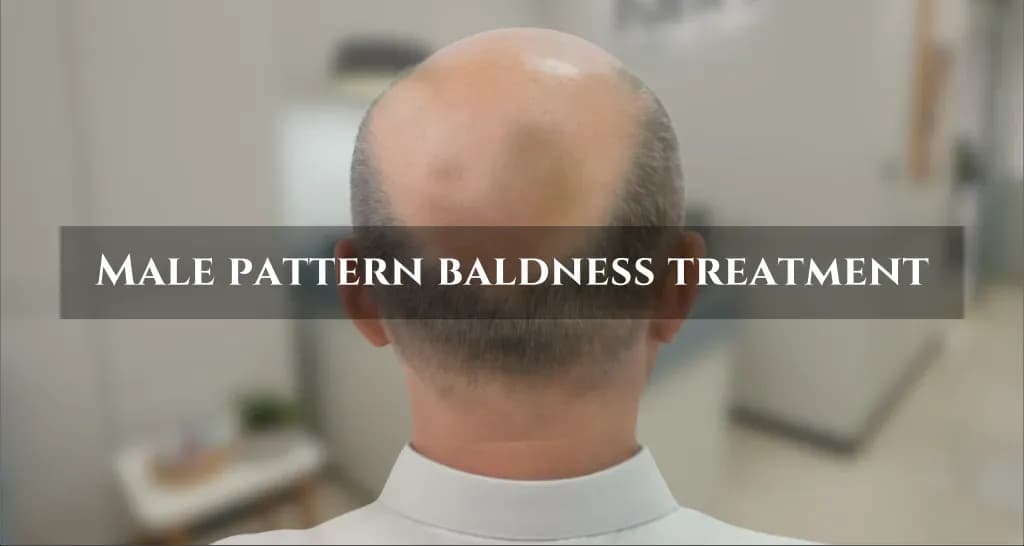
Male pattern baldness, or androgenetic alopecia, occurs in about 50% of men during their 50s. It is the most prevalent type of male hair loss. The condition is primarily due to genetic reasons and the hormone dihydrotestosterone (DHT), which causes hair follicles to shrink over time through a process called miniaturization.
Symptoms of male pattern baldness start with a thinning of the hairline in the temples, giving an M-shaped pattern. This is followed by thinning at the crown and generalized miniaturization of the hair. The Norwood Scale, used to measure the stages of male pattern baldness, assesses advancement in seven phases, ranging from slight recession to widespread baldness.
Male pattern baldness treatments depend on severity. The early stages (1-2) can be treated with drugs such as Minoxidil and Finasteride, which can delay progression. Surgical treatment is generally needed for advanced cases.
Follicular Unit Extraction or FUE hair transplant is currently the gold standard for permanent hair restoration. This is a minimally invasive technique in which individual hair follicles are removed from donor sites and implanted in balding areas, giving natural-looking results with no linear scarring.
The Executive Who Waited Too Long
Rajesh, a 42-year-old investment banker working in Mumbai's Bandra Kurla Complex, first noticed his temples receding at age 28 but dismissed it as normal aging. By 35, his crown had thinned noticeably, and colleagues began commenting on his appearance during video calls and client meetings.
He tried over-the-counter Minoxidil foam for 18 months without consulting a specialist, applying it inconsistently and seeing minimal results. The lack of professional guidance meant he never addressed underlying DHT activity or assessed whether he was a candidate for early intervention versus waiting for advanced-stage treatment.
By age 41, Rajesh had progressed to Norwood Stage 5, with significant crown and mid-scalp thinning. A comprehensive consultation at Kibo Clinics revealed he needed 4,200 grafts to restore density across the frontal zone, mid-scalp, and crown. Understanding protective styling during recovery and combining Sapphire FUE with post-transplant Finasteride helped him achieve natural-looking restoration within 12 months.
Symptoms of Male Pattern Baldness
Like any other medical condition, early recognition has always been the key in male pattern baldness. The earlier the signs are detected, the better the time to start intervention.
The visible symptoms of male pattern baldness are a receding hairline, which is the first sign that the temples show hair loss, slowly developing an M-shaped pattern around the temples. Crown thinning is a hair thinning issue noticed at the top and back of the scalp, progressively exposing more scalp. Hair miniaturization occurs when new and existing hair starts turning thinner and shorter with reduced pigmentation, often a sign of the beginning of male pattern baldness.
Most trichologists use the Norwood Scale, which is quite reliable to measure the patterns of such male baldness. The scale has global acceptance for tracking the progression of hair loss in an individual. Usually, the set parameters of the Norwood Scale record hair loss as mild recession to extensive baldness.
Stages of Male Pattern Baldness
The Norwood Scale considers male pattern baldness to be a progressive condition divisible into seven stages:
| Stage | Description |
|---|---|
| Stages 1 & 2 | It is the beginning of male pattern baldness, characterised by minimal hair loss. If the baldness is identified at this stage, Finasteride and Minoxidil are the right companions. |
| Stages 3 & 4 | This is an advanced stage where the volume of hair loss increases. The thinning becomes evident as a distinctive bald area. A FUE hair transplant could be beneficial here. |
| Stages 5 & 6 | The baldness is quite extensive now. There is a likelihood that only a thin hair band will be visible either on the sides or back of the person's head. FUE still is a good choice here. However, the counts of transplantable grafts might be more. |
| Stage 7 | This is the most severe stage, where very little hair remains. Body hair transplant may be needed if donor area is insufficient for extensive coverage. |
To know the exact male pattern baldness stage is the first step towards understanding the right solution to opt for. If you are in a 2nd or 3rd stage, you may find medicines useful. Beyond stage 4, you have no other option than a transplant.
Causes and Risk Factors
Primarily, male pattern baldness might be an outcome of genetic and hormonal factors. It can also be an inherited condition. Dihydrotestosterone, or DHT hormone, has a role here.
However, there are other triggers too, such as age (the risk of male pattern baldness increases with age), family history (individuals with close family members who have dealt with this issue may show early signs through genetic patterns), and chronic stress (the more chronic the stress turns out to be, the more it results in hair loss, sometimes a temporary condition called telogen effluvium).
Treatment Options for Male Pattern Baldness
Hair transplant should always be the last choice when none of the other safer treatments work. Medicines may lower the rate of progression of hair loss. Such male pattern baldness medication options are usually good.
Here are some commonly used ones: Minoxidil (Rogaine) is a topical solution or foam applied directly to the scalp. It works by stimulating hair growth and improving blood flow to the follicles. Finasteride (Propecia) is an oral medication whose main role is to stop the activity of the enzyme that converts testosterone to DHT. However, supporting studies have also shown that Finasteride supports hair growth as well.
PRP (Platelet-Rich Plasma) Therapy involves drawing a very small volume of blood and centrifuging it to derive platelets and other growth factors. This mixture is then injected into the crown region of the scalp to stimulate the growing hair follicles. Microneedling involves the use of a device containing microneedles. The moment this device is run over the scalp region, it stimulates growth factors and collagen. The tiny punctures formed support the absorption of topical treatments.
FUE Hair Transplant as a Permanent Solution
Many men consider a hair transplant the ultimate male pattern baldness cure. Among the latest advancements in hair transplant technique is the FUE or Follicular Unit Extraction. Hair care experts prefer it as it requires minimal invasion and is a highly effective solution for hair fall.
What is FUE?
FUE treatment or Follicular Unit Extraction is a surgical method for hair transplant where a doctor uses individual hair follicles from the donor area to transplant them to the bald area. The hair on the transplanted side starts resisting DHT action, and hence, FUE is considered one of the most trusted permanent male pattern baldness treatments.
Why FUE is Ideal for Patterned Baldness
Why FUE is Ideal for Patterned Baldness
Natural Results: The final outcome is close to a natural look through careful hairline design that complements facial features.
No Linear Scar: With minimal invasion, FUE leaves minimal to no scar behind.
Minimally Invasive: It requires minimal invasion, and that too is performed under local anesthesia. The recovery period is usually quick, and the patients can resume their work early.
High Success Rate: With the right and experienced doctors, FUE results in a successful outcome, especially when graft survival factors are optimized.
FUE is a good choice if you are dealing with moderate to advanced levels of hair loss issues. These issues usually rate between 3 to 6 on the Norwood Scale. The FUE procedure is quite effective in permanently restoring hair density.
Choosing the Right Specialist
Thinking about whether to go for a hair transplant? It is one of the biggest decisions you will make. Selecting the right male pattern baldness specialist is also important. Find a good specialist with years of extensive experience and credentials. A great specialist is well-versed in creating a hairline that naturally complements the original one and your facial features.
The more experienced specialist you choose, the thorough your consultation will be. They will discuss with you your hair restoration goals and what you expect out of the procedure. An ethical specialist will prioritize the long-term health of your donor area and plan for future hair loss.
Why Kibo Clinics for Male Pattern Baldness Treatment
Many patients choose Kibo Clinics for male pattern baldness because our approach addresses both immediate restoration needs and long-term hair preservation planning. We begin with comprehensive Norwood Scale assessment evaluating hairline recession patterns, measuring crown thinning severity, and assessing donor area capacity for current and future procedures.
Our No Ghost Surgery pledge ensures the consulting surgeon personally performs your entire FUE procedure, maintaining consistent graft handling quality and artistic hairline design throughout the 6-8 hour surgery. We don't delegate extraction or implantation to technicians, maintaining ethical standards that prioritize your long-term donor health.
The Sapphire FUE technique at Kibo Clinics uses precision sapphire blades for creating recipient sites, reducing trauma and accelerating healing compared to traditional steel punches. This advanced approach combined with detailed pre-operative planning ensures natural density distribution matching your original hair growth patterns.
We provide 12-month post-transplant monitoring with scheduled assessments at months 3, 6, 9, and 12, tracking growth progress through standardized photography and addressing any concerns during the shock loss or early growth phases.
Stop guessing your Norwood stage. Get expert assessment and personalized treatment planning.
<a href="https://kiboclinics.com/book-consultation" target="_blank" rel="noopener noreferrer"
 style="display:inline-flex;align-items:center;justify-content:center;padding:12px 16px;border-radius:10px;background:#20255C;color:#fff;text-decoration:none;font-weight:600;white-space:nowrap;">

Get A Call Back
<a href="https://kiboclinics.com/hair-graft-calculator" target="_blank" rel="noopener noreferrer"
 style="display:inline-flex;align-items:center;justify-content:center;padding:12px 16px;border-radius:10px;background:#fff;color:#20255C;border:1px solid #20255C;text-decoration:none;font-weight:600;white-space:nowrap;">

Graft Calculator
Frequently Asked Questions
Can male pattern baldness be cured completely?
There is no known single traditional cure for male pattern baldness. However, you can manage and treat it more effectively. Medicines can slow hair loss, while an FUE transplant is a permanent solution to restore the patch in bald areas. The key is understanding that transplanted hair resists DHT action but surrounding native hair may continue thinning without ongoing medication support.
Is FUE better than male pattern baldness medications?
Medicines such as Minoxidil and Finasteride are good to prevent the progress of hair loss from the non-transplanted hair. FUE is a permanent hair restoration solution. Many times, a combination of both is ideal for good results because medications protect existing hair while transplant restores density in areas already lost.
When should I start treating male pattern baldness?
It is advisable to visit a specialist the moment you notice the first signs and symptoms. It can help you plan early for your male pattern baldness. Talk to your doctor about where you stand on the Norwood Scale. Early intervention with medications at stages 1-2 can preserve more hair long-term.
Is it possible to reverse male pattern baldness naturally?
There is no identified natural way or approach to prevent or treat male baldness pattern. A healthy diet and lifestyle can support to some extent. However, they cannot help to stop or reverse the issues related to genetic hair loss. Natural approaches may support overall hair health but cannot counteract genetic DHT sensitivity.
How many grafts are needed for advanced baldness?
The counts of grafts for an FUE transplant depend on how severe the baldness is. It also depends on what density of hair you expect. For advanced stages (Norwood 5-6), 3,000 to 5,000 grafts are more than sufficient. However, this requires adequate donor hair density and may need to be staged across multiple sessions.
Do medications and transplant work together?
Many specialists support the combination of medicine and transplant for better results. A hair transplant is for fixing the hair loss issue permanently, while the medicines support the health of existing natural hair. Most surgeons recommend continuing Finasteride post-transplant to protect native hair from further DHT-related thinning.
What is the success rate of FUE for male pattern baldness?
FUE hair transplant success rates typically range from 85-95% when performed by experienced surgeons using proper technique. Success depends on factors including surgeon expertise, graft handling quality, patient compliance with post-operative care, and overall health status. Realistic expectations and proper candidate selection are crucial.
Can I get a hair transplant if I'm still losing hair?
Yes, but timing matters significantly. Most surgeons recommend stabilizing ongoing loss with medications before transplant to prevent the patchy appearance where transplanted areas remain dense while surrounding native hair continues thinning. A comprehensive plan addressing both current restoration and future loss prevention is essential.
Disclaimer
This content is for informational purposes only and does not substitute personalized medical advice. Male pattern baldness progression varies significantly between individuals based on genetic factors, age, hormonal levels, and treatment compliance. FUE transplant outcomes depend on donor hair quality, surgeon expertise, and post-operative care. Results shown in case studies represent individual experiences and may not reflect typical outcomes. Always consult a qualified dermatologist or hair restoration specialist for comprehensive evaluation and personalized treatment planning based on your specific Norwood stage, donor capacity, and restoration goals.
Hair Transplant
Bio FUE |
Hair Regrowth
Low-Level Laser Helmet Therapy |
Mesotherapy for Hair Regrowth |
Must Read
Crown Restoration Challenges in MPB |
Shock Loss in Male Pattern Baldness |
Long-Term Maintenance of Transplanted Hair |
DHT vs FUE for Faster Implantation |
Donor Overharvesting Awareness
Relevant Blogs
Bangalore Hair Transplant Cost |