
֎ Show Quick Answer
AI Quick answer summary
- Salt water can make hair feel rough, stiff and tangled, which increases breakage during brushing and styling.
- The strongest evidence is for direct seawater exposure, especially when hair is bleached or dyed. Evidence that ordinary coastal air alone damages hair is much weaker.
- Sun exposure, wind, humidity, salt residue and repeated wetting often act together at the beach, so salt should not be blamed for every change.
- Rinse with fresh water after swimming, condition the lengths, detangle gently and reduce heat until the hair feels flexible again.
- Salt water does not usually cause permanent follicular hair loss. Persistent thinning, patches or scalp inflammation need medical assessment.
Does Salt Water Damage Hair?
Salt water can damage the hair shaft when exposure is repeated or followed by rough handling, sun and heat. The usual effects are roughness, tangling, stiffness, colour fading and greater breakage risk. It does not normally destroy healthy follicles or directly cause permanent baldness.
The current evidence is more convincing for direct seawater exposure than for simply living near the coast. Sea spray aerosol exists in coastal air, but clinical studies have not established that routine airborne salt exposure alone causes measurable hair loss. The practical concern is the combined beach environment: seawater, ultraviolet radiation, wind, humidity, repeated wetting and styling.
What Salt Water Does to the Hair Shaft
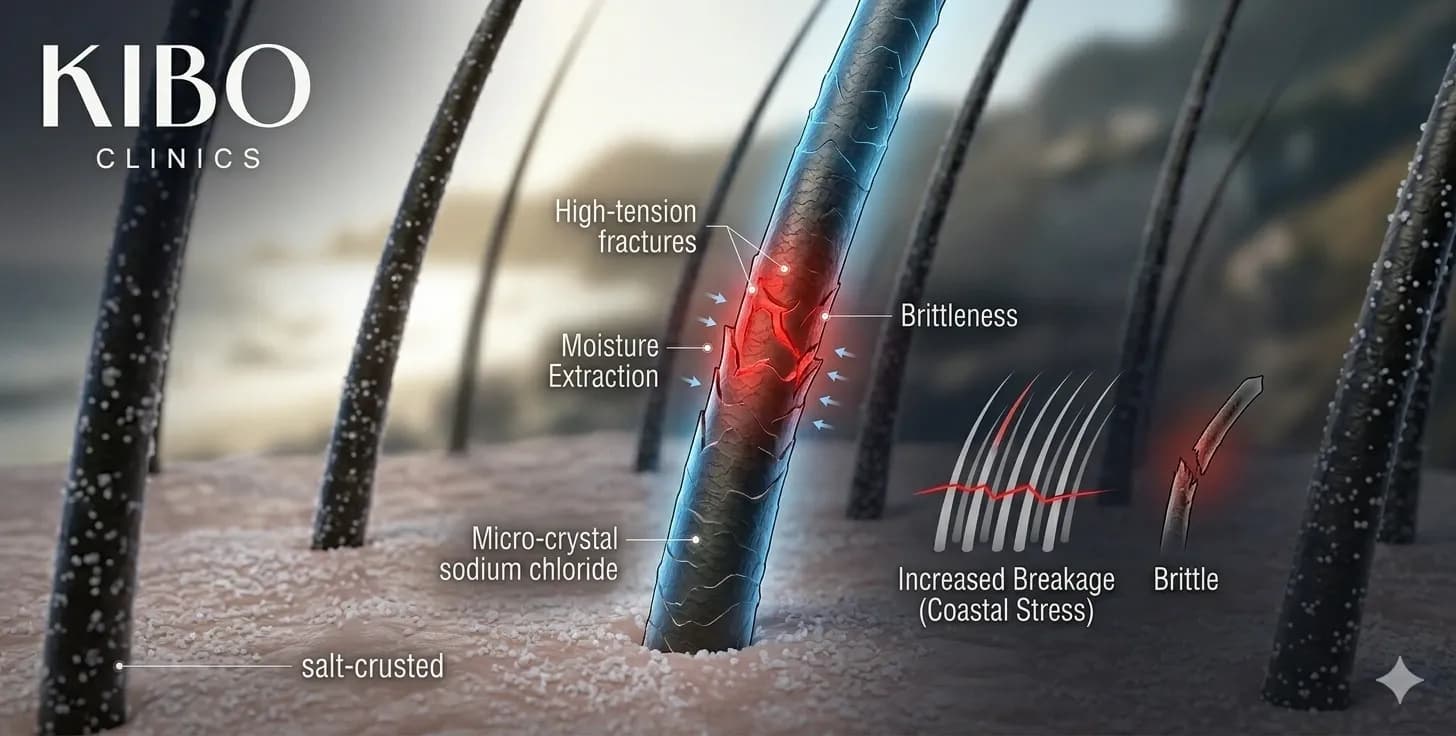
Hair is a keratin fibre covered by overlapping cuticle cells. When seawater dries on the strand, dissolved salts and minerals remain on the surface. This residue can increase friction, reduce smoothness and make detangling harder. Repeated swelling and drying also adds mechanical stress.
A 2025 laboratory study using artificial seawater found greater combing resistance, protein loss and colour changes in chemically treated hair. Bleached and dyed fibres were more vulnerable than untreated hair. This supports a cautious conclusion: salt exposure matters most when the shaft is already porous or damaged.
Salt Water vs Coastal Air: What Is Actually Proven?
| Exposure | Evidence position | Likely effect |
|---|---|---|
| Direct seawater swimming | Supported by laboratory and hair-fibre research | Roughness, residue, tangling and higher breakage risk |
| Sea-salt styling spray | Formulation-dependent, limited direct clinical evidence | Texture and volume, with possible dryness or stiffness |
| Coastal air without water contact | Sea-salt aerosol is measurable, but hair-damage evidence is limited | Possible residue and friction near surf, but not proven as a major independent cause |
| Sun plus salt plus wind | Biologically plausible and supported by separate environmental studies | Cumulative weathering, colour loss and breakage |
Why Sun Often Matters More Than Salt
Ultraviolet exposure is a well-established cause of hair weathering. Reviews report protein loss, lipid oxidation, colour fading, reduced strength and a rougher surface after repeated UV exposure. Salt residue can make hair harder to manage, but sun damage has a stronger research base as an independent environmental stressor.
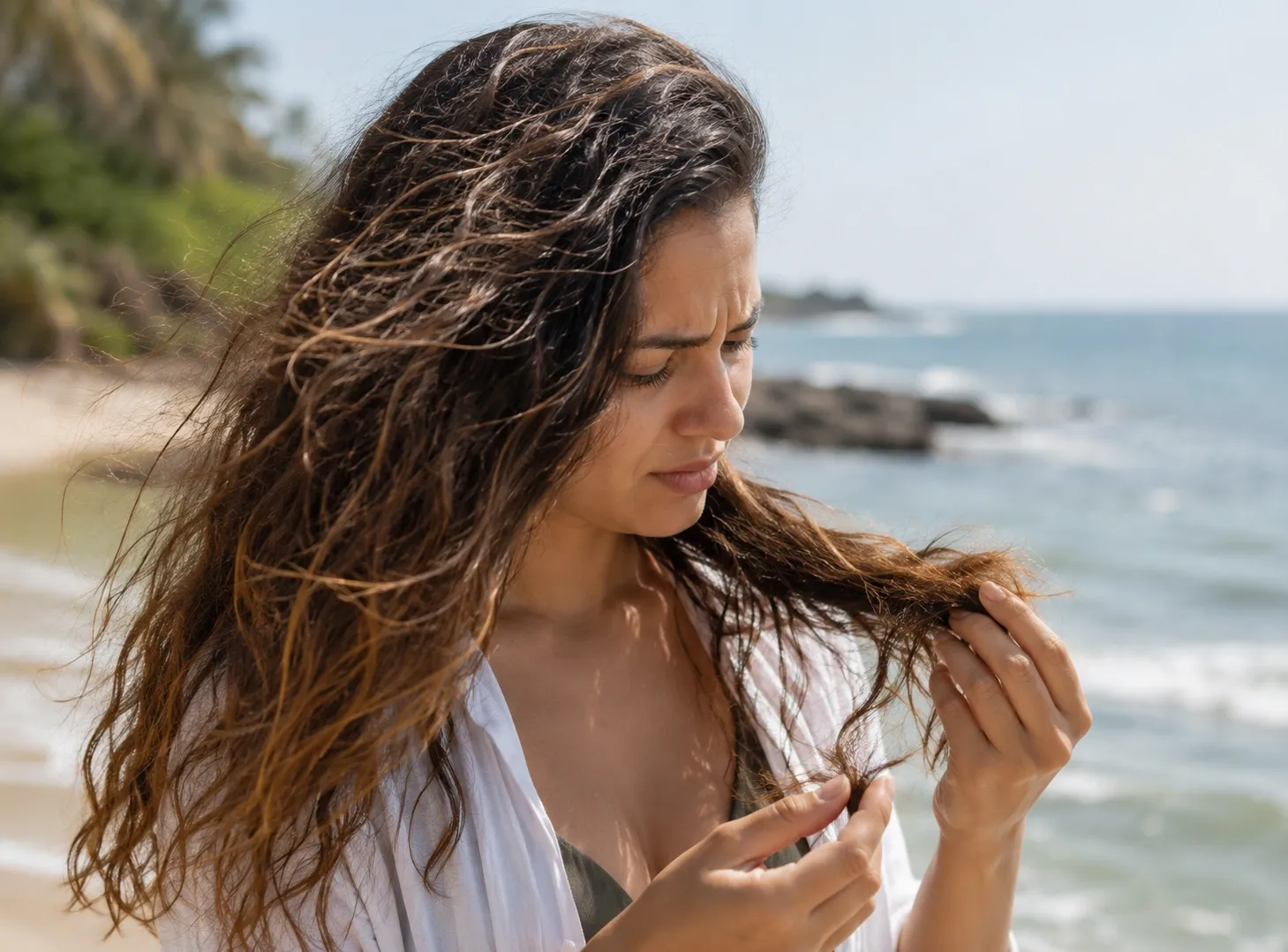
This is why beach damage is rarely caused by one factor. Hair may be wet with seawater, dried in the sun, blown by wind and brushed while tangled. Each step adds friction or structural stress.
Who Is Most at Risk?
- Bleached, highlighted, relaxed or permanently coloured hair
- Curly, coily or highly porous hair
- Fine strands that tangle easily
- Hair already damaged by straighteners or frequent blow-drying
- Long hair repeatedly tied while wet
- People who swim in the sea several times each week
- Hair exposed to strong sun without a hat or shade
Does Salt Water Cause Hair Loss?
Salt water mainly affects the shaft, so the common result is breakage rather than follicular hair loss. Broken strands may make a ponytail feel thinner or create uneven lengths, but this is different from a receding hairline, widening part or smooth bald patch.
Heavy rubbing, tight wet hairstyles and inflamed scalp conditions can worsen shedding or traction, but seawater itself is not a recognised cause of androgenetic alopecia. Compare hair breakage versus shedding and hair-loss types and causes.
How to Tell Salt Damage From Root Shedding
| Sign | Shaft breakage | Root shedding |
|---|---|---|
| Length | Short or uneven pieces | Usually full-length strands |
| End | Frayed or blunt broken end | May have a small club-shaped bulb |
| Pattern | Split ends and uneven density | Overall shedding or patterned thinning |
Before Swimming in the Sea
- Wet the hair with fresh water so it absorbs less seawater immediately.
- Apply conditioner or a leave-in product to the lengths if the hair is dry or porous.
- Use a loose braid or low-tension style instead of a tight bun.
- Wear a swimming cap when practical, especially for frequent swimmers.
- Use a hat or shade to reduce UV exposure to the hair and scalp.
After Swimming: The Best Recovery Routine
- Rinse thoroughly with fresh water as soon as practical.
- Wash gently when residue, sunscreen or sweat remains.
- Use conditioner on the mid-lengths and ends.
- Detangle in sections, starting at the ends.
- Blot with a soft towel instead of rubbing.
- Reduce high heat until the hair feels flexible and smooth again.
- Use a clarifying or chelating product only when buildup persists, not after every swim.
Should You Use Clarifying Shampoo After the Beach?
Clarifying shampoo can remove residue, but frequent use may worsen dryness in bleached, curly or fragile hair. Most occasional swimmers can use a normal gentle shampoo and conditioner. A stronger cleanser is more useful when the hair remains coated, dull or difficult to manage after rinsing.
Chelating shampoos are designed for mineral deposits and are more relevant when hard water or pool minerals are involved. Read hard water and hair damage in Mumbai.
Can Conditioner Repair Salt-Damaged Hair?
Conditioner cannot biologically repair a fractured strand, but it can reduce friction, improve flexibility and make damaged hair easier to comb. Film-forming ingredients, silicones, cationic conditioners and some oils can temporarily smooth the surface.
Coconut oil has evidence for reducing protein loss from hair. It may be used on the lengths before or after washing when suitable, but it does not regrow follicles. Read the truth about hair growth oils.
Salt Water and Coloured or Bleached Hair
Bleaching raises porosity and damages cuticle and cortex structures. A 2025 artificial-seawater study found the combined effect of seawater with bleaching or dyeing altered combing properties, shine, colour and protein loss more than exposure in untreated hair.
Rinse promptly, use conditioning care and delay additional bleaching when the hair feels rough or stretches abnormally. Colour change after sun and seawater is a shaft issue, not evidence of follicle damage.
Salt Water and Curly or Coily Hair
Curly and coily fibres already have bends where mechanical stress concentrates. Salt residue, shrinkage and tangling can increase detangling force. Use high-slip conditioner, sectioned detangling and low-tension styles.
Read curly hair breakage and curl patterns for texture-specific guidance.
Does Sea Salt Spray Damage Hair?
Sea-salt sprays can create texture, grip and volume. Their effect depends on salt concentration, alcohol content, conditioning ingredients, frequency and hair condition. Dry or bleached hair may become stiff and tangled with frequent use.
Use a small amount, avoid daily layering, wash out buildup and stop if the hair becomes rough or snaps more easily. A styling effect is not a health benefit.
Can Coastal Air Irritate the Scalp?
Wind, sweat, sunscreen, salt residue and repeated washing can irritate a sensitive scalp. Sea-salt aerosol is present near breaking waves, but direct evidence that normal coastal air causes scalp disease is limited. Burning, persistent itch, thick scale, pus or sores need diagnosis rather than repeated clarifying shampoo.
Compare seborrhoeic dermatitis and scalp psoriasis versus dandruff.
When to See a Dermatologist
Book an assessment for a widening part, receding hairline, smooth patches, eyebrow loss, scalp pain, pus, shiny scarring or shedding that continues for several months. These findings are not explained by salt exposure alone.
A dermatologist can distinguish shaft weathering from male pattern baldness, hair loss in women or alopecia areata.
What This Means for You
Direct seawater exposure can increase roughness, tangling and breakage, especially in bleached or porous hair. Sun, wind, humidity and handling usually contribute at the same time. Ordinary coastal air alone has not been shown to cause permanent hair loss.
Rinse after swimming, condition the lengths, detangle gently and protect hair from strong sun. When density is reducing rather than only the ends looking rough, investigate the follicle instead of blaming the coast.
Need help separating environmental hair damage from medical hair loss?
Frequently Asked Questions
Does salt water damage hair?
Yes. Direct seawater exposure can leave hair rough, tangled and easier to break, especially when it is bleached, dyed or already porous.
Does coastal air cause hair loss?
Evidence that ordinary coastal air alone causes hair loss is limited. Direct seawater, UV exposure, wind and grooming are more plausible causes of shaft damage.
Can salt water make hair fall out from the root?
Salt water usually affects the shaft rather than the follicle. Root shedding or patterned thinning needs another explanation.
Should I wash my hair immediately after swimming in the sea?
Rinse with fresh water as soon as practical. Shampoo when residue, sweat or sunscreen remains.
What should I put on hair before swimming?
Fresh water and a leave-in conditioner can reduce immediate seawater uptake and friction. A swim cap provides additional protection.
Is sea salt spray bad for hair?
It can cause dryness or stiffness when overused, especially on bleached or fragile hair. Results depend on the full formulation.
Does salt water damage coloured hair?
It can increase roughness and colour change, particularly when combined with UV exposure and pre-existing bleach damage.
Can conditioner repair salt damage?
Conditioner can smooth the surface and reduce friction, but it cannot permanently repair a fractured strand.
Is clarifying shampoo necessary after every sea swim?
No. Frequent clarifying can worsen dryness. Use it when buildup persists rather than automatically after every exposure.
Does salt water damage curly hair more?
Curly and coily hair may be more vulnerable to tangling and breakage because bends concentrate mechanical stress.
How long does salt-damaged hair take to recover?
Surface feel may improve after conditioning, but severely split or fractured hair must grow out or be trimmed.
When should I see a dermatologist?
Seek assessment for persistent thinning, patches, scalp pain, inflammation, pus or shiny scarring.
Want a diagnosis-led plan for breakage, scalp symptoms or thinning?
Why Kibo Clinics
Kibo Clinics separates shaft weathering from root shedding and follicular miniaturisation before recommending treatment. The assessment considers swimming, chemical processing, heat, scalp findings and the distribution of density loss.
The doctor who conducts your consultation is the same doctor who handles your treatment through every stage.
Explore Kibo Clinic Services
Hair Transplant: FUE Hair Transplant | Sapphire FUE | Direct Hair Transplant | Bio FUE | Corrective Hair Transplant | Hairline Correction
Non-Surgical: PRP Therapy | GFC Therapy | Mesotherapy | Microneedling | Low-Level Laser Therapy
Explore More
Environment and Weather: Mumbai Air Pollution and Hair | Monsoon Hair Fall | Hair Dryer Heat Safety | Wet Hair Styling Damage
Breakage and Hair Care: Hair Brushes and Combs | Hair Ties vs Scrunchies vs Clips | Natural Hair Thickening | Dermatologist-Recommended Shampoo
Treatment Decisions: PRP vs PRF | GFC vs PRP | FUE Hair Transplant Guide | Hair Transplant Results Timeline
Medical Disclaimer : Information from Kibo Hair Clinics is for educational purposes only. It does not replace diagnosis, trichoscopy, blood test interpretation, prescription treatment, procedure advice, or side-effect counselling from a qualified dermatologist or hair restoration doctor.