
Who This Is For: Anyone in Mumbai who has noticed rougher, duller, or more brittle hair and wonders whether the water is behind their hair fall, and anyone who has been sold a filter or softener as a cure for hair loss.
Does Hard Water Cause Hair Loss?
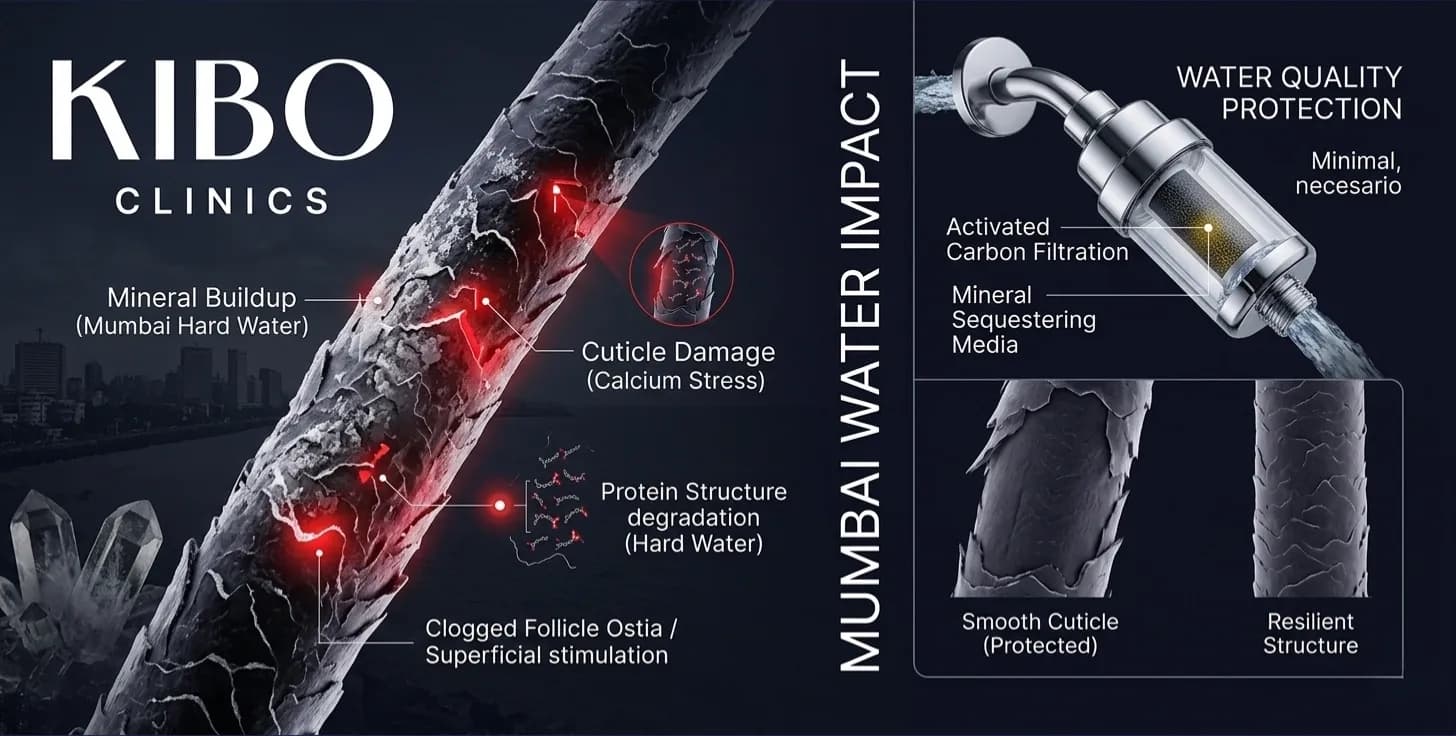
No direct cause has been proven. Water hardness describes how much calcium and magnesium is dissolved in water, while hair loss is a symptom with many possible causes, so a rough, dull, coated, or tangled strand does not tell you that your follicles are shedding. We reviewed the published studies on hard water and hair directly, and the first thing to know is what they are: laboratory experiments on cut hair strands. None examines the scalp or hair loss in people, so none can show that hard water causes baldness. What they can show is how minerals interact with the hair shaft, and on that question the studies disagree with each other.
| Study | What Was Done | What It Found |
|---|---|---|
| Int J Trichology, 2013 | Shed hairs from 15 volunteers soaked in hard water (212.5 ppm as calcium carbonate) or distilled water for 10 minutes on alternate days for 30 days | No significant difference in tensile strength or elasticity |
| Int J Dermatol, 2016 | Same group and design, examined under a scanning electron microscope | More calcium and magnesium on the hard-water hair, a ruffled surface, and lower hair thickness |
| J Pak Med Assoc, 2016 | Hair from 76 young men treated with local hard water or deionised water for 3 months | Significantly lower tensile strength with hard water, described by the authors as weakening of hair and not hair loss |
| Indian J Dermatol Venereol Leprol, 2017 | Hair from 20 volunteers treated with hard or soft water for 3 weeks, examined under a scanning electron microscope | More magnesium with hard water, no significant difference in calcium, and no significant difference in surface changes |
| Int J Cosmet Sci, 2011 | Virgin and bleached hair analysed for calcium and magnesium uptake and for fibre mechanics and styling | Hair, especially chemically treated hair, takes up minerals from tap water, which stiffened the fibres and changed combing and style retention |
Taken together, the honest reading is that hard water can leave minerals on hair, particularly damaged or chemically treated hair, and may change how it feels and handles, while the evidence on whether it actually weakens hair is mixed. These studies are small, use cut hair, and vary in exposure, so they cannot be applied to every person or every water supply. It is a question about the hair shaft. Hair loss that starts at the follicle is a different problem, which is why our guides to breakage and shedding versus mechanical breakage keep the two apart.
What Hard Water Can Look Like on Hair
Hair affected by mineral and product buildup may feel coated or rough, look dull, tangle more, feel dry, lather less well, be harder to condition, or break. Every one of these describes the shaft. None shows a follicle disorder, and we did not find evidence for the popular claim that minerals "clog follicles". Buildup is also not unique to hard water, since styling products and pollution add their own residue, which our pages on scalp buildup and Mumbai air pollution and hair cover.
How to Check Your Own Water
You will find confident claims online that Mumbai's water is soft, moderately hard, or very hard. The figures conflict, they come mostly from sellers of softeners, purifiers, and filters, and we found no current official hardness report for the whole city. That is not surprising, because the water that reaches your shower depends on its source, whether municipal supply, tanker, or borewell, and on your storage tank, pipes, and building plumbing. So we do not give a city-wide figure. If hardness worries you, test the water that reaches your own home.
- Use an official municipal or housing-society report if one exists for your supply
- Or use an accredited laboratory test, and ask for total hardness reported in mg/L as calcium carbonate
- Or use a reliable test kit for a rough estimate, and repeat it, because supply can change with season and storage
- Do not rely on a TDS meter alone, because it measures total dissolved solids and not hardness specifically
- Ask which classification scale the report uses, because scales differ, and for reference the hard water in the 2013 study measured 212.5 ppm as calcium carbonate
Practical Hair-Care Options
Start with gentle handling, which helps whatever the water is doing. Massage shampoo into the scalp, let the rinse water run through the lengths without rubbing them, and use conditioner after every shampoo, as the American Academy of Dermatology (AAD) advises, and avoid over-washing or aggressive scrubbing. How often you wash depends on your scalp, sweat, and hair texture, as our page on frequent washing explains, and our guide to night-time hair care covers the rest of the routine.
Some products are marketed as chelating or clarifying, designed to remove mineral and product residue. Treat them as an optional cosmetic step, follow the instructions, and stop if your hair or scalp becomes dry or irritated, because frequent or aggressive use can cause both. Persistent scalp symptoms need a dermatologist's review.
A filter or softener is also optional. Depending on the device and your water chemistry, it may reduce exposure to some minerals or improve how washing feels, and it is worth checking what a device actually claims to remove, since reducing chlorine and softening hardness are different things. The shed-reduction figures that accompany some shower filters come from the sellers' own testing, and we did not find independent peer-reviewed trials showing that a filter reduces hair loss. No filter can diagnose or treat androgenetic alopecia, alopecia areata, telogen effluvium, scarring alopecia, or nutritional hair loss.
When Thinning Needs a Dermatologist
Effective treatment for hair loss begins with finding the cause, and AAD guidance describes how a dermatologist does it: asking how long the loss has gone on and how quickly it came, examining the scalp and nails, testing how the hair behaves with a gentle pull, and arranging a blood test or scalp biopsy if a disease, deficiency, hormone problem, or infection is suspected. A person can also have more than one cause at once, so water may be one factor among several, and the same guidance notes that starting treatment earlier gives a better chance of regrowth. See a dermatologist if you notice:
- Progressive recession or a widening part
- Crown thinning
- Patchy bald spots
- Sudden diffuse shedding
- Pain, scale, pustules, or scarring on the scalp
- No improvement after you have reduced shaft damage
Our guides to androgenetic alopecia, telogen effluvium, alopecia areata, iron deficiency, and blood tests for hair fall explain the commoner causes, the types of hair loss gives the wider picture, and dermatologist versus trichologist explains who to see.
Thinning that has not improved after you have dealt with buildup? A scalp assessment can find the cause.
Kibo Clinics' Perspective on Water and Hair
Water is an easy thing to blame, and in a city where the taps, tanks, and tankers all differ, nobody can say for certain what is coming out of yours without testing it. It is also rarely the whole story.
At Kibo Clinics, our doctors believe the sensible order is to test the water, treat the hair shaft gently, and have genuine thinning properly diagnosed, instead of buying a fix for a problem that has not been confirmed.
If your hair is thinning, shedding, or not improving with gentle care, a dermatologist-led Kibo Clinics team can examine your scalp and tell you what is going on. Our page on hair loss in Mumbai covers the other local factors, including monsoon scalp problems.
Frequently Asked Questions
Can hard water cause permanent baldness?
Current evidence does not establish hard water as a direct cause of common permanent follicle-level baldness. Laboratory studies on cut hair give mixed results on whether it weakens the shaft, and none has shown that it causes hair loss from the follicle.
Does a shower filter stop hair fall?
It may change water exposure or washing feel, depending on the device and what it removes. We found no independent trials showing that it reduces hair loss, and it does not treat genetic, autoimmune, inflammatory, or nutritional hair loss.
What does mineral buildup look like?
Hair may feel coated, rough, dull, tangled, dry, or more difficult to condition. These signs describe the shaft and do not prove a follicle disorder.
Should I use a chelating shampoo?
It is an optional cosmetic step that may help with mineral buildup. Use it according to the instructions and avoid frequent use if it causes dryness or irritation. Persistent symptoms require clinical assessment.
How can I tell hard-water breakage from hair shedding?
Breakage produces short fragments and uneven lengths. Shedding produces full-length hairs. A dermatologist can assess the scalp and hair pattern when the distinction is unclear.
Is Mumbai water hard everywhere?
Do not assume so. Hardness can vary by supply, locality, storage, plumbing, and season. Test the water that reaches your own home, using a laboratory or a reliable kit.
References
We referred to the following guidelines, patient-information pages, and peer-reviewed studies when preparing this guide, and we have named them in full so that you can check them yourself.
- Srinivasan G, Srinivas CR, Mathew AC, Duraiswami D. Effects of hard water on hair. Int J Trichology. 2013;5(3):137-139.
- Srinivasan G, Chakravarthy Rangachari S. Scanning electron microscopy of hair treated in hard water. Int J Dermatol. 2016;55(6):e344-e346.
- Luqman MW, Ali R, Khan Z, Ramzan MH, Hanan F, Javaid U. Effect of topical application of hard water in weakening of hair in men. J Pak Med Assoc. 2016;66(9):1132-1136.
- Alahmmed LM, Alibrahim EA, Alkhars AF, Almulhim MN, Ali SI, Kaliyadan F. Scanning electron microscopy study of hair shaft changes related to hardness of water. Indian J Dermatol Venereol Leprol. 2017;83(6):740.
- Evans AO, Marsh JM, Wickett RR. The structural implications of water hardness metal uptake by human hair. Int J Cosmet Sci. 2011;33(5):477-482.
- American Academy of Dermatology. Hair loss: diagnosis and treatment. Patient guidance.
- American Academy of Dermatology. Stop damaging your hair. Patient guidance.
Related Articles & Services
Hair Transplant
FUE Hair Transplant | Sapphire FUE Hair Transplant | Real-Time FUE Hair Transplant | Bio FUE Hair Transplant | Unshaven Hair Transplant | Direct Hair Transplant (DHT) | Body Hair Transplant | Corrective Hair Transplant | Hairline Correction
Hair Regrowth
Exosomes Therapy | GFC Therapy | IV Hair Boosters | Low-Level Laser Therapy | Mesotherapy for Hair Regrowth | Microneedling for Hair Regrowth | PDO Threads for Hair Regrowth | PRP Therapy
Must Read
Hair Myths Busted | Why Scalp Hygiene Matters | Hair Density vs Strength | Hair Elasticity and Stress Resistance
Relevant Blogs
Sulfate-Free vs Regular Shampoo | Dermatologist-Recommended Shampoo for Hair Loss | Chlorine and Swimming Hair Damage | Humidity, Hair Texture, and Breakage | Pollution Build-Up and Hair Roots | Dust, Micro-Particles, and Scalp Health in India
Medical Disclaimer : Information from Kibo Hair Clinics is for educational purposes only. It does not replace diagnosis, trichoscopy, blood test interpretation, prescription treatment, procedure advice, or side-effect counselling from a qualified dermatologist or hair restoration doctor.