
Who This Is For: Anyone who sees hair in their brush, comb, or the shower drain and wants to know how much of it is just the normal cycle doing its thing, versus something that actually needs looking at.
Hair follicles cycle independently through growth, transition, rest, and shedding. Brushing or washing often makes hairs that were already ready to shed visible, but routine grooming does not usually cause permanent follicle loss. Tight repeated hairstyles can cause traction alopecia, while heat, friction, chemicals, and rough detangling can break the hair shaft. Diffuse heavy shedding, progressive thinning, patches, inflammation, or pain needs assessment.
The Four Phases of the Hair Cycle
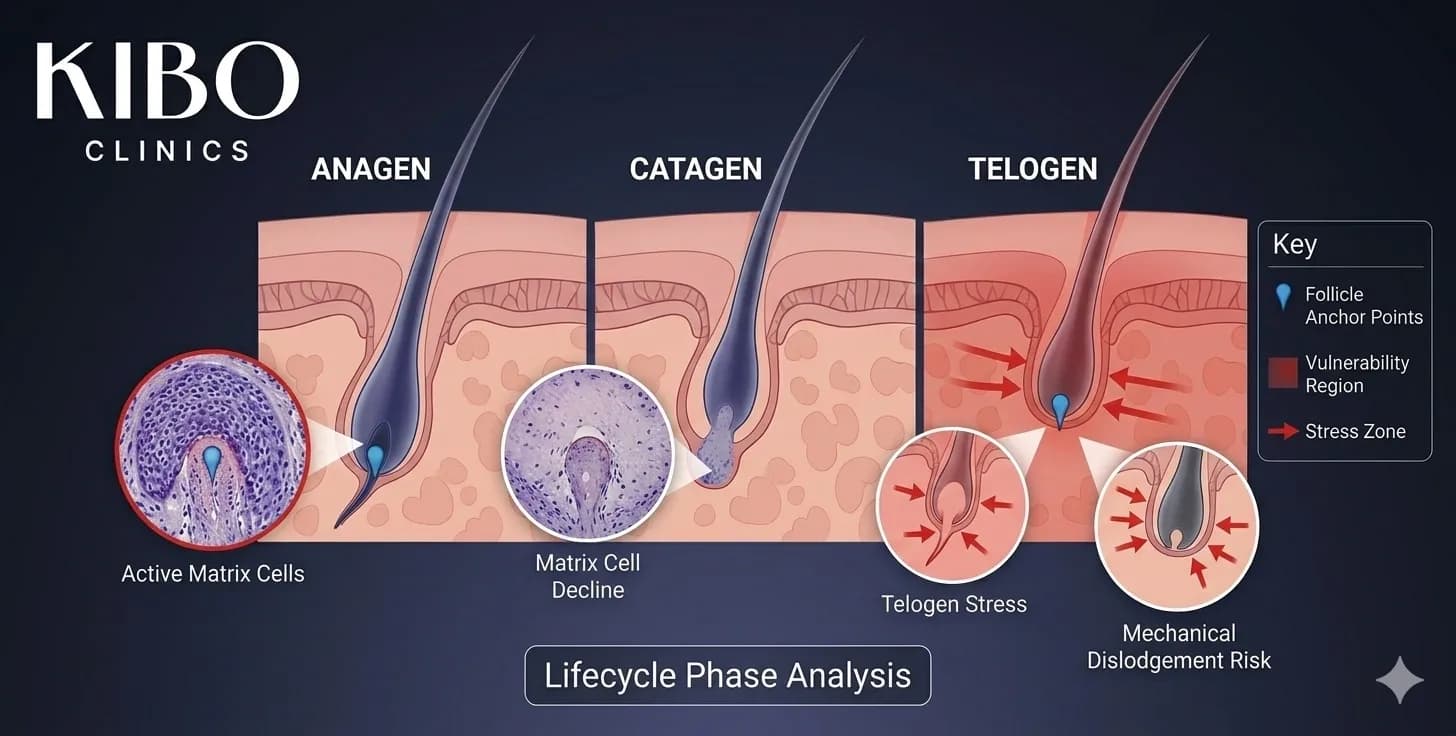
Every hair on your scalp is somewhere in a four-phase cycle: anagen (active growth), catagen (a short transition), telogen (rest), and exogen (active shedding). Anagen is when the follicle's matrix cells are actively dividing to produce the shaft, and it's the longest phase by far, usually running several years. Catagen is a brief regression phase, typically two to three weeks. Telogen is a resting period of around three months, though exact ranges vary between studies. Exogen is the point where the resting hair actually detaches and comes out.
The important part: follicles don't run on the same clock as each other. At any given moment, roughly 85 to 90% of your follicles are in anagen and around 5 to 10% are in telogen, though the exact split differs by source and measurement method. Because phases overlap across thousands of individual follicles rather than syncing up, your scalp keeps its density even though hairs are constantly cycling through and being replaced in the background.
What Does a Shed Hair Actually Look Like?
A genuinely shed hair is usually a full-length strand, often with a small, club-shaped white or translucent bulb at the root end. That bulb is a sign the hair completed telogen and released naturally. But here's the limit of this: a club root tells you a hair went through a normal cycle, not why you're seeing so many of them, or whether anything else is going on. You can't diagnose a cause just by staring at the root.
Shedding vs Breakage vs Follicle Loss
These three get lumped together constantly, but they're genuinely different problems. Shedding is loss of a complete fibre, root and all, at the natural end of its cycle. Breakage is the shaft physically snapping somewhere along its length, which shows up as short, uneven pieces, split ends, or frizz, with no bulb at the end. Follicle loss or miniaturization is different again: it changes how the follicle itself produces hair over time, altering density rather than just releasing or snapping individual strands.
| Feature | Normal Shedding | Shaft Breakage | Traction Alopecia | Telogen Effluvium | Pattern Hair Loss |
|---|---|---|---|---|---|
| Main process | End-of-cycle fibre release | Shaft fractures | Repeated tension injures the follicle | Many follicles shift into telogen together | Progressive miniaturization |
| What you see | Full-length hairs | Short pieces, splits, uneven lengths | Hairline or tension-point thinning | Diffuse shedding, overall volume loss | Frontal, crown, or patterned thinning |
| Common triggers | Normal cycle, washing schedule | Friction, heat, chemicals, rough detangling | Tight styles, extensions, coverings | Illness, childbirth, stress, diet, medications | Genetics, androgen sensitivity |
| Can brushing cause it? | Makes it visible | Can worsen if aggressive | Not usually, unless tension is high | Does not cause the underlying trigger | No |
| Reversibility | Normal replacement | Stop the damage; existing breakage can't be repaired | Early tension removal may help; advanced loss can be permanent | Often self-limited once the cause resolves | Needs diagnosis and long-term management |
Does Brushing or Washing Cause Hair Loss?
For ordinary, gentle handling, no. What actually happens is that combing or washing releases hairs that had already completed their cycle and were waiting to come out, and it can make them visible all at once, which feels alarming even though nothing new just happened. Avoiding washing doesn't preserve those hairs either. It usually just delays when you notice them, since hairs that have entered telogen will come out eventually regardless.
Where it gets real is with force. Rough brushing, aggressive towel drying, and harsh detangling can genuinely fracture the shaft rather than just releasing loose hairs, and that's breakage, not shedding. If you notice a sudden, marked increase in shedding that doesn't match this pattern, it's worth asking whether something has changed recently, since a sudden shift is more consistent with a cycle disturbance like telogen effluvium than with your grooming routine.
When Does Mechanical Stress Become Traction Alopecia?
Tight braids, cornrows, locs, ponytails, buns, extensions, weaves, and repeated pressure from head coverings can all pull on the follicle enough, over time, to cause real damage. This isn't about any particular style being wrong. It's about repeated, sustained tension, and it shows up most often as thinning right at the hairline or wherever the tension concentrates, which you can read more about in our piece on what actually causes a receding hairline.
Warning signs worth taking seriously include pain, stinging, crusting, broken hairs specifically around the forehead, a visibly receding hairline, or small bald patches where the hair is being pulled. This applies whether the tension comes from a tightly tied bun or from extensions and weaves. Catch it early and loosening the style can genuinely help. Left long enough, though, traction can permanently damage the follicle, which is a real difference from ordinary shedding that just needs time.
How Telogen Effluvium Differs From Mechanical Shedding
Telogen effluvium is a delayed, diffuse increase in shedding that follows an internal trigger, things like illness, childbirth, a fever, major stress, rapid weight loss, or certain medications. It commonly shows up around three months after the trigger, once the affected follicles that shifted into telogen together finally reach the point of release. This is genuinely different from what handling and grooming do. A cycle disturbance like this can't be explained away as "mechanical," and no amount of gentler brushing will fix it, because the trigger already happened months earlier.
It commonly resolves on its own without treatment once the trigger has passed, though full recovery of visible volume tends to take noticeably longer than the shedding itself does to slow down. If your situation involves a recent pregnancy specifically, our guide on postpartum hair loss covers that particular version of this same underlying pattern in more depth.
Practical Steps to Reduce Breakage and Traction
Loosen tight styles where you can, and give your scalp regular breaks from sustained tension rather than keeping the same style in constantly. Detangle gently, starting from the ends and working up, rather than dragging a brush straight through from root to tip. Blot wet hair with a towel instead of rubbing it, since the shaft is genuinely more fragile when wet, and if you use heat tools, keep them moving and at a moderate temperature rather than holding them close and hot in one spot.
If you regularly use straighteners or curling irons, or get frequent salon blowouts, know that these add up over time even when each individual session seems fine. Condition your lengths rather than your scalp, cut back on chemical processing where your hair is already fragile, and if dandruff or itching is part of the picture, address that directly rather than assuming it will settle on its own.
On helmets specifically: wearing one doesn't automatically cause hair loss. But a tight, unclean, or poorly ventilated helmet can trap sweat and friction against the scalp, which can genuinely worsen irritation, tangling, or breakage in some people. A proper fit and a clean liner go a long way here.
If your shedding doesn't match a normal pattern, get a proper look rather than guessing from a strand count.
When to See a Dermatologist
Get it looked at for round patches, rapidly expanding loss, shiny bald areas with no visible follicle openings, scalp pain or burning, redness, pustules, thick scale, broken hairs alongside inflammation, severe itch, or a receding hairline tied to consistently tight styling. The same goes for diffuse shedding that persists, keeps getting worse, follows a clear trigger, or comes with fatigue, unexplained weight change, or heavy bleeding, since those point toward something systemic rather than local.
It's also worth ruling out androgenetic alopecia or alopecia areata if the pattern looks progressive or patchy rather than diffuse, since neither of these has anything to do with how gently or roughly you're handling your hair. A dermatologist or trichologist can actually examine your scalp and tell you which of these categories you're really dealing with, rather than you trying to work it out from a strand count or a photo. And genuinely, whether the cycle recovers on its own depends entirely on which of these you're actually dealing with, which is exactly why the diagnosis matters more than the strand count.
Kibo Clinics' Perspective on Mechanical Shedding
"Mechanical shedding" is a useful everyday phrase, not a diagnosis. Most of what people notice in a brush or drain is just the ordinary cycle becoming visible, but that same phrase gets used to wave away things that genuinely need a closer look, and that's where we think it matters to be precise.
At Kibo Clinics, we believe understanding which category you're actually in, normal shedding, breakage, traction, or a real cycle disturbance, is the first step, well before any conversation about treatment.
If what you're seeing doesn't fit the ordinary pattern, a Kibo Clinics hair specialist can examine your scalp and help you understand what's actually going on, rather than guessing from what's in your hairbrush.
Frequently Asked Questions
Is hair shedding every day normal?
Yes, some shedding is normal because follicles cycle independently. The amount noticed varies with hair length, density, washing, and combing. A persistent change in density, pattern, or scalp condition matters more than a single day's count.
Why do I see more hair on wash day?
Hairs that shed between washes can remain trapped until washing or detangling releases them. Wash day can therefore make normal or ongoing shedding appear concentrated. Washing itself is not necessarily the cause.
Does a white bulb mean the follicle is permanently damaged?
No. A small club-shaped end can occur on a naturally shed telogen hair. It does not show that the entire follicle has been lost or that the cause is known.
Can hair grow back after breakage?
The broken shaft cannot fuse back together, but the follicle can continue producing hair if it is healthy. Preventing repeated damage allows new growth to become visible over time.
How tight is too tight for a hairstyle?
Pain, stinging, headache, crusting, or pulling at the hairline are warning signs that the style is too tight. Loosening or changing the style and avoiding repeated tension is recommended.
Does mechanical shedding cause baldness?
Routine grooming generally does not cause baldness. Repeated traction can cause traction alopecia, and other conditions can produce progressive thinning. The pattern and a scalp examination determine the actual cause.
Related Articles & Services
Hair Transplant
FUE Hair Transplant | Sapphire FUE Hair Transplant | Real-Time FUE Hair Transplant | Bio FUE Hair Transplant | Unshaven Hair Transplant | Direct Hair Transplant (DHT) | Body Hair Transplant | Corrective Hair Transplant | Hairline Correction
Hair Regrowth
PRP Therapy | GFC Therapy | Exosomes Therapy | IV Hair Boosters | Low-Level Laser Therapy | Mesotherapy for Hair Regrowth | Microneedling for Hair Regrowth | PDO Threads for Hair Regrowth
Must Read
Hair Fall in Monsoon | Hair Transplant Side Effects Guide | Hair Growth Cycle Explained | Hair Density and the Growth Cycle
Relevant Blogs
Headgear and Hair Follicle Health | Helmet Use and Hairline Damage | Repeated Hair Parting Damage | Night-Time Hair Care to Reduce Breakage
Medical Disclaimer : Information from Kibo Hair Clinics is for educational purposes only. It does not replace diagnosis, trichoscopy, blood test interpretation, prescription treatment, procedure advice, or side-effect counselling from a qualified dermatologist or hair restoration doctor.