
Curly Hair Breakage: Why Curl Pattern Makes Hair More Prone to Damage
Published on Fri Apr 03 2026
Quick Summary
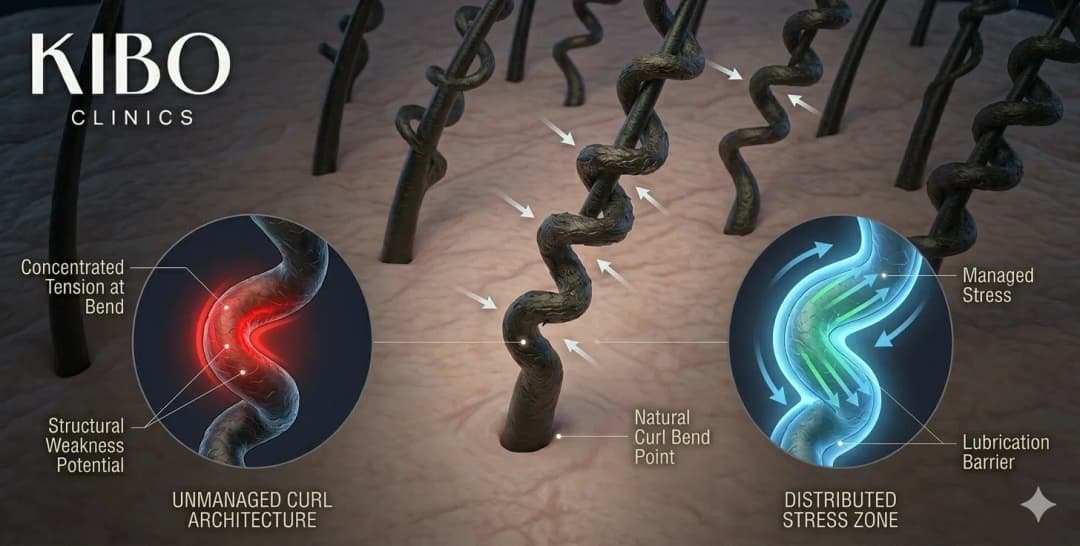
Curly hair breakage is not about weak products or rough technique alone it begins in the structure of the strand. Tighter curl patterns create more bends along the hair shaft, and each bend is a structural weak point where tension concentrates during combing, tying, or heat styling.
Combined with uneven oil distribution from root to tip, higher inter-strand friction, and a natural tendency for moisture loss, curly and coily hair reaches its mechanical damage threshold at lower pulling forces than straight hair. The same detangling session that causes no damage in straight hair creates multiple micro-fractures in a 3C or 4B curl which is why curly hair appears to "break more" even with seemingly identical care habits.
Why Did Ananya's Curly Hair Keep Breaking?
Ananya, 29, from Hyderabad, always loved her thick 3C curls. But over the past year, she noticed more hair on her pillow and shorter broken strands around her crown.
She tried oiling heavily, changed shampoos, and even avoided combing. Still, her hair felt dry and snapped during detangling. Tight ponytails for work and frequent heat styling made it worse.
After proper scalp and hair assessment, she understood that her curl pattern itself required different tension management. With structured care, reduced pulling styles, and targeted strengthening treatments, her breakage reduced within a few months.
How Does Curl Pattern Affect Hair Tension?
Hair structure differs based on how the follicle grows from the scalp.
Straight hair grows from round follicles and distributes natural scalp oils evenly along the shaft. This makes strands smoother, more lubricated, and more resistant to mechanical stress.
Wavy hair grows from slightly oval follicles. The gentle bends create mild weak points where tension can concentrate, but the curves are gradual enough that oil travels reasonably well from root to end.
Curly and coily hair grow from more elliptical or flattened follicles. The tighter the curve, the more stress points exist along the strand. Each bend is a structural weak area. When you comb, tie tightly, or apply heat, tension concentrates at these curves and dramatically increases breakage risk.
Scalp health compounds this. If the scalp is dry or inflamed, follicles produce structurally weaker strands from the point of production. Hormonal stress, nutritional gaps, and environmental damage reduce protein strength in already curved hair shafts — starting a cycle where breakage accumulates faster than new healthy growth replaces it. The hair brushes and combs scalp stress guide explains why tool choice matters especially in textured hair types.
Why Tighter Curls Break Faster
Curly and coily hair have four compounding structural disadvantages compared to straight hair:
- Uneven moisture distribution from root to tip — oil from the sebaceous gland cannot travel along a tightly curved shaft as efficiently as along a straight one
- Reduced natural oil spread — mid-lengths and ends of curly hair are chronically drier than equivalent straight hair even with similar sebum production
- More friction between strands — curved strands catch on neighbouring strands constantly, creating friction that straight hair strands slide past
- Higher shrinkage — making length seem shorter and increasing the mechanical effort needed during detangling, concentrating tension at the most vulnerable bend points
Breakage Risk by Curl Type
| Curl Pattern | Main Tension Source | Breakage Risk | Primary Prevention |
|---|---|---|---|
| Straight (Type 1) | Heat and chemical exposure | Moderate | Reduce heat frequency; protect from chemical stress |
| Wavy (Type 2) | Over-brushing and dryness | Moderate | Wide-tooth comb on conditioned damp hair; reduce brushing |
| Curly (Type 3) | Detangling and tight styles | High | Detangle only on damp conditioned hair; avoid tight ponytails |
| Coily (Type 4) | Traction and moisture loss | Very High | Section detangling with generous slip; avoid all tight traction styles |
| Chemically treated + any curl | Chemical damage + existing curl stress points | Highest | Protein-moisture treatment; maximum tension reduction; professional guidance |
How Does Hair Tension Affect Follicles Over Time?
Repeated tension does not only snap strands — it progressively affects follicles through the same mechanism described in traction alopecia from tight hairstyles.
Constant pulling from tight braids, ponytails, or extensions inflames follicles. Over time this may lead to traction alopecia — where the same hairstyles worn without visible consequence for years begin producing permanent hairline recession as the follicle anchoring progressively weakens.
Stress hormones also affect hair growth cycles. When combined with mechanical tension, the anagen (growth) phase shortens. Hair becomes thinner and more fragile across successive cycles — meaning each new hair that grows in is structurally weaker than the previous one.
Environmental exposure — hard water, pollution, and sun damage — further weakens protein bonds, especially in textured hair where the structural stress points from curl pattern already make the shaft more vulnerable to environmental degradation.
How Does Curl Pattern Show in Men and Women?
In women, longer hair length increases cumulative tension. Styling practices like tight braids, buns, and straightening increase breakage risk in curly and coily hair significantly — because longer hair transfers more gravitational and styling force to the follicle over the course of a day.
In men, shorter styles reduce length-based tension but frequent fades, chemical straightening, or aggressive brushing can weaken curl structure and cause breakage that is invisible until thinning at the crown or edges becomes noticeable.
Hormonal changes after pregnancy or during thyroid imbalance may worsen fragility in women with tight curls — the structural vulnerability from curl pattern combines with the growth cycle disruption from hormonal changes, accelerating both breakage and shedding simultaneously.
Both genders experience higher breakage when scalp health is ignored — a healthy scalp produces structurally stronger strands from the follicle, which are more resistant to the bend-point stress of tight curl patterns.
What Daily Habits Make It Better or Worse?
Habits that worsen curly hair breakage:
- Rough towel drying — increases friction and snaps curved strands at the weakest bend points
- Combing dry curly hair without slip — creates mechanical stress at every curve along the shaft
- Frequent heat styling — alters protein bonds and reduces elasticity that curly hair needs more than straight hair
- Very tight hairstyles — create continuous tension at roots on hair that already concentrates stress at bends
- Skipping conditioning — reduces the moisture retention that textured hair needs to maintain flexibility at bend points
- Sleeping on cotton pillowcases — increases friction throughout the night on strands that are already catching on each other
Habits that protect curly hair:
- Using a wide-tooth comb on damp, conditioned hair — the slip from conditioner and the wide gaps of the comb are the single most impactful combination for reducing detangling breakage in curly hair
- Sleeping on satin or silk pillowcase or using a satin bonnet — eliminates 6 to 8 hours of nightly friction that compounds daily styling stress
- Regular scalp cleansing — prevents buildup that blocks follicles and reduces oil flow to already-dry textured strands
- Sectioning hair during detangling — detangling in small sections prevents the force of a large mass of tangled strands being applied to individual follicles
What Helps First — Practical Relief Steps
Start by reducing mechanical tension immediately. Avoid tight hairstyles for at least 6 to 8 weeks. This is the highest-priority intervention — no product change produces results equivalent to eliminating the tension that is snapping strands and stressing follicles daily.
Detangle only when hair is damp with conditioner applied. This is the most impactful technique change for how to detangle curly hair without breakage — the slip from conditioner allows fingers or a wide-tooth comb to work through tangles without the pulling force being concentrated at the bend point weak spots.
Trim split ends to prevent upward shaft splitting that progresses with each friction event. Split ends in curly hair travel upward faster than in straight hair because the bends create additional catching points.
Protect hair at night using a satin bonnet, silk pillowcase, or loose pineapple-style updo that minimises tension and friction simultaneously.
For anyone experiencing visible thinning edges or hairline recession alongside breakage, hair accessories that create hidden pulling covers the specific mechanisms by which clips, pins, and bands compound tension damage in textured hair.
Breakage reduction is typically noticeable within 4 to 6 weeks if tension habits improve consistently. Visible thickness improvement may take 3 to 4 months as new healthier strands grow.
When to See a Hair Specialist
Do not wait if you notice:
- Persistent breakage despite proper technique and habit correction
- Thinning edges or widening part lines — may indicate traction alopecia that has crossed from reversible to progressive
- Scalp redness, itching, or pain — suggests follicle-level inflammation beyond surface breakage
- Sudden increase in hair shedding alongside breakage — could signal hormonal imbalance rather than mechanical cause
- Hair feeling thinner at the roots, not just shorter at the ends — follicle health may be compromised
Professional evaluation helps differentiate breakage from hair fall disorders before follicle damage becomes established.
Common Myths About Curl Pattern and Breakage
Myth 1: Curly hair grows slower. Curl pattern does not change growth speed. Shrinkage makes length less visible. Curly hair grows at the same rate but retains length less effectively due to increased breakage.
Myth 2: Oil alone fixes curly hair breakage. Oil reduces friction and improves shaft flexibility but does not repair internal protein damage at bend-point weak areas. Deep conditioning with protein-moisture balance is needed alongside oil.
Myth 3: Cutting hair makes it stronger. Trimming removes weak split ends and prevents upward splitting. It does not change follicle strength or reduce the curl-pattern bend points that make strands vulnerable. Ongoing tension reduction is what prevents new damage.
Myth 4: Only chemical treatments cause breakage. Mechanical tension alone — from detangling, tight styles, and sleep friction — creates significant cumulative damage over time, particularly in textured hair where each curl bend concentrates that force.
Myth 5: Men do not face curl-related breakage. Short hair reduces visibility but root tension and dryness still affect men with curly or coily patterns. Persistent crown dryness or thinning edges in men with textured hair needs assessment.
Why Kibo Clinics
Many patients choose Kibo Clinics for curl-related hair breakage because our approach addresses both scalp stability and long-term follicle planning. We begin with comprehensive scalp assessment, hair and follicle analysis, and thorough lifestyle and environmental review — identifying whether curly hair breakage is purely mechanical or has an underlying follicle-level component requiring active treatment.
Our No Ghost Surgery pledge ensures the consulting surgeon personally performs your entire procedure, maintaining consistent quality throughout the session. We do not delegate critical steps to technicians.
The Kibo Hair Analysis (scalp and follicle assessment) is the first step in understanding your specific condition. We provide education, guidance, and support without guarantees, exaggerated claims, or miracle cure promises.
For patients needing advanced care, options like PRP therapy, IV hair boosters, or supportive regenerative treatments may be discussed based on suitability. Structured 12-month monitoring helps track breakage reduction, density stability, and response to interventions.
If you are noticing increasing breakage, thinning edges, or tension-related discomfort, early assessment can prevent long-term damage.
Frequently Asked Questions
Q: Is curly hair more prone to breakage than straight hair? Yes. Curly hair has more structural bends, which create weak points where tension concentrates during combing, tying, and styling. Tighter curl patterns (Type 3 and 4) have more bend points per inch of hair, less oil travel from root to tip, and more inter-strand friction — all of which increase breakage risk compared to straight hair under the same styling conditions. However, proper moisture balance and gentle handling significantly reduce damage regardless of curl type.
Q: How to detangle curly hair without breakage? The most effective method is to detangle only when hair is damp with conditioner applied — the slip from conditioner allows tangles to release without the pulling force concentrating at curl bend weak points. Work in small sections from the ends upward, never from the roots down. Use a wide-tooth comb or fingers rather than a brush. Never detangle dry curly hair. The less mechanical force applied during detangling, the less breakage accumulates over time.
Q: Can tight ponytails cause permanent damage in curly hair? Yes. Repeated tight styles can inflame follicles and lead to traction alopecia — particularly at the temples and hairline where curly hair styling tension concentrates. Early stages are reversible if tension stops. Long-term pulling — especially in curly hair where the follicle is already handling the structural stress of producing a tightly curved shaft — may cause permanent thinning. Monitoring edge density is important.
Q: Is breakage the same as hair fall in curly hair? No. Breakage occurs along the shaft where curl bend weak points fracture under tension — leading to shorter strands without a white root bulb. Hair fall involves shedding from the root with a visible white bulb. Both can happen simultaneously but require different management. Breakage responds to tension reduction and moisture improvement. Root-level hair fall needs follicle assessment.
Q: How long does it take to reduce curly hair breakage? Improved habits show reduced snapping in 4 to 6 weeks when tension is reduced and detangling technique improves. Visible density improvement may take 3 to 4 months as healthier hair grows in. Severe cases with follicle involvement need professional evaluation.
Q: Are protein treatments safe for curly hair? Protein treatments strengthen weak strands at the bend-point structural weak areas. However, excess protein without balanced moisture can make curly hair stiff and brittle — counterproductively increasing breakage at the same bend points they were meant to protect. Professional guidance helps maintain the correct protein-moisture balance for each curl type.
Key Takeaways
- Curly hair breakage is structural — each curl bend is a weak point where tension concentrates during every styling session; tighter patterns (Type 3 and 4) have more bend points and higher breakage risk
- Is curly hair more prone to breakage? Yes — due to uneven oil distribution, inter-strand friction, and tension concentration at bend points; the same handling that causes no damage in straight hair creates multiple fractures in tight curls
- How to detangle curly hair without breakage — always damp, always with conditioner slip, always from ends upward in small sections, always with a wide-tooth comb or fingers only
- Sleeping on cotton pillowcases creates 6 to 8 hours of nightly friction on hair that is already catching on itself — switching to satin or silk is one of the highest-impact habit changes for curly hair users
- Thinning edges in curly hair users are a red flag for traction alopecia — not just breakage — and need professional assessment before the follicle damage becomes irreversible
- Most curly hair breakage is fully reversible within 4 to 6 weeks of corrective habits; persistent breakage beyond 8 weeks despite technique changes needs clinical evaluation
Disclaimer
This content is for informational purposes only and does not substitute personalized medical advice. Curl pattern, scalp condition, hormonal balance, and treatment responses vary between individuals. Breakage management outcomes differ based on consistency and underlying causes. Professional consultation is recommended before starting any medical or regenerative treatment.
Hair Transplant
FUE Hair Transplant | Sapphire FUE Hair Transplant | Bio FUE Hair Transplant | Realtime FUE Hair Transplant | Direct Hair Transplant (DHT)
Hair Regrowth
PRP Therapy | GFC Therapy | IV Hair Boosters | Mesotherapy for Hair Regrowth | Microneedling for Hair Regrowth
Must Read
Hair Loss Types Symptoms Causes | Hair Breakage Causes Treatments | DHT Blockers Hair Loss Guide | Hair Transplant Good Or Bad | Understanding The Language Of Natural Hairline
Relevant Blogs
Hair Brushes Combs Scalp Stress | Hair Dryer Heat Follicle Safety | Straighteners and Curling Irons Hair Stress | Pollution Build Up Weakening Hair Roots | Scalp Oil Reducing Hair Friction