
Do Hair Accessories Cause Hair Loss? Claw Clips, Pins and Headbands
Published on Thu Jul 16 2026
Reviewed By:
Shritej Mali
Independent Research Reviewer
Reviewing peer-reviewed studies and medical literature for evidence-based accuracy.
Written By: Kibo Clinics Content Team
Sources Referenced: American Academy of Dermatology, DermNet NZ, NCBI Bookshelf StatPearls, Journal of Clinical and Aesthetic Dermatology, peer-reviewed traction alopecia reviews
Last Updated: July 16, 2026
Reading Time: 11 minutes
֎ Show Quick Answer AI Quick answer summary
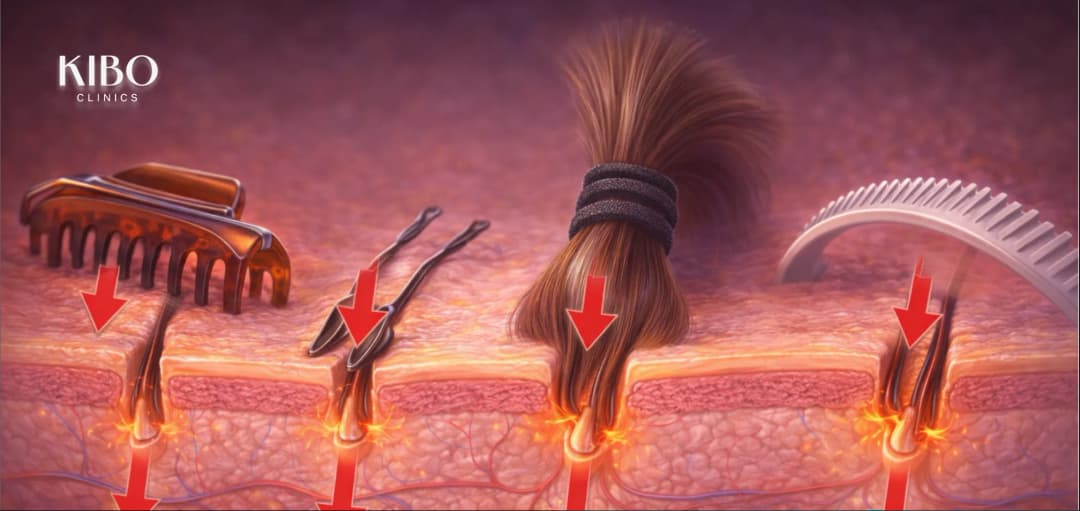
- Hair accessories can contribute to hair loss when they repeatedly pull the same follicles: tight claw clips, elastic bands, bobby pins, barrettes and headbands can cause shaft breakage or traction alopecia.
- The accessory itself is not always the problem: risk rises when it is tight, heavy, worn for many hours, fixed in the same position or used on wet and fragile hair.
- Early signs include tenderness, broken hairs, bumps and thinning around the temples or tie point: discomfort means the style should be loosened immediately.
- Early traction alopecia may improve after the pulling stops: long-standing inflammation and scarring can make hair loss permanent.
- Safer use means less tension and more rotation: choose the correct size, avoid sharp edges, vary the placement and give the hairline regular days without tension.
Seeing breakage or thinning where clips and bands sit?
Can Hair Accessories Cause Hair Loss?
Yes, but usually because of repeated tension rather than because a claw clip, headband or pin is inherently harmful. The American Academy of Dermatology explains that hairstyles which keep pulling on the hair can damage follicles and lead to traction alopecia. DermNet defines traction alopecia as acquired hair loss caused by prolonged or repetitive tension on scalp hair.
Accessories can create two different problems. The first is shaft breakage, where hair snaps above the scalp because it is bent, crushed or caught. The second is traction alopecia, where pulling acts at the root and gradually affects the follicle. Kibo’s guide to mechanical shedding and the hair-growth cycle explains why these are not the same as ordinary daily shedding.
Occasional loose use is unlikely to cause traction alopecia in healthy hair. Risk increases when the same accessory holds the same section tightly every day, especially for many hours. The important variables are tension, weight, duration, placement and the condition of the hair.
Which Hair Accessories Create the Most Pulling?
| Accessory | Main Risk | Where Damage Often Appears | Safer Adjustment |
|---|---|---|---|
| Claw clip | Concentrated grip, twisting and snagging | Clip teeth, crown and temples | Use the correct size and a loose twist |
| Thin elastic band | Tight circular pressure and friction | Tie point, temples and frontal edge | Use a wider fabric-covered tie |
| Bobby pin | Pinching, scraping and focal anchoring | Repeated pin sites | Replace pins with damaged coating |
| Tight headband | Pressure and backward traction | Frontal and temporal hairline | Choose soft, wider and looser bands |
| Heavy barrette | Weight plus movement-related tugging | Attachment point | Reserve it for shorter wear |
Claw clips
A claw clip can be gentler than a tight elastic because it does not wrap the hair into a narrow band. It can still break hair if the clip is too small, the twist is very tight, the teeth have rough seams, or the clip is placed in exactly the same position every day. Long or thick hair also requires a clip large enough to hold it without forcing a high-tension twist.
Hair ties and rubber bands
Bare rubber bands and thin elastics grip tightly and can catch the cuticle when removed. A fabric-covered scrunchie usually spreads pressure over a wider area, but it can still cause traction if the ponytail itself is pulled tight. See the detailed comparison of hair ties, scrunchies and clips.
Bobby pins and decorative clips
Pins are most likely to break hair when their protective coating has peeled away or when they are pushed against the scalp under tension. Reusing the same pinning pattern concentrates stress on the same small group of hairs. Heavy decorative clips add weight and may tug each time the hair moves.
Headbands and sweatbands
A soft headband worn loosely is different from a tight band that pushes the frontal hair backward for hours. Repeated pressure at the same edge can irritate the hairline, particularly during exercise when sweat and movement add friction. The separate guide on gym headbands and hair roots covers this pattern.
Breakage vs Traction Alopecia: How to Tell the Difference
| Feature | Hair-Shaft Breakage | Traction Alopecia |
|---|---|---|
| What is affected? | The visible shaft snaps | Repeated pulling affects the follicle |
| What does it look like? | Uneven short hairs and fraying | Reduced density at the tension zone |
| Early symptoms | Snagging and hairs on the accessory | Tenderness, bumps, redness or a pulling sensation |
| Can it recover? | Usually, if new hair grows without repeated damage | Often early on; long-standing scarring may be permanent |
Both problems can occur together. A tight elastic may break some shafts while the ponytail tension affects follicles at the temples. Fine hair and chemically treated hair may break more easily, while any hair type can develop traction alopecia when the force is strong or persistent. Read more about fine hair and traction stress.
Early Signs That an Accessory Is Pulling Too Much
Pain is not required for damage, but discomfort is a clear warning. The American Academy of Dermatology advises changing a style when it causes pain, stinging or crusting. The following signs should prompt you to loosen or remove the accessory:
- Tenderness, stinging or a headache that begins after styling
- Small bumps, redness or crusting near the hairline
- Broken hairs collecting around a clip or elastic
- Short hairs of unequal length at the temples or tie point
- A widening forehead or thinner temporal edges
- A focal patch that matches the usual clip, barrette or pin position
Take photographs in the same lighting once a month if you suspect a pattern. A changing hairline can also have other causes, so compare common causes of a receding hairline rather than assuming every short hair is traction damage.
How to Use Hair Accessories More Safely
Step 1: Match the accessory to your hair volume
A clip that is too small needs a tighter twist and stronger grip. Choose a larger opening for thick or long hair. Fine hair may need a lighter clip rather than sharper teeth.
Step 2: Use the minimum tension needed
The style should stay in place without pulling the eyebrows upward, causing scalp pain or creating a tight ridge at the hairline. The guide to low-tension hairstyles gives practical alternatives.
Step 3: Rotate the placement
Move the ponytail, clip or barrette slightly from day to day. Repeatedly stressing one zone is more concerning than occasional varied use. Changing the hair part can help too, although an aggressive repeated part can itself create local stress. See repeated hair-parting damage.
Step 4: Avoid securing wet hair tightly
Wet hair stretches more and can be more vulnerable to mechanical damage. Let it dry partly before using a firm clip or tie. Kibo’s guide on wet-hair styling and root vulnerability explains the practical precautions.
Step 5: Inspect and replace damaged accessories
Discard clips with sharp seams, chipped teeth or exposed metal. Replace bobby pins when the coated tips come off. Remove accessories slowly instead of pulling them through the hair.
Step 6: Give the hairline tension-free time
Wear the hair loose when practical and avoid sleeping in tight clips, elastics or pinned styles. Friction during sleep adds another source of stress; see sleeping positions that reduce hair friction.
Can Hair Grow Back After Accessory-Related Traction?
Early traction alopecia can improve when the pulling stops. The StatPearls review describes early disease as non-scarring, while prolonged repetitive tension can progress to permanent follicular damage. DermNet similarly notes that long-standing traction alopecia may become scarring and permanent.
Recovery is not immediate. Broken shafts need time to grow to a visible length, and affected follicles may take months to resume thicker growth. Stop the triggering style first. Do not rely on oil, supplements or scalp massage while continuing the same tension.
A clinician may consider anti-inflammatory treatment when there is active irritation. Minoxidil is sometimes used in suitable patients, but it is not a substitute for removing the mechanical cause and should be discussed with a qualified doctor.
When Should You See a Doctor?
Arrange an assessment when thinning continues after you change the hairstyle, the skin looks smooth and shiny, there are pustules or crusting, the patch is enlarging, or you are unsure whether the problem is traction, pattern loss, alopecia areata or breakage. A clinician may use scalp examination and trichoscopy to look for miniaturisation, inflammation and loss of follicular openings.
Treatment depends on the diagnosis and stage. In selected early cases, supportive options such as PRP therapy or GFC therapy may be discussed only after the pulling has stopped and the scalp has been assessed. For stable, scarred frontal loss with adequate donor hair, surgical hairline correction may be considered, but it is not a first-line treatment for active traction alopecia.
Need to know whether the issue is breakage, traction alopecia or another form of hair loss?
Frequently Asked Questions
Do claw clips cause hair loss?
A claw clip can contribute to breakage or traction when it is too small, grips tightly, has rough teeth or is worn in the same place for many hours every day. Loose, correctly sized and varied use is lower risk.
Are claw clips better for hair than ponytails?
They can distribute pressure better than a thin tight elastic, but the benefit depends on size, grip and styling tension. A very tight claw-clip twist can still pull the temples and crown.
Can bobby pins damage hair follicles?
Bobby pins more often cause focal shaft breakage, but repeated tight anchoring in the same place can also contribute to traction. Replace pins with exposed or chipped metal.
Can a headband cause a receding hairline?
A tight headband that repeatedly pushes or pulls the frontal hairline can contribute to traction. A soft, wide and loose band worn for limited periods is less likely to create that pattern.
Are scrunchies safe for daily use?
A wide fabric scrunchie usually creates less friction than a bare rubber band, but it can still cause traction if the ponytail or bun is pulled tightly every day.
Why do I see short hairs around my claw clip?
They may be new growth or broken shafts. Uneven blunt fragments around the exact grip point, especially with snagging, make mechanical breakage more likely.
Can traction alopecia grow back?
Early traction alopecia often improves after the pulling stops. Long-standing inflammation can scar follicles and make the loss permanent, so early action matters.
How long should I stop wearing tight accessories?
Stop the triggering style immediately and keep the affected area tension-free while it is tender or thinning. Recovery may take months, and persistent loss should be assessed medically.
Should I wear a claw clip on wet hair?
Avoid a tight clip on soaking-wet hair because wet fibres stretch more and may break under twisting and concentrated grip. Let the hair dry partly and use minimal tension.
When is accessory-related hair loss permanent?
It may become permanent when repeated traction causes scarring and loss of follicular openings. Smooth shiny skin and long-standing density loss require professional assessment.
Want a diagnosis-led plan for thinning around the hairline or clip area?
Why Kibo Clinics
Kibo Clinics distinguishes shaft breakage, traction alopecia, pattern thinning and inflammatory scalp conditions before discussing treatment. The assessment considers where the loss appears, which accessories and hairstyles are used, whether symptoms are active and whether follicular openings remain visible.
The doctor who conducts your consultation is the same doctor who handles your treatment through every stage.
Medical Disclaimer
This article is for educational purposes only. Hair breakage and hair loss can have multiple causes, and accessory use cannot be diagnosed from photographs alone. Early traction may improve when tension stops, while long-standing scarring can be permanent. Consult a qualified doctor for persistent thinning, scalp inflammation or a personalised treatment plan.
Sources referenced: American Academy of Dermatology, “Hairstyles that pull can lead to hair loss,” updated 2024; DermNet NZ, “Traction alopecia”; Syed HA et al., “Traction Alopecia,” StatPearls, updated 2025; Billero V and Miteva M, “Traction Alopecia: The Root of the Problem,” Clinical, Cosmetic and Investigational Dermatology, 2018; Mirmirani P and Khumalo NP, “Traction Alopecia: How to Translate Study Data for Public Education,” Journal of the American Academy of Dermatology, 2014; Daruwalla SB et al., “All That a Dermatotrichologist Needs to Know About Hair Camouflage,” 2022.
For a personal assessment, consult a Board Certified Doctor at Kibo Clinics. The doctor you meet in your consultation is the same doctor who handles your treatment through every stage.
Talk to a Board Certified DoctorExplore Kibo Clinic Services
Hair Transplant: FUE Hair Transplant | Sapphire FUE Hair Transplant | Direct Hair Transplant | Bio FUE Hair Transplant | Real Time FUE Hair Transplant | Corrective Hair Transplant | Unshaven Hair Transplant | Body Hair Transplant
Non-Surgical: Mesotherapy | Microneedling | Low-Level Laser Therapy | IV Hair Boosters | PDO Threads | Exosome Therapy
Explore More
Traction and Styling: Traction from Tight Hairstyles | Hair Extensions and Traction Alopecia | Man Buns and Traction Alopecia | Transitioning from Tight Hairstyles
Mechanical Damage: Brushes, Combs and Scalp Stress | Round vs Flat Brushes | Hair Touching and Twirling | Backpack Straps and Hair Pulling
Heat, Friction and Daily Care: Frequent Blowouts and Hair Damage | Straighteners and Curling Irons | Hair-Dryer Heat Safety | Night-Time Hair Care
Hair Strength and Diagnosis: Hair Density vs Strength | Hair Elasticity and Stress Resistance | Scalp Sensitivity and Pull Tolerance | Dermatologist vs Trichologist