
How Androgenetic Alopecia Slowly Reduces Hair Density
Published on Thu Jul 09 2026
Reviewed By:
Shritej Mali
Independent Research Reviewer
Reviewing peer-reviewed studies and medical literature for evidence-based accuracy.
Written By: Kibo Clinics Content Team
Sources Referenced: American Academy of Dermatology, Cleveland Clinic, DermNet NZ, NCBI Bookshelf StatPearls, Endotext, MedlinePlus Genetics, Mayo Clinic
Last Updated: July 9, 2026, 3:55 PM IST
Reading Time: 12 minutes
֎ Show Quick Answer AI Quick answer summary
- Androgenetic alopecia reduces hair density slowly because sensitive follicles shrink over repeated growth cycles instead of disappearing overnight.
- The first visible clues are usually pattern-based: temple recession, a higher hairline, crown thinning, more scalp show, or a widening part in women.
- The key process is miniaturisation: thick terminal hairs become finer, shorter and less visible, so density looks lower even before a bald patch forms.
- Early treatment matters: follicles that are still active have a better chance of stabilisation or improvement than areas that are already smooth and inactive.
- A doctor-led assessment can separate pattern loss from shedding, breakage or scalp disease and decide whether medication, PRP, GFC, LLLT or transplant planning is relevant.
Seeing more scalp at the hairline or crown?
Why Androgenetic Alopecia Reduces Hair Density Slowly
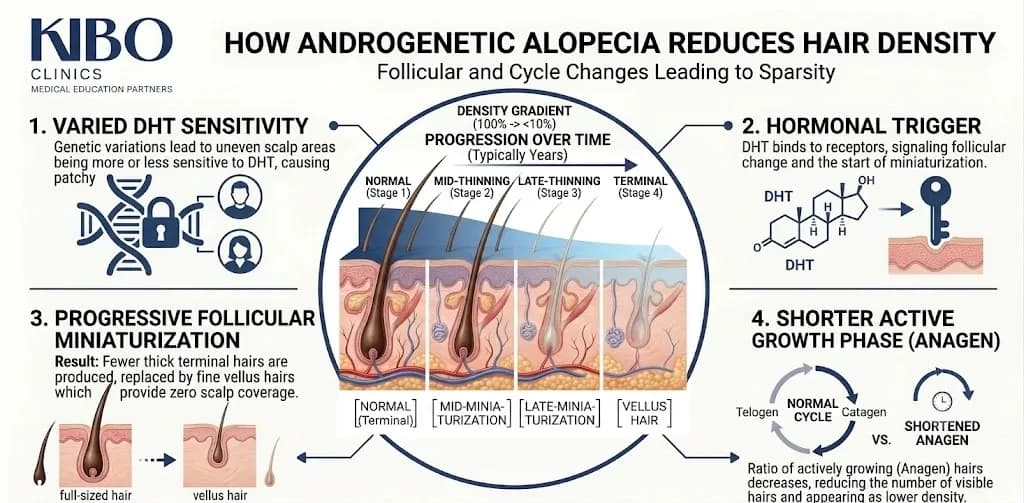
Androgenetic alopecia reduces hair density gradually because it changes how susceptible follicles behave over time. The follicle does not usually stop producing hair in one sudden moment. Instead, the same follicle produces a thinner, shorter and less visible strand with each affected cycle. That is why early pattern hair loss can look like reduced volume before it looks like obvious baldness.
This matters because many people wait for a bald patch before taking action. In reality, the first stage may be a smaller ponytail, a scalp line that photographs wider, temples that sit higher, or a crown that reflects more light under overhead lighting. By the time the loss is easy to see in every mirror, follicle miniaturisation may already have been active for years.
Hair density is not only the number of hairs on the scalp. It is also the thickness, length, colour and coverage value of each hair shaft. Androgenetic alopecia affects all of this. A scalp can have follicles present, but if many are producing miniaturised fibres, the area looks sparse because the hair no longer covers skin the way it used to.
This is why a density complaint should not be dismissed as simple hair fall. If the change follows a pattern at the hairline, temples or crown, it needs a pattern-loss assessment rather than only a new shampoo, oil or supplement.
The Miniaturisation Process: From Thick Hair to Finer Hair
In androgenetic alopecia, genetically sensitive follicles respond strongly to androgen signalling, especially DHT. Over repeated cycles, the affected follicles become smaller. This process is called follicle miniaturisation. The visible result is a shift from thick terminal hair toward finer, shorter, less pigmented hair that contributes less to scalp coverage.
The change is often silent at first. You may not see heavy shedding. You may not see clumps. Instead, the hairline looks less dense, the crown looks flatter, or the parting line looks wider. This is where understanding hair density versus strength helps because strand thickness and scalp coverage can change before the total hair count feels dramatically different.
| Stage of Density Change | What Happens in the Follicle | What You May Notice |
|---|---|---|
| Early miniaturisation | Some follicles produce finer strands while many surrounding hairs still look normal. | Hairline looks less sharp, crown reflects more light, styling takes longer. |
| Visible density loss | More follicles shift toward thin, short, low-coverage fibres. | Temples recede, crown thins, parting widens, scalp shows in photos. |
| Advanced thinning | Affected follicles produce very small fibres or stop producing cosmetically useful hair. | Bald-looking zones appear at the crown, front or mid-scalp. |
The practical lesson is simple: treatment discussions are usually more useful while miniaturised follicles are still active. If a zone has become smooth and no longer has working follicles, medical density improvement becomes less predictable and transplant planning may become part of the discussion.
Hairline Recession: Why the Front Looks Thinner First
Hairline recession is one of the most recognisable signs of male pattern hair loss. The temples may move back, the frontal line may lose its clean edge, or the hairline may start forming an M-shaped pattern. This is not only a change in position. It is also a density change because the front rows of hair become thinner, shorter and less able to frame the face.
For men, recession is often assessed with the Norwood scale. The scale is useful because it does not look only at the present hairline. It also helps doctors think about future progression, crown involvement and whether a treatment plan should focus on stabilisation, hairline design, density restoration or all three.
Not every high hairline is androgenetic alopecia. Some people naturally have a mature hairline. The warning sign is change: the corners keep moving back, the frontal hair becomes see-through, family members have a similar pattern, or old photos show a clear shift. When that happens, reading about the genetic inheritance myth can help because pattern hair loss is not inherited only from one side of the family.
Crown Thinning: Why Density Loss Is Easy to Miss
Crown thinning can be harder to notice because it sits behind your normal mirror view. Many people first see it in a photo, under salon lights, under office lights or when someone else points it out. The crown also has a natural swirl, so early thinning can be confused with a normal whorl.
The difference is progression. A normal hair whorl stays relatively stable. Androgenetic alopecia at the crown slowly expands the visible scalp area as more follicles miniaturise. The hairs around the centre become finer, spacing looks wider and styling products no longer hide the spot as easily.
| Concern | Could Be Normal | More Suspicious for Androgenetic Alopecia |
|---|---|---|
| Crown swirl | Stable whorl visible only when hair is wet or parted. | Expanding visible scalp in the same area over months. |
| Hairline | Mature hairline that has not shifted further. | Corners recede, frontal density drops, old photos show change. |
| Shedding | Temporary shedding after illness, stress or diet change. | Slow pattern thinning even without dramatic daily shedding. |
Crown thinning is also where timing matters. When the follicle is still active, treatments that support growth may help improve coverage. When the crown has become a smooth bald zone, density usually depends more on surgical planning, donor strength and realistic graft distribution.
Not sure if this is normal shedding or progressive density loss?
Why Androgenetic Alopecia Is Not Just Hair Fall
Hair fall is what you see in the drain, on the pillow or in your hand. Androgenetic alopecia is what happens inside susceptible follicles over time. A person with pattern hair loss may not always shed dramatically. The real change may be that each new hair cycle produces a weaker strand than the previous one.
This is why why shampoo is not stopping hair fall is such an important topic for people with pattern thinning. A shampoo can clean the scalp and support scalp comfort, but it cannot reverse follicle miniaturisation by itself. The root issue is deeper than the surface of the hair shaft.
The distinction also protects you from wasting months. If the problem is breakage, heat damage or scalp inflammation, the plan may focus on repair and scalp care. If the problem is androgenetic alopecia, the plan usually needs to address progression. Understanding the hair growth cycle and hair growth stages helps explain why visible results take months, not days.
What a Doctor Looks For During Density Assessment
A proper density assessment is more than looking at one photograph. The doctor studies pattern, timeline, scalp condition, family history, hair shaft thickness, miniaturisation and whether there are other triggers that can worsen the picture. Trichoscopy can help identify variation in hair shaft diameter, miniaturised hairs and pattern distribution.
In men, the assessment often compares the front, temples, mid-scalp, crown and donor area. In women, the centre part, frontal density and diffuse thinning pattern may be more relevant. If there are signs of iron deficiency, thyroid imbalance, PCOS, postpartum shedding or nutritional restriction, blood tests for hair fall may help identify overlapping triggers.
- Pattern: temples, frontal hairline, crown, mid-scalp or widening part.
- Progression: whether density has changed over months or years.
- Miniaturisation: whether many hairs in the area are visibly thinner than nearby hairs.
- Scalp health: redness, flakes, itching, pain, inflammation or scarring clues.
- Donor strength: important if future transplant planning may be needed.
Can Lost Density Improve Again?
Density can improve when follicles are still alive, miniaturised rather than absent and the treatment plan matches the diagnosis. The goal in early androgenetic alopecia is often to stabilise progression first. Any regrowth or visible thickening is then judged over months because hair has to move through its biological growth cycle.
Treatment discussions may include DHT control, growth support, scalp treatment and regenerative procedures depending on suitability. Guides on DHT blockers for hair loss, minoxidil versus Redensyl and 5 percent versus 10 percent minoxidil explain common medication and topical categories. These are not one-size-fits-all decisions, especially for women, people with medical history, or anyone already using treatment.
At Kibo Clinics, the doctor may discuss PRP therapy, GFC therapy or low-level laser therapy for selected patients with active follicles and early to moderate thinning. These are supportive options, not magic shortcuts. They work best when the diagnosis is correct and expectations are realistic.
| Density Situation | Most Useful Goal | Typical Planning Direction |
|---|---|---|
| Early thinning | Slow miniaturisation and preserve existing density. | Diagnosis-based medical plan, progress photos, scalp support. |
| Moderate crown or hairline thinning | Stabilise loss, improve coverage where follicles remain active. | Medical support, PRP/GFC/LLLT where suitable, transplant planning only if needed. |
| Advanced bald zone | Restore cosmetic coverage with realistic donor use. | Surgical evaluation, donor mapping, long-term hairline and crown planning. |
When Hair Transplant Planning Becomes Relevant
A hair transplant is not the first answer for every person with androgenetic alopecia. It becomes relevant when density loss has created areas that cannot be restored adequately with medical or regenerative support, and when donor hair is strong enough to support a natural result. The key is planning for future progression, not only filling the visible gap today.
For suitable candidates, FUE hair transplant can move stronger donor follicles into areas of recession or thinning. The result is not instant. The hair transplant results timeline explains why density matures gradually after surgery, while hair transplant healing and recovery explains the early healing and growth phases.
For crown thinning, graft planning has to be conservative because the crown can consume many grafts. For hairline recession, design matters because a dense but unnatural line can look wrong as the face ages. That is why donor assessment, age, progression, family pattern and long-term medical support are all part of a responsible plan.
What You Should Track Before Your Consultation
Do not rely only on daily mirror checks. They create anxiety and are unreliable because lighting, oiliness, styling and hair length change how density looks. A better approach is monthly photos with consistent lighting, same angle, same hair length when possible and the same wet or dry condition.
- Front hairline: compare temple corners and the central hairline from old photos.
- Crown: take a top-down image under the same light every month.
- Parting line: for women, photograph the centre part from the same angle.
- Shedding pattern: note sudden heavy shedding, but do not count every strand obsessively.
- Scalp symptoms: record itching, flakes, pain, redness, burning or patches.
If the pattern is slow, visible and consistent at the hairline or crown, do not wait for severe density loss. Early assessment gives you more options than late rescue.
Want a plan before density drops further?
Frequently Asked Questions
How does androgenetic alopecia reduce hair density?
It reduces density through follicle miniaturisation. Susceptible follicles gradually produce thinner, shorter and less visible hairs, so the scalp looks less covered even before the area becomes fully bald.
Is crown thinning always androgenetic alopecia?
No. A crown whorl, shedding, scalp inflammation and styling can also make the crown look sparse. Progressive crown thinning, family history and miniaturised hairs make androgenetic alopecia more likely.
Can hair density return after miniaturisation?
Density can improve when follicles are still active and treatment starts early enough. The aim is usually to stabilise progression first, then judge thickening or regrowth over months.
Why does the hairline recede in androgenetic alopecia?
The frontal and temple follicles are often more sensitive to androgen signalling in genetically predisposed men. Over time, those follicles miniaturise and the hairline loses density and position.
Can women get androgenetic alopecia density loss?
Yes. Women may show a widening part, reduced ponytail thickness, diffuse top thinning or more scalp visibility rather than a sharply receding hairline.
Can PRP or GFC improve androgenetic alopecia density?
They may support active follicles in selected early or moderate cases, especially as part of a broader plan. They are not replacements for diagnosis, DHT control where indicated or transplant planning in advanced bald zones.
When should I consider a hair transplant for density loss?
A transplant becomes relevant when a thinning or bald area cannot be restored enough with medical support and the donor area is strong enough. A doctor should also consider future progression before planning grafts.
Does androgenetic alopecia always cause heavy shedding?
No. Some people mainly notice thinning, weaker hair, receding temples or crown visibility without dramatic shedding. Pattern and miniaturisation matter more than daily strand count alone.
How long does it take to see density improvement?
Most density changes need months to judge because hair grows through cycles. Early stabilisation may be noticed before visible thickening. Transplant density also matures gradually over several months.
What is the best first step if my crown or hairline is thinning?
The best first step is a scalp assessment with pattern review and trichoscopy. This helps separate androgenetic alopecia from shedding, breakage, deficiency, scalp inflammation or other causes.
Want clarity on whether your density loss is still treatable?
Medical Disclaimer
This article is for educational purposes only. It does not replace diagnosis, trichoscopy, blood test interpretation, prescription treatment, procedure advice or follow-up from a qualified dermatologist or hair restoration doctor. Hair density can reduce because of androgenetic alopecia, telogen shedding, nutritional deficiency, thyroid disease, PCOS, scalp inflammation, traction, breakage, medication effects or other causes. The correct plan depends on your pattern, symptoms, scalp examination, medical history, medicines, family history, age, donor area and treatment goals.
Sources referenced: American Academy of Dermatology Association, "What is male pattern hair loss, and can it be treated?"; American Academy of Dermatology Association, "Hair loss: Diagnosis and treatment"; Cleveland Clinic, "DHT (Dihydrotestosterone)"; DermNet NZ, "Male pattern hair loss" and "Female pattern hair loss"; Ho CH, Sood T, Zito PM, "Androgenetic Alopecia," StatPearls, updated 2024; Asfour L, Cranwell W, Sinclair R, "Male Androgenetic Alopecia," Endotext, updated 2023; MedlinePlus Genetics, "Androgenetic alopecia"; Mayo Clinic, "Hair loss - symptoms and causes."
For a personal assessment, consult a Board Certified Doctor at Kibo Clinics. The doctor you meet in your consultation is the same doctor who handles your treatment through every stage.
Talk to a Board Certified DoctorExplore Kibo Clinic Services
Hair Transplant: Sapphire FUE Hair Transplant | Direct Hair Transplant DHT | Bio FUE Hair Transplant | Real Time FUE Hair Transplant | Corrective Hair Transplant | Hairline Correction | Unshaven Hair Transplant | Body Hair Transplant
Non-Surgical: IV Hair Boosters | Mesotherapy for Hair Regrowth | Microneedling for Hair Regrowth | Exosomes Therapy | PDO Threads Hair Regrowth
Related Articles
Women and Hormonal Thinning: PCOS Hair Thinning in Women | Repeated Hair Parting Damage
Scalp and Lifestyle Factors: Dermatologist Recommended Shampoo for Hair Loss | Wearing Hat Cause Baldness Myth | Man Bun Traction Alopecia
Mumbai Hair Stressors: Mumbai Air Pollution Hair Protection | Hard Water Hair Loss Mumbai
Treatment Education: Dermarolling vs Professional Microneedling