
Does Humidity Cause Hair Loss? Why Hair Gets Frizzy and Breaks in Humid Weather
Published on Thu Apr 02 2026
Quick Summary
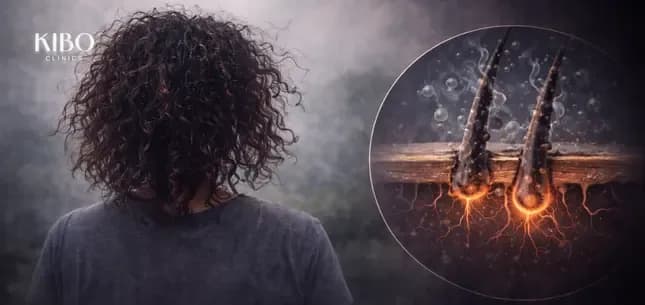
Humidity makes hair frizzy and weak by causing the hair shaft to absorb excess moisture from the air swelling the cortex, lifting the cuticle scales, and breaking down the hydrogen bonds that give hair its structural resilience. The result is a strand that stretches more than it should and snaps under everyday handling that healthy dry hair would tolerate without damage.
Humidity does not cause root-level hair fall directly, but when humid conditions combine with tight hairstyles, rough towel drying, or heat styling, the mechanical stress on swollen weakened strands creates breakage patterns that look and feel like hair loss especially around the temples and hairline where styling tension concentrates.
A Story Many People Relate To
Riya, 29, lives in Mumbai where humidity is high most of the year. She noticed that during monsoon, her hair became frizzy and difficult to manage. She started tying it tightly into a bun to control the volume.
Within a few months, she saw more broken strands on her pillow and near her hairline. She assumed it was seasonal hair fall and tried switching shampoos. Nothing changed.
After a scalp evaluation, she learned that her hair shaft was becoming weak due to moisture overload and constant mechanical tension. With proper scalp care, gentler styling, and structured treatment, the breakage reduced significantly.
How Does Humidity Affect Hair Structure and Strength?
Humidity affects hair in a stepwise manner, starting from the outermost layer:
Scalp moisture disruption — In high humidity, excess moisture can disrupt the scalp's natural oil balance. This may lead to mild inflammation, itching, or dandruff-like flaking in some individuals.
Hydrogen bond breakdown — Hair is made of keratin proteins held together by hydrogen bonds. When exposed to high humidity, these bonds repeatedly break and reform as the hair absorbs and releases moisture. This cycle causes the hair strand to swell progressively with each humid exposure.
Cuticle lifting — Swelling lifts the cuticle layer. Once the cuticle is raised, the hair becomes rough and porous. Porous hair loses moisture quickly and becomes prone to tangling.
Mechanical stress amplification — When you comb, towel-dry, or tie your hair, the friction creates mechanical stress on the shaft. Because the cuticle is already lifted and weakened, the strand breaks more easily than it would under dry conditions.
Hormones and stress also play a role. High stress levels increase scalp oil production in some people, and combined with humid weather, this can clog follicles and worsen scalp irritation. Frequent heat styling, chemical treatments, and tight hairstyles further strain already swollen strands.
Why Does Hair Get Frizzy in Humidity?
Frizz happens because swollen hair strands expand unevenly. Curly and wavy hair types are more vulnerable because their structure already has natural bends — these bends are weak points where breakage can occur under tension. Straight hair may appear limp instead of frizzy, but it still suffers the same internal weakening from moisture absorption.
Humidity vs Hair Damage — Step by Step
| Stage | What Happens | Visible Sign | Risk if Ignored |
|---|---|---|---|
| 1 — Moisture absorption | Hair shaft absorbs ambient moisture; hydrogen bonds break and reform repeatedly | Hair feels heavier, slightly damp | Low at this stage |
| 2 — Shaft swelling | Cortex expands; cuticle scales lift away from shaft surface | Frizz, rough texture, tangles | Medium — now vulnerable to breakage |
| 3 — Mechanical stress | Combing, tying, towel rubbing creates friction on lifted cuticle | Short broken strands without root bulb | High — breakage accelerates |
| 4 — Repeated daily cycle | Cuticle never fully seals between cycles; porosity increases | Chronic frizz, uneven strand lengths | High — cumulative structural weakening |
| 5 — Combined with tight styling | Traction on humidity-softened hair damages follicle anchor points | Temple thinning, hairline recession | Highest — may progress to traction alopecia |
| Recovery (with corrective habits) | Cuticle sealing products + reduced mechanical stress + gentle handling | Reduced frizz in 3–4 weeks; improved strength in 8–12 weeks | Low with consistent care |
How Humidity-Related Breakage Shows in Men and Women
In women, it often appears as frizz, split ends, and thinning near the temples due to tight hairstyles combined with moisture. Women with chemically treated hair are at higher risk because their cuticle layer is already compromised — humidity accelerates damage that was already progressing from chemical processing.
In men, helmet use in humid climates creates constant friction on swollen strands. Sweat accumulation can irritate the scalp. Men who use styling gels daily may notice stiffness and snapping in humid weather as the gel layer interacts with absorbed moisture to create uneven tension along the shaft.
Both genders may confuse breakage with hair fall. The key difference is that broken hair is shorter and lacks the white bulb at the root.
What Daily Habits Make It Better or Worse?
Habits that worsen the problem:
- Overwashing in humid weather — strips natural oils and increases dryness after swelling
- Using very hot water — weakens the cuticle further when it is already compromised by humidity
- Aggressive towel drying — creates friction on already swollen strands; a major breakage trigger
- Sleeping on rough cotton pillowcases — increases friction throughout the night
- Tying wet hair tightly — wet strands stretch more and break easily, and the combination of humidity-softened hair with tight styling tension is where traction alopecia begins
Habits that help:
- Using a microfiber towel to gently pat rather than rub — significantly reduces friction damage
- Applying a lightweight leave-in conditioner — creates a protective barrier that partially seals lifted cuticle scales
- Using a wide-tooth comb on damp hair — reduces snapping compared to fine-tooth combs or brushes
- Keeping the scalp clean without over-stripping — maintains the oil balance that protects against humidity absorption
- Limiting heat styling during high humidity periods — prevents compounding thermal damage on already weakened strands
What Helps First — Practical Relief Steps
Start by reducing friction. Switch to a gentle shampoo suited to your scalp type. Use a conditioner to smooth the cuticle layer after every wash. Dry hair by patting rather than rubbing.
Apply an anti-frizz serum or leave-in product before going into humid environments. These products coat the cuticle and slow down moisture absorption, giving the shaft more time before swelling begins.
Limit heat styling during monsoon and high humidity weeks. Heat on already swollen strands accelerates the protein breakdown that reduces long-term elasticity.
Most people notice reduced breakage within 3 to 4 weeks if mechanical stress is reduced consistently. Severe breakage may take 2 to 3 months to improve as new stronger strands grow.
If scalp inflammation is present alongside breakage, structured scalp treatments may be required before surface-level hair care produces visible results.
When to See a Hair Specialist
Do not wait if you notice:
- Sudden excessive shedding along with breakage — these are separate mechanisms and the combination needs evaluation
- Hair thinning visible near the hairline or crown — particularly in areas where tight hairstyles are applied
- Persistent itching, redness, or painful scalp patches — may indicate folliculitis rather than simple humidity stress
- Breakage continuing despite changing hair care habits for over 8 weeks
- Hair feeling elastic or gummy when wet after chemical treatments — indicates over-processed porosity requiring clinical assessment
These signs may indicate deeper follicle stress or early traction alopecia, requiring clinical evaluation beyond at-home habit changes.
Common Myths About Humidity and Hair Damage
Myth 1: Humidity causes permanent hair loss from the roots. Humidity mainly affects the hair shaft, not the follicle directly. Root-level loss requires hormonal, genetic, or inflammatory causes.
Myth 2: Frizz means your hair is unhealthy. Frizz can occur even in healthy hair due to moisture imbalance. It becomes a damage indicator when combined with split ends and elastic weakness.
Myth 3: Oiling daily prevents humidity damage. Excess oil in humid weather can clog follicles and attract dust, adding to scalp burden rather than reducing it. Light, occasional application is different from heavy daily oiling.
Myth 4: Cutting hair stops breakage completely. Trimming removes existing split ends but does not address the internal structural weakness causing new splits to form. The root cause must be addressed alongside trimming.
Myth 5: Only curly hair is affected by humidity. All hair types absorb moisture — the effect just appears differently. Straight hair shows limpness and internal weakening where curly hair shows frizz.
Why Kibo Clinics
Many patients choose Kibo Clinics for hair breakage and thinning concerns because our approach addresses both scalp health and long-term planning. We begin with comprehensive scalp assessment, hair and follicle analysis, and thorough lifestyle and environmental review — identifying whether the concern is mechanical breakage, traction stress, early pattern thinning, or inflammatory scalp issues before recommending any treatment.
Our No Ghost Surgery pledge ensures the consulting surgeon personally performs your entire procedure, maintaining consistent quality throughout the session. We do not delegate critical steps to technicians.
The Kibo Hair Analysis (scalp and follicle assessment) is the first step in understanding your specific condition. For individuals with structural weakening, treatment options such as PRP therapy, IV hair boosters, or advanced transplant planning may be discussed where medically appropriate. We also provide structured 12-month monitoring to track progress, adjust treatment, and support scalp recovery across seasons.
If humid weather is making your hair weak or unmanageable, a structured scalp assessment can help you understand the root cause.
Frequently Asked Questions
Q: Does humidity cause hair fall from the root? Humidity mainly affects the hair shaft, not the root. It makes strands swell and weaken, leading to breakage. True hair fall from the root involves the follicle and may be hormonal or medical. If you see a white bulb at the end of fallen hair, it is root shedding. Persistent root loss needs evaluation.
Q: Why does my hair break more during monsoon? High moisture breaks hydrogen bonds inside the hair shaft. This causes swelling and cuticle lifting. When you comb or tie your hair in this state, it snaps more easily than in dry conditions. Reducing friction and avoiding tight styles during monsoon prevents most of this breakage.
Q: Is frizz the same as damage? Not always. Frizz often results from moisture imbalance and can occur even in healthy hair. But chronic frizz with split ends and reduced elasticity indicates cuticle damage. Observing texture and how hair responds to gentle stretching helps differentiate.
Q: Can oiling prevent humidity damage? Light oiling may reduce friction temporarily. But heavy oiling in humid weather can clog pores and attract dust, worsening scalp conditions. Scalp type should guide frequency — those with oily scalps should avoid root oiling in humid conditions entirely.
Q: How can I protect my hair in humid climates? Use anti-frizz serums or leave-in conditioners before exposure. Avoid tight hairstyles, particularly on wet or damp hair. Dry hair gently with a microfiber towel and avoid excessive heat. These steps reduce the mechanical stress that converts humidity-induced weakness into actual breakage.
Q: How long does it take to repair humidity-related breakage? Mild cases improve in 3 to 4 weeks with proper care. Significant structural damage may take 2 to 3 months. Hair grows slowly, so patience is required. Continuous mechanical stress from ongoing tight styling delays recovery regardless of other interventions.
Q: Can mechanical stress from humidity lead to permanent thinning? If traction continues on humidity-weakened hair for long periods, follicles may weaken. Early stages are reversible with habit changes. Advanced traction alopecia can become permanent if tight styling on swollen hair continues for months to years. Early intervention gives better outcomes.
Key Takeaways
- Humidity makes hair frizzy by causing the shaft to swell, lifting cuticle scales, and breaking down hydrogen bonds — turning everyday handling into a breakage trigger
- Does humidity cause hair loss? Not from the root directly — it causes shaft breakage that mimics hair fall; check for a white bulb on shed strands to differentiate
- The highest-risk combination is humidity plus tight hairstyles — soft moisture-weakened hair under traction stress is where breakage transitions toward traction alopecia
- How to prevent frizzy hair in humidity — apply a leave-in conditioner or anti-frizz serum before exposure, dry with a microfiber towel by patting, and avoid tying hair while damp
- Breakage reducing within 3 to 4 weeks of corrective habits is expected; breakage persisting beyond 8 weeks despite changes needs clinical assessment
- All hair types absorb humidity — curly hair shows frizz, straight hair shows limpness, but internal weakening occurs in both
Disclaimer
This content is for informational purposes only and does not substitute personalized medical advice. Hair response to humidity varies based on genetics, scalp health, chemical exposure, and lifestyle. Treatment outcomes differ between individuals. Professional evaluation is recommended for persistent thinning, inflammation, or unexplained hair loss.
Hair Transplant
FUE Hair Transplant | Sapphire FUE Hair Transplant | Bio FUE Hair Transplant | Realtime FUE Hair Transplant | Direct Hair Transplant (DHT)
Hair Regrowth
PRP Therapy | GFC Therapy | IV Hair Boosters | Mesotherapy for Hair Regrowth | Microneedling for Hair Regrowth
Must Read
Hair Loss Types Symptoms Causes | Hair Breakage Causes Treatments | DHT Blockers Hair Loss Guide | Hair Transplant Good Or Bad | Understanding The Language Of Natural Hairline
Relevant Blogs
Hair Brushes Combs Scalp Stress | Hair Dryer Heat Follicle Safety | Straighteners and Curling Irons Hair Stress | Pollution Build Up Weakening Hair Roots | Scalp Oil Reducing Hair Friction
People Also Read
Hair transplant cost in Patna | Hair transplant cost in Kolkata | Hair transplant cost in Ludhiana | Best hair transplant in Powai | Best hair transplant in Mahalaxmi | Hair transplant safety myths and facts | Multi session hair transplant guide | Hair transplant results timeline | Seasonal shedding after transplant | Hair transplant planning tips | Choosing clinic beyond distance Nashik | Local clinic vs expert centre Nashik | Pre surgery checklist Nashik