
Rice Water for Hair Growth: Benefits, Evidence and Risks
Published on Fri Jul 17 2026
Reviewed By:
Shritej Mali
Independent Research Reviewer
Reviewing peer-reviewed studies and medical literature for evidence-based accuracy.
Written By: Kibo Clinics Content Team
Sources Referenced: PubMed systematic reviews, Cleveland Clinic, University of Minnesota Medical School, peer-reviewed rice-bran research and current hair-fibre literature
Last Updated: July 17, 2026
Reading Time: 11 minutes
֎ Show Quick Answer
AI Quick answer summary
- Homemade rice water is not proven to regrow hair: direct clinical evidence for faster follicle growth, increased density or reversal of pattern hair loss is lacking.
- Its realistic benefit is cosmetic: starch and rice-derived compounds may temporarily coat the shaft, improve slip or reduce friction, which can help some people retain length by reducing breakage.
- Rice water is not the same as rice-bran extract: concentrated rice-bran products have been studied in laboratory and small clinical research, but those results cannot be transferred to DIY soaking water.
- Overuse can make hair feel dry or stiff: residue may increase tangling and breakage, especially in coily, bleached, chemically treated or already fragile hair.
- Use it as an optional rinse, not a treatment: try a short-contact, well-rinsed application only if the scalp is healthy, and stop if irritation, stiffness or increased breakage appears.
Not sure whether you have breakage or medical hair loss?
Does Rice Water Really Grow Hair?
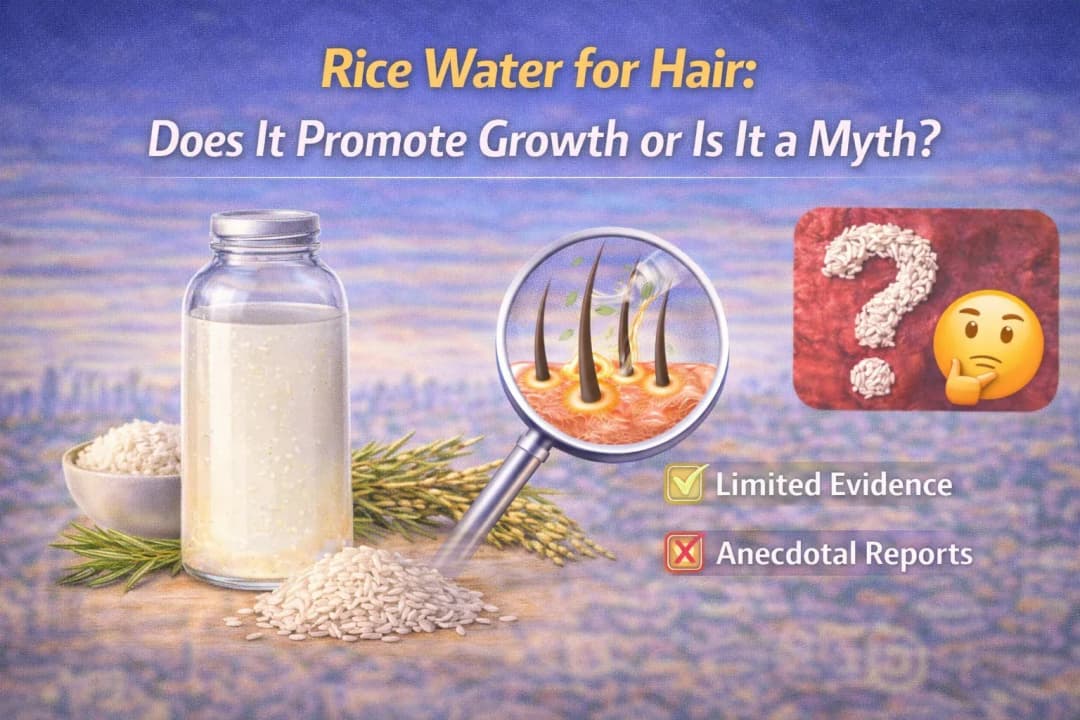
There is no strong clinical evidence that homemade rice water makes scalp follicles grow faster, increases hair density or reverses hair loss. Its more realistic role is as a temporary hair-shaft rinse that may improve smoothness or reduce friction for some people.
That distinction matters because less breakage can make hair look fuller or allow it to retain length, even when the follicle growth rate has not changed. Rice water may therefore improve appearance without creating new hair.
Current dermatology guidance describes the evidence as largely anecdotal and notes that hair growth is mainly determined by genetics, health, age and other biological factors. Starchy rice water may also dry or damage some hair, particularly fragile coiled hair.
Rice Water vs Rice-Bran Extract: Why the Difference Matters
| Product | What It Is | Evidence | What You Can Conclude |
|---|---|---|---|
| DIY rice water | Water left after soaking or boiling rice | Very limited direct hair-growth evidence | May affect hair feel; regrowth is unproven |
| Fermented rice water | Rice water left to ferment | No strong clinical growth evidence | Greater contamination and irritation uncertainty |
| Rice-bran extract | Concentrated, formulated rice-derived extract | Laboratory and limited clinical research | Cannot be used to prove DIY rice-water efficacy |
A 2022 systematic review examined rice-bran products, not ordinary kitchen rice water. It found a small evidence base and highlighted the need for better clinical studies. Laboratory studies of rice-bran mineral extracts also use standardised concentrations that are not reproduced by soaking rice at home.
This is a common evidence error: an ingredient or extract shows activity in cells, animals or a formulated product, and the result is then applied to a DIY rinse. The two exposures are not equivalent.
What Rice Water May Do to the Hair Shaft
Rice water contains starch and variable amounts of water-soluble rice compounds. The starch may coat the cuticle and change how fibres slide against one another. If that improves slip, detangling may require less force and breakage may fall.
However, a coating can also make hair rigid, dull or difficult to comb when residue accumulates. The outcome depends on rice type, preparation, dilution, hair porosity, chemical history and how thoroughly the hair is rinsed.
The current Kibo page attributed benefits to inositol and amino acids too confidently. These compounds are discussed in rice-derived research, but there is insufficient direct evidence to promise that homemade rice water penetrates every hair fibre, repairs it internally or produces predictable improvements.
For a clearer explanation of shaft damage, see hair breakage causes and treatments and hair elasticity and stress resistance.
Can Rice Water Cause Dryness or Breakage?
Yes. Starch residue can make some hair feel stiff, rough or dehydrated. When fibres lose flexibility or tangle more, combing force rises and breakage may increase.
Coily, bleached, relaxed, heat-damaged and highly porous hair may be more vulnerable because the shaft is already fragile. Current clinical guidance cautions that rice water may be harmful to coiled hair that breaks easily.
The popular phrase “protein overload” is not a complete explanation. Rice water composition is variable, and dryness may reflect starch, residue, low flexibility, overuse or inadequate conditioning rather than a single protein mechanism.
If the hair becomes rigid, squeaky, rough or harder to detangle, stop the rinse and return to a gentle shampoo and conditioner. Learn why friction matters in hair brushes, combs and scalp stress and wet-hair styling damage.
Is Fermented Rice Water Better?
There is no strong clinical evidence that fermented rice water grows hair better than a short-soak rinse. Fermentation changes acidity, odour and microbial content, but the final composition is uncontrolled in a home container.
A shorter soak is more practical because prolonged soaking can allow bacterial growth. Fermented mixtures may also sting an inflamed or scratched scalp.
People with dandruff, psoriasis, folliculitis, eczema or a damaged scalp barrier should not use a ferment as a substitute for diagnosis. Compare seborrhoeic dermatitis and scalp psoriasis versus dandruff.
How to Try Rice Water More Safely
- Use a short soak: rinse the rice, soak it in clean water and strain the liquid rather than fermenting it for days.
- Make a fresh, small batch: discard any mixture with a strong odour, visible contamination or uncertain storage.
- Patch test the scalp: apply a small amount and wait if you have sensitive skin or a history of contact dermatitis.
- Apply after shampooing: use it mainly on the lengths rather than rubbing it into an inflamed scalp.
- Keep contact brief: there is no evidence that longer exposure or overnight use improves growth.
- Rinse thoroughly and condition: remove residue and restore slip.
- Stop when texture worsens: stiffness, dryness, itching or extra breakage means the routine is not helping.
There is no clinically validated once-weekly or twice-weekly schedule. Start infrequently and judge tolerance. The goal is easier handling, not a fixed calendar.
Rice Water for Different Hair Types
| Hair Type or Condition | Possible Response | Main Caution |
|---|---|---|
| Healthy, untreated hair | Temporary smoothness or no visible change | Residue and stiffness |
| Curly or coily hair | May improve slip for some users | Dryness and breakage if rigidity increases |
| Bleached or chemically treated | May temporarily coat porous areas | Already weakened fibres may snap |
| Oily or inflamed scalp | No proven therapeutic benefit | Residue and irritation |
| Pattern hair loss | No proven follicle regrowth | Delaying effective diagnosis |
Rice Water vs Proven Hair-Loss Treatments
Rice water is a cosmetic rinse. It should not be compared as an equal alternative to medicines or procedures studied for diagnosed hair-loss conditions.
| Option | Primary Target | Evidence Position |
|---|---|---|
| Rice water | Hair-shaft feel and breakage | Limited and mainly indirect |
| Minoxidil | Suitable forms of pattern hair loss | Established clinical evidence |
| Finasteride | DHT-mediated hair loss in appropriate patients | Prescription treatment with known benefits and risks |
| PRP or GFC | Adjunctive treatment in selected cases | Variable protocols and evidence |
Review minoxidil versus Redensyl, DHT-blocker side-effect research and GFC versus PRP before treating these options as interchangeable.
Can Rice Water Stop Hair Fall?
It may reduce broken pieces if it improves detangling for your hair. It cannot stop shedding caused by fever, childbirth, thyroid disease, iron deficiency, autoimmune disease or follicular miniaturisation.
Short fragments of different lengths suggest breakage. Full-length hairs with a club-shaped bulb may reflect shedding. A widening part, crown thinning or receding hairline points toward a follicular problem rather than a cosmetic-rinse problem.
Compare the hair-growth cycle and mechanical shedding, telogen effluvium and iron deficiency and hair thinning.
When Rice Water Is Not Appropriate
- An inflamed, painful, scratched or infected scalp
- Active eczema, psoriasis or severe dandruff
- Hair that becomes rigid, rough or difficult to detangle
- Patchy loss, progressive recession or widening of the part
- Persistent shedding after illness, childbirth or major stress
Medical warning signs need assessment rather than another DIY treatment. The guide to trichologist versus dermatologist explains why sudden, patchy or inflammatory loss should be evaluated by a qualified doctor.
What This Means for You
Rice water is optional hair care, not proven hair-growth therapy. It may improve slip or reduce breakage in some people, while making other hair dry, stiff or more fragile.
Use a short-soak, fresh preparation only if the scalp is healthy. Keep contact brief, rinse well, condition and stop if the texture worsens. Do not delay diagnosis for a receding hairline, widening part, patches or persistent shedding.
Need to know whether your hair fall is breakage or follicular loss?
Frequently Asked Questions
Does rice water actually make hair grow faster?
There is no strong clinical evidence that homemade rice water accelerates follicle growth or reverses hair loss. It may improve the feel of the hair shaft or reduce breakage in some people.
Can rice water regrow a receding hairline?
No. A receding hairline usually reflects follicular miniaturisation or another medical cause. Rice water cannot recreate lost follicles or reverse established androgenetic alopecia.
Is rice water good for damaged hair?
It may temporarily coat the shaft and improve smoothness, but results vary. Starch can also make some hair feel dry, stiff or brittle, especially when used too often.
Is fermented rice water better than soaked rice water?
Fermentation is not proven to improve hair growth and may increase odour, acidity and contamination risk. A short soak is simpler and easier to control.
Can rice water cause hair breakage?
Yes. If it leaves the hair dry, rigid or difficult to detangle, breakage can increase. Coily, bleached, chemically treated and already fragile hair may be more vulnerable.
How often should rice water be used?
There is no clinically established schedule. Start infrequently, rinse thoroughly and stop if dryness, stiffness, itching or breakage develops.
Should rice water be left on overnight?
No clear evidence supports overnight use. Longer contact may increase residue, stiffness, irritation or contamination without proving greater benefit.
Does rice water contain protein?
Rice water may contain small amounts of amino acids and rice-derived material, but calling every adverse effect protein overload is an oversimplification. Starch and residue may also affect texture.
Can rice water help dandruff?
Rice water is not an established dandruff treatment. Persistent flaking or itching may need an antifungal or other medicated shampoo based on the diagnosis.
When should I see a dermatologist instead of using rice water?
Seek assessment for a widening part, receding hairline, patches, scalp pain, inflammation, scarring or persistent full-length shedding.
Want a diagnosis-led plan instead of another DIY remedy?
Why Kibo Clinics
Kibo Clinics distinguishes hair-shaft breakage from shedding and progressive follicular hair loss before discussing treatment. Assessment considers the pattern, scalp findings, timeline, styling history and whether trichoscopy or targeted tests are needed.
The doctor who conducts your consultation is the same doctor who handles your treatment through every stage.
Medical Disclaimer
This article is for educational purposes only. Homemade rice water is not a proven treatment for androgenetic alopecia, alopecia areata, telogen effluvium or scalp disease. Preparation, contamination risk, hair response and scalp tolerance vary.
Sources referenced: Hashemi K et al., “A Systematic Review: Application of Rice Products for Hair Growth,” 2022; Cleveland Clinic, “Could Rice Water Be the Secret to Healthier Hair?”, 2024; University of Minnesota Medical School, “Does Rice Water Help With Hair Growth?”, 2024; Kim YM et al., rice-bran mineral extract and dermal-papilla research, 2017; Chithambharan A et al., review of conventional and scientific uses of rice-washed water, 2023.
For persistent shedding, thinning or scalp symptoms, consult a Board Certified Doctor at Kibo Clinics.
Explore Kibo Clinic Services
Hair Transplant: FUE Hair Transplant | Sapphire FUE | Direct Hair Transplant | Bio FUE | Real Time FUE | Corrective Hair Transplant | Hairline Correction | Unshaven Hair Transplant | Body Hair Transplant
Non-Surgical: PRP Therapy | GFC Therapy | Mesotherapy | Microneedling | Low-Level Laser Therapy | IV Hair Boosters | PDO Threads | Exosome Therapy
Explore More
DIY and Natural Remedies: Rosemary Oil for Hair Growth | Saw Palmetto for Hair Loss | DIY Hair Mask Risks | Biotin Supplements and Hair
Hair Shaft Protection: Silk Pillowcases and Hair | Straighteners and Curling Irons | Hair Dryer Heat Safety | Night-Time Hair Care
Scalp and Diagnosis: Scalp Detox and Product Buildup | Oily Scalp and Hair Fall | Blood Tests for Hair Fall | Hair Loss in Women
Treatment and Restoration: Non-Surgical Treatment Comparison | FUE Hair Transplant Guide | Hair Transplant Cost in India | Is a Hair Transplant Worth It?