
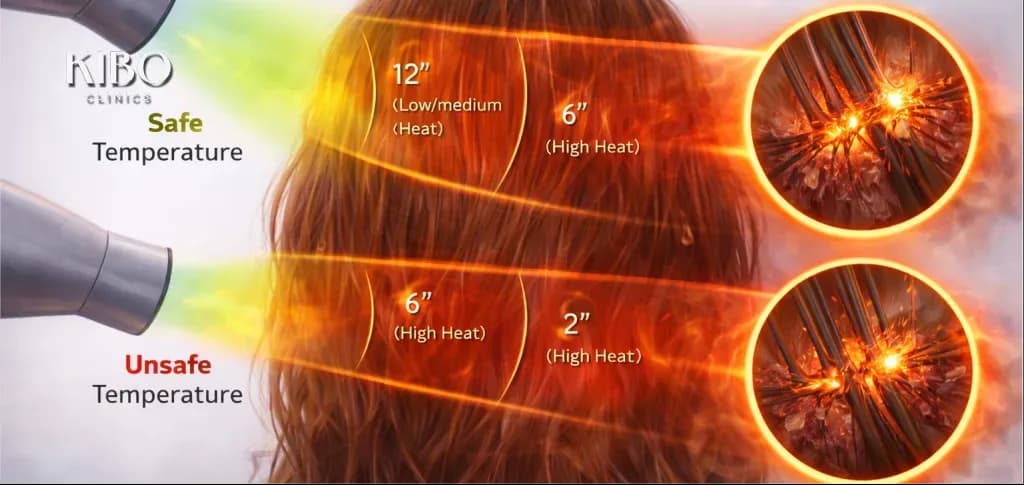
Hair dryer heat usually damages the visible hair shaft before it damages the follicle. Your follicle sits deeper in the scalp, while the dryer mainly reaches the cuticle, cortex, scalp surface, and natural oil layer. The real risk is breakage that looks like thinning, dry or itchy scalp, and, rarely, a scalp burn from very close high heat. The safest routine is simple: towel-dry first, keep the dryer 15 to 20 cm away, use low or medium heat, keep the airflow moving, and stop if the scalp feels hot or painful.
Reviewed By: Shritej Mali
Written By: Kibo Clinics Content Team
Sources Referenced: American Academy of Dermatology, NCBI Bookshelf, Annals of Dermatology, PubMed Central, Cell Stress and Chaperones
Last Updated: April 2026
Reading Time: 19 minutes
Who This Is For: People worried about hair dryer temperature, scalp burning, dry scalp, heat damage, breakage that looks like hair fall, or whether blow drying can damage follicles.
This article is educational and does not replace a scalp examination or treatment plan from a qualified dermatologist or hair restoration doctor.
Can a Hair Dryer Damage Hair Follicles?
The honest answer is reassuring: normal hair dryer use is unlikely to damage hair follicles directly. The follicle is not sitting on top of your scalp where hot air first lands. It is housed inside the skin and surrounded by tissue, blood vessels, oil glands, and other structures that buffer short bursts of surface heat. Most everyday dryer damage happens to the visible hair fiber, not the living follicle that produces the hair.
This matters because many people blame their dryer when their hair starts looking thin. Sometimes the dryer is involved, but not in the way they think. Heat can roughen the cuticle, dry the shaft, and make strands snap, especially around the hairline, crown, and areas pulled by brushes. That breakage can make hair look less dense even when the follicle is still producing hair. For the bigger hair-cycle picture, compare this with hair growth cycle explained and the breakdown of hair growth stages.
Permanent follicle injury is a different situation. That usually requires a true burn, scarring inflammation, or a medical hair loss condition. A hot dryer held very close to the scalp can cause discomfort, redness, and sometimes a superficial burn, but routine blow drying at a safe distance is not the same as burning the follicle. The article should therefore avoid the scary message that all blow drying causes baldness, and instead teach the safer, more accurate distinction between heat-damaged hair shafts and follicle-based hair loss.
What Hair Dryer Heat Actually Touches
Hair dryer heat first reaches the outer hair shaft, then the scalp surface. The hair shaft is dead keratinized tissue, so it cannot heal biologically after damage the way skin can. The follicle, on the other hand, is a living mini-organ in the skin that produces the hair. This is why a damaged hair shaft can feel rough, frizzy, brittle, or uneven, while a damaged follicle changes growth, shedding, density, or patch patterns.
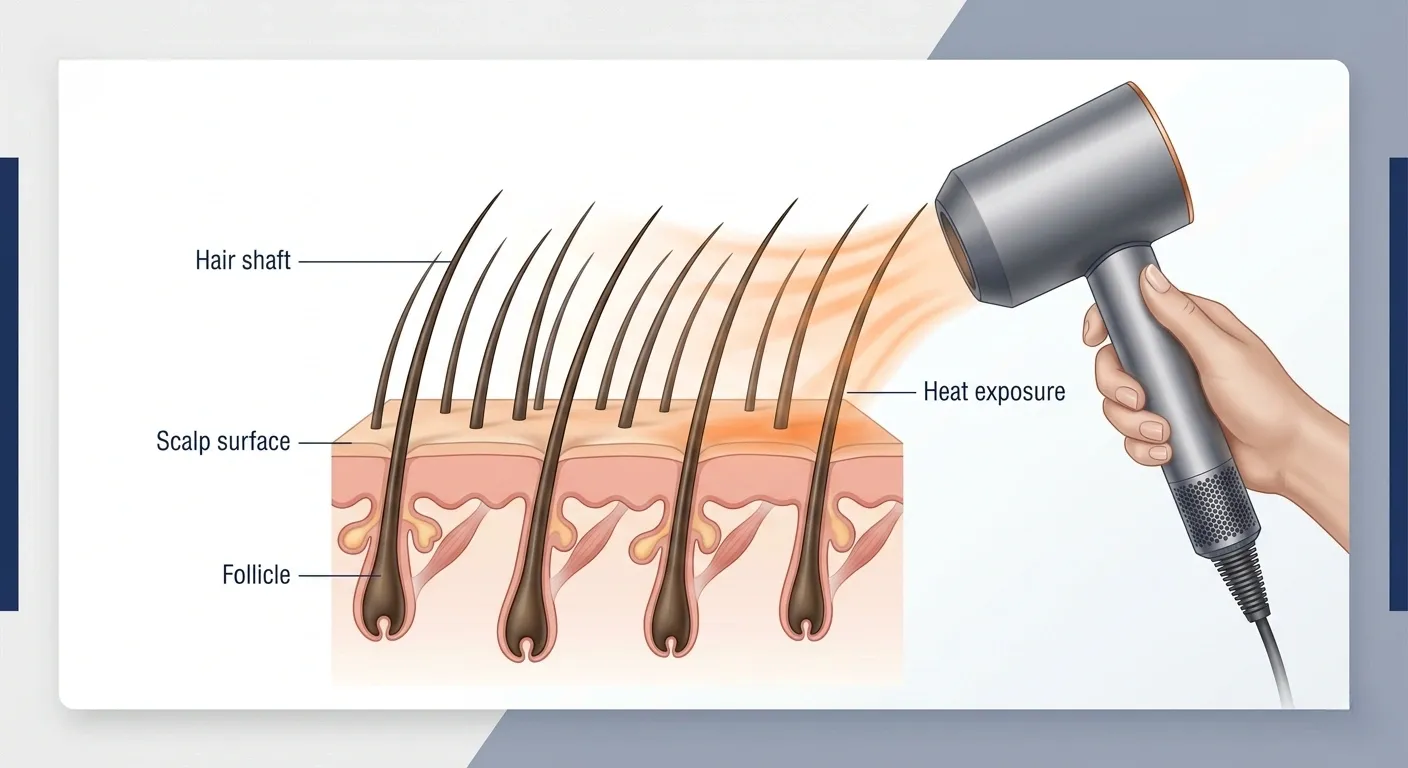
According to NCBI Bookshelf, the hair shaft includes a cortex, surrounding cuticle cells, and sometimes a central medulla in thicker hair. The cuticle is the outer protective layer. Heat, friction, chemical processing, and rough brushing can lift or chip the cuticle. Once that outer layer is compromised, the strand loses smoothness and strength, which creates breakage that patients often mistake for root shedding.
This is why hair density and the hair growth cycle should be read differently from styling damage. Density loss from the follicle means the scalp is producing fewer visible hairs or thinner replacement hairs. Heat breakage means the hair is present, but the shaft breaks before it can contribute length and coverage. Both can make the scalp look sparse, but they need different solutions.
| Structure | Where It Is | What Heat Can Do | What You Notice |
|---|---|---|---|
| Cuticle | Outer surface of the visible strand | Lifting, roughness, chipping, loss of shine | Frizz, dullness, tangling, rough texture |
| Cortex | Inner bulk of the shaft | Weaker structure when moisture and bonds are stressed | Breakage, poor elasticity, limp hair |
| Scalp surface | Skin and oil layer on top of scalp | Dryness, tightness, redness, irritation if overheated | Itching, flakes, sensitivity, discomfort |
| Follicle | Living structure inside the skin | Usually protected from normal dryer heat | Concern only with burns, inflammation, or real hair loss conditions |
What the Hair Dryer Temperature Study Actually Found
The key research behind many hair dryer safety discussions is Lee et al., published in Annals of Dermatology in 2011. The study compared natural drying with several hair dryer temperatures and distances. Its important conclusion was not that all blow drying is harmless. It found that hair dryers can create more surface damage than natural drying, but drying from 15 cm away with continuous motion caused less overall damage than some other methods because the hair did not stay wet for too long.
This is where many articles oversimplify the science. Wet hair is more vulnerable because water enters the fiber and changes its swelling behavior. High heat is also damaging because it stresses the cuticle and surface. The safest practical compromise is not dripping-wet high heat and not aggressive towel friction. It is gentle towel drying, partial air drying, moderate heat, distance, and movement. This is also why wet hair styling and root vulnerability deserves attention in the same routine.
The study also gives a practical way to understand questions like “how hot does a hair dryer get?” and “what hair dryer temperature range is safer for hair?” The temperature your hair experiences is not just the machine temperature. It depends on distance, movement, nozzle design, airflow, drying time, wetness, and hair thickness. A hot dryer touching one spot is very different from warm air moving continuously 15 to 20 cm away.
| Distance From Dryer Nozzle | Approximate Surface Temperature Reported | Practical Risk | What to Do |
|---|---|---|---|
| 5 cm | About 95°C in the study setup | High cuticle stress and greater surface damage risk | Too close for routine drying |
| 10 cm | About 61°C in the study setup | Moderate risk if held still or used often | Use only briefly and keep moving |
| 15 cm | About 47°C in the study setup | Lower risk when airflow moves continuously | Best practical minimum distance |
| 20 cm | About 40°C in the study setup | Very low heat stress for most users | Good for sensitive scalps and fine hair |
Worried that your hair thinning is more than heat damage? Get a diagnosis before changing treatments.
How Hot Does a Hair Dryer Get in Real Life?
The exact temperature of a hair dryer depends on the model, setting, airflow, nozzle attachment, distance, room temperature, and how long it is aimed at the same area. Searchers often want a single number, but that number can mislead them. A dryer can feel safe at one distance and damaging at another. A high-heat setting used for 10 seconds in motion is not the same as high heat pressed close to one hairline section for several minutes.
For practical hair safety, distance and movement matter more than the maximum machine rating. If the dryer is held close enough that the scalp stings, feels sharp, or stays red afterward, the setting is too aggressive even if the tool label sounds normal. If the dryer is 15 to 20 cm away, moving constantly, and used after the hair has been blotted first, the heat reaching the hair surface is much lower and less concentrated.
Hair type changes the risk. Fine, bleached, chemically treated, curly, aging, or already brittle hair can break more easily than thick untreated hair. A person with fragile strands should also think about hair elasticity and stress resistance, because the real cosmetic problem is often that strands lose stretch and snap before reaching full length. People with dense or coarse hair may tolerate drying better, but longer drying time can still create cumulative surface damage if the technique is harsh.
Heat Damage vs Hair Loss: Why They Look Similar
Heat damage and hair loss can both make hair look thinner, but they are not the same problem. Heat damage usually affects the shaft. Hair loss usually starts at the follicle or growth cycle. A person with shaft breakage may see many short pieces near the parting, front hairline, or ends. A person with true shedding may see full-length hairs with a small club-like bulb at one end.
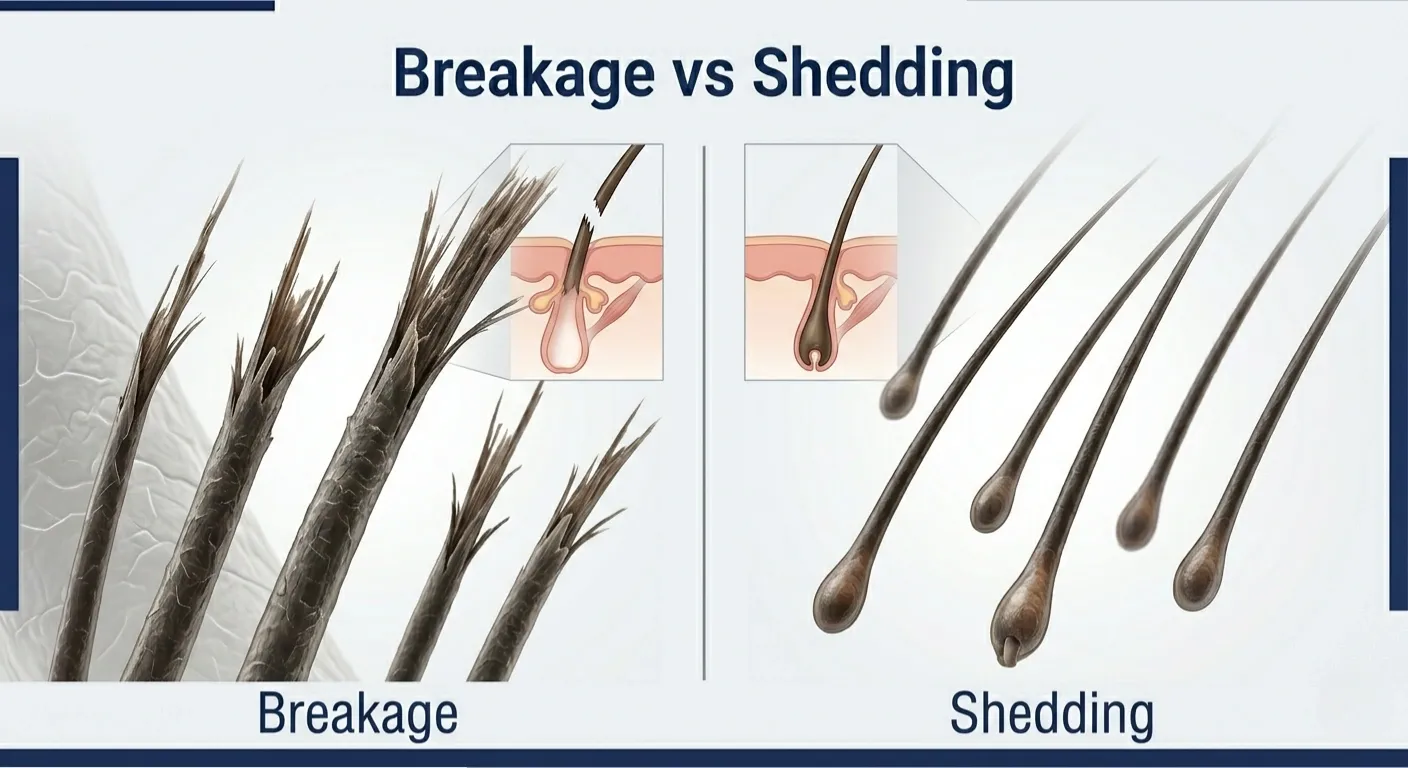
Breakage becomes especially confusing near the front hairline because the short broken hairs can look like regrowth or thinning. If the hair has been repeatedly pulled over a round brush while hot air hits the same area, the front pieces can snap and create flyaways. This is different from progressive recession, which should be evaluated in relation to androgenetic alopecia explained and DHT hormone and hair loss.
Another clue is pattern. Heat damage follows styling habits. It may be worse on the side where the dryer is held longer, around face-framing pieces, or on highlighted ends. Follicle hair loss follows biological patterns: diffuse shedding after stress, crown or part widening, temple recession, patchy loss, or thinning linked with hormonal shifts. When the pattern is unclear, it is safer to examine the scalp than to keep changing products.
| What You See | More Likely Heat Damage | More Likely Hair Loss | Next Step |
|---|---|---|---|
| Hair on pillow or drain | Short uneven broken pieces | Full-length hairs with club ends | Check length and root end of shed hair |
| Texture | Dry, rough, frizzy, tangly, dull | Texture may be normal but density reduces | Compare strand feel and scalp visibility |
| Location | Ends, face-framing pieces, brushed sections | Crown, temples, widening part, diffuse scalp | Track pattern monthly |
| Response to routine change | Less breakage after gentler heat habits | Continued shedding or progressive thinning | Review if no improvement in 8 to 12 weeks |
Can Hair Dryer Heat Cause Dry Scalp, Itching, or Flaking?
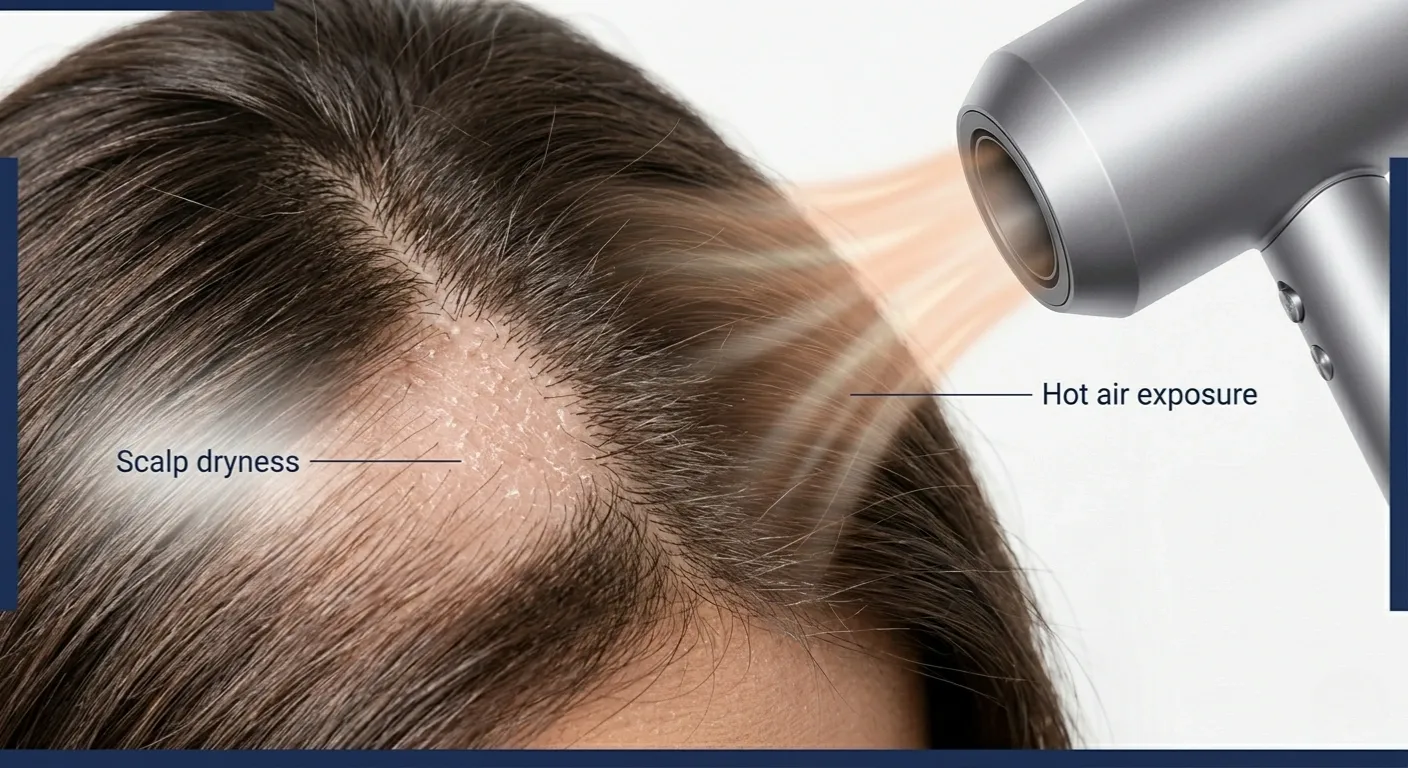
Yes, hot air can worsen scalp dryness in some people, especially if the dryer is close, the setting is high, or the person already has a sensitive scalp. The scalp surface has a barrier and natural oil layer. Repeated heat, harsh shampooing, hard water, and rough towel friction can make that barrier feel tight or irritated. This does not automatically mean follicle damage, but an irritated scalp can make hair fall anxiety worse because itching and flakes draw attention to the area.
If dandruff, greasy flakes, redness, or recurrent itching are present, the problem may not be heat alone. Conditions like dandruff, seborrheic dermatitis, or scalp psoriasis can flare independently of dryer habits. That is why related guides such as does dandruff cause hair loss, seborrheic dermatitis and scalp flaking, and scalp psoriasis versus dandruff matter for this topic. Treating scalp inflammation often improves comfort and reduces scratching-related breakage.
People also confuse dryness with hair fall triggers. A dry scalp may flake and itch, but it does not explain every pattern of thinning. If you are shedding full-length hairs or your part is widening, the dryer may be a background aggravator, not the root cause. In those cases, the question shifts from “which heat setting is safest?” to “what is causing the shedding or miniaturization?”
The Safe Blow-Drying Routine Dermatologists Usually Prefer
The goal is not to ban hair dryers. The goal is controlled drying. According to the American Academy of Dermatology, excessive heat can damage hair, and decreasing the number of times per week you blow dry helps limit damage. AAD also advises allowing hair to partially air dry before styling or combing, because wet hair can break more easily. The routine below combines those principles with the 15 cm continuous-motion lesson from the hair dryer study.
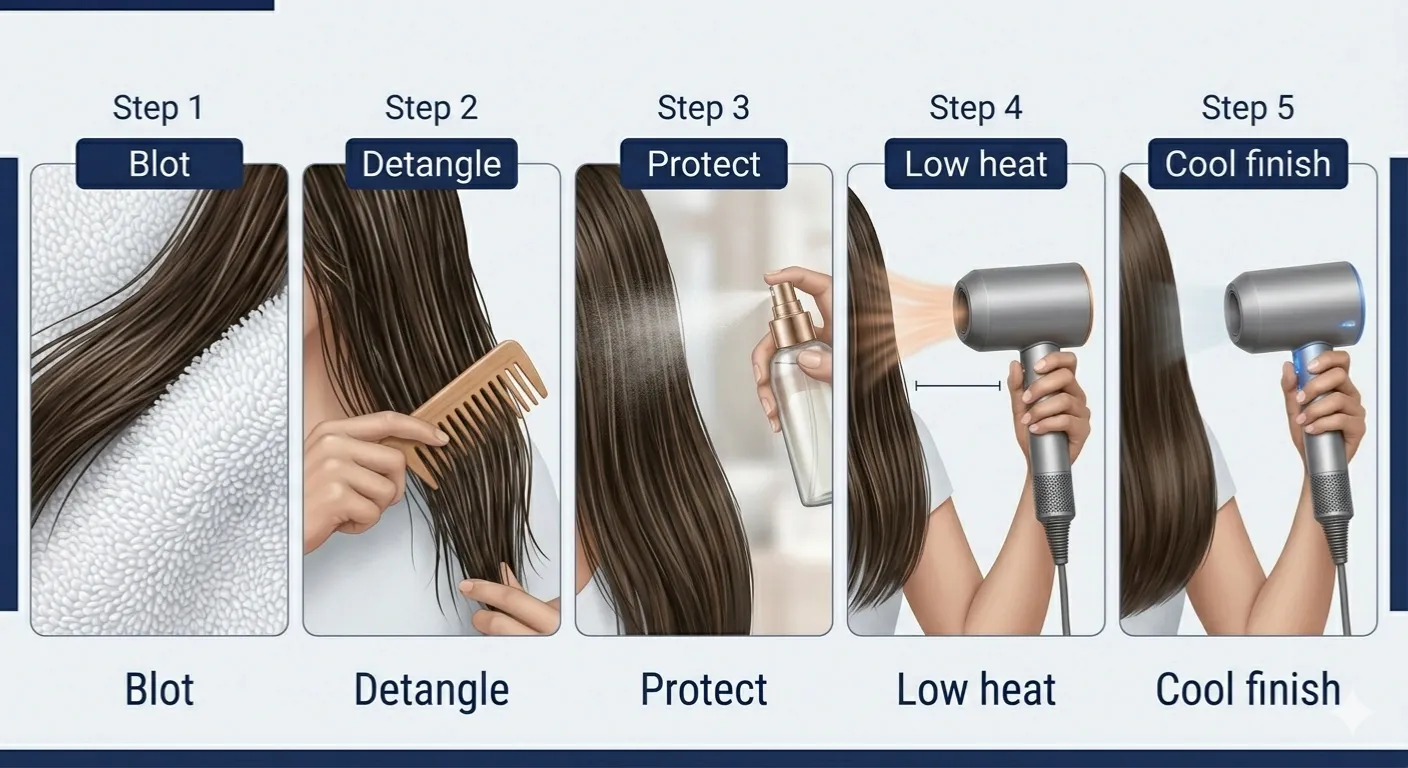
Step 1: Blot first, do not rub aggressively
After washing, press water out with a soft towel or microfiber towel. Do not scrub the hair in circles. Rubbing raises friction while the cuticle is swollen with water, and this is where breakage starts. If you already have fragile strands, this is just as important as the dryer setting.
Step 2: Let hair reach damp, not dripping
Start drying when the hair is damp rather than dripping wet. This reduces total drying time and reduces the temptation to use high heat for speed. For curly or textured hair, keep enough moisture to style gently, but do not blast soaking wet hair with maximum heat at close range.
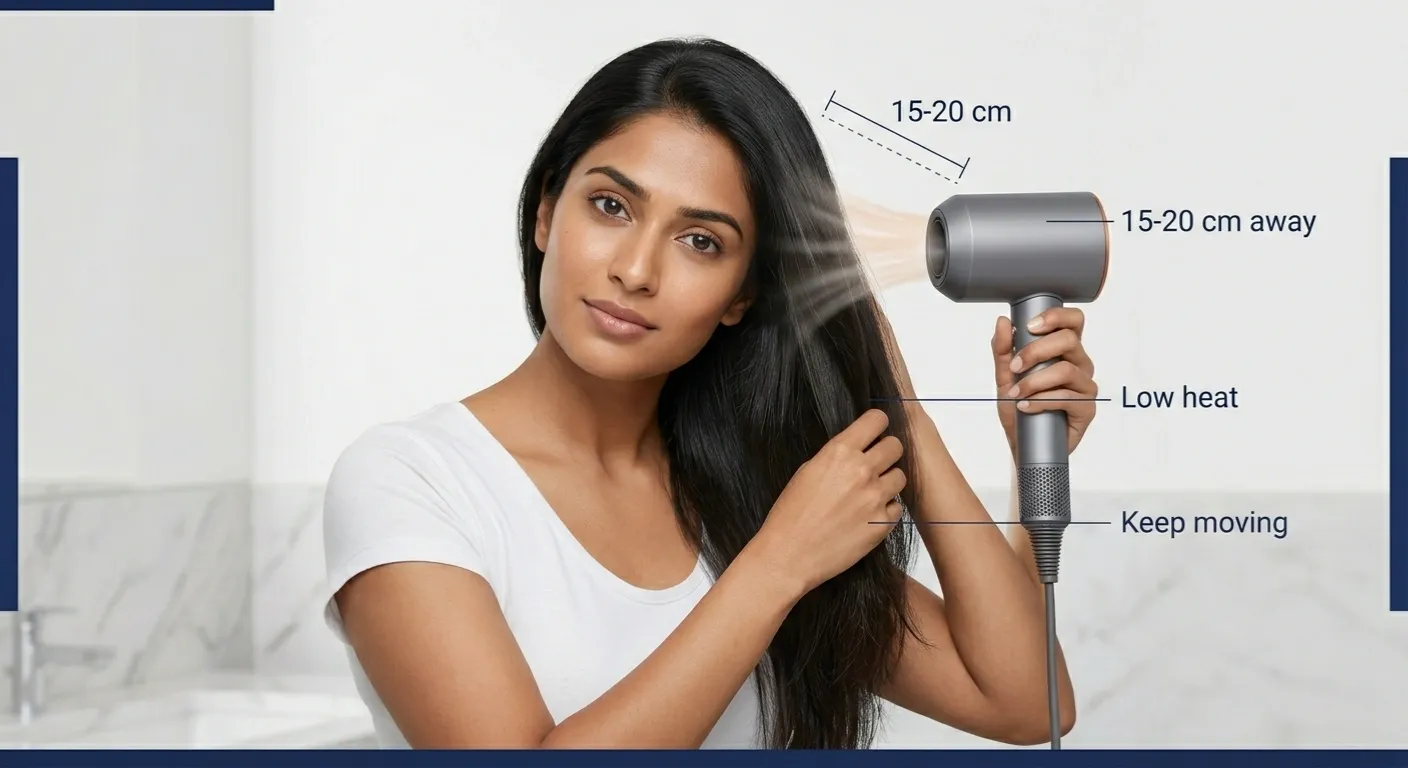
Step 3: Keep 15 to 20 cm distance
Use a palm-width distance from the scalp and hair shaft. The study data makes this one of the most practical rules because surface temperature drops sharply as distance increases. A narrow concentrator nozzle can be useful for styling, but it should not be pressed onto the scalp, brush, or hairline.
Step 4: Use low or medium heat with constant movement
Move the dryer continuously. Do not hold one hot stream over the same part, crown, or hairline. Fine hair, highlighted hair, older hair, and chemically treated hair should usually stay on lower settings. Thick hair may need more airflow, but airflow is not the same as maximum heat.
Step 5: Finish before hair feels crispy
Over-drying makes hair rough, dull, and more likely to snap. Stop when the hair is dry enough to style, not when it feels hot and bone-dry. A cool air finish can make the scalp more comfortable and help the hair feel smoother, although it does not reverse existing damage.
People who style daily should also review mechanical stress from tools. Drying technique is one part of a wider routine that includes hair brushes, combs, and scalp stress, round brush versus flat brush hair roots, and repeated pulling around the hairline. Heat plus tension is usually more damaging than gentle warm airflow alone.
Who Should Be Extra Careful With Hair Dryer Heat?
Some people can use a dryer often without obvious problems. Others develop breakage quickly because their hair fiber is already fragile. Bleached hair, chemically straightened hair, high-porosity hair, fine hair, aging hair, postpartum regrowth, and curly hair that tangles easily all need more caution. The same applies if the scalp already burns, flakes, or becomes red after drying.
People with recent shedding should also be careful, not because the dryer caused the shedding, but because the remaining hair mass may look thinner if more strands break. Telogen shedding, iron deficiency, thyroid changes, postpartum shifts, medications, and pattern hair loss can all reduce density. Heat then adds a second visual problem by breaking shafts that are still growing. This is why persistent shedding belongs in a diagnostic pathway such as blood tests for hair fall and telogen effluvium explained.
People with low scalp tolerance should pay attention to symptoms, not just temperature numbers. If the scalp feels hot, itchy, sore, or tight after blow drying, reduce heat, increase distance, change shampoo frequency, and avoid styling products that require combing through stiff hair. Guides on scalp sensitivity and hair pull tolerance and scalp oil and hair friction can help separate scalp barrier discomfort from follicle disease.
Can Heat-Damaged Hair Be Repaired?
Heat-damaged hair can be improved cosmetically, but the damaged portion of the hair shaft cannot biologically heal back to its original structure. The visible shaft is not living tissue. Conditioners, bond-supporting products, masks, and leave-in treatments may reduce friction, improve feel, and make the cuticle lie smoother temporarily. They can make hair look and behave better, but they do not turn a cracked shaft into an undamaged one.
That is why prevention is more important than rescue. Once a strand has split, split ends can travel upward and create more breakage. Trimming damaged ends, reducing heat frequency, using lower settings, and avoiding aggressive brushing help preserve the new hair that grows from the follicle. If your hair looks short and thin because it keeps breaking, the improvement timeline depends on growth rate and how much damaged length n...
Medical Disclaimer : Information from Kibo Hair Clinics is for educational purposes only. It does not replace diagnosis, trichoscopy, blood test interpretation, prescription treatment, procedure advice, or side-effect counselling from a qualified dermatologist or hair restoration doctor.