
Best Silk Pillowcases for Hair Health: Do They Really Work?
Published on Mon May 11 2026
Article Information
Reviewed By: Shritej Mali
Written By: Kibo Clinics Content Team
Sources Referenced: American Academy of Dermatology guidance on shedding and hair loss, textile testing on silk and friction, dermatology guidance on breakage and scalp evaluation
Last Updated: May 2026
Reading Time: 20 minutes
Who This Is For: Anyone with frizz, tangles, breakage, hairline stress, chemically treated hair, or confusion about whether silk pillowcases can help hair fall
This article is for education only. Silk pillowcases may reduce mechanical hair damage, but they do not treat genetic, hormonal, nutritional, or scalp-related hair loss.
Not sure whether your hair issue is breakage or root-level hair loss? A scalp assessment can help you identify the actual cause.
Does a Silk Pillowcase Help Your Hair? The Direct Answer
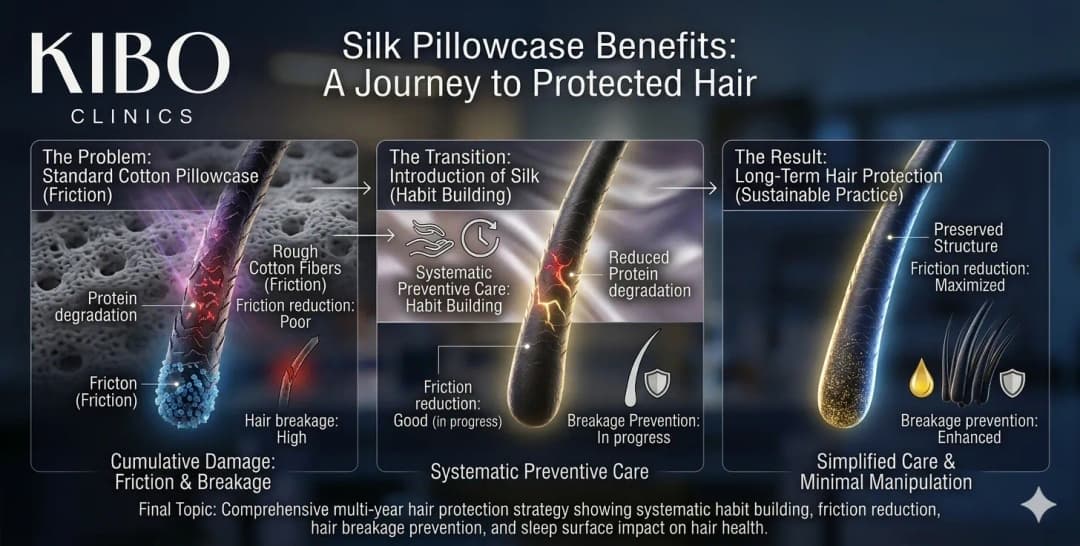
A silk pillowcase reduces overnight friction on your hair shaft. It does not treat hair loss. That distinction matters.
Natural mulberry silk has a smoother surface than cotton or synthetic fabrics. Less surface friction means the outer cuticle layer of each hair strand lifts less during sleep. The result is fewer tangles, reduced mechanical breakage, and less overnight moisture loss, particularly for long, curly, or chemically treated hair.
What silk cannot do: it cannot reverse androgenetic alopecia, correct a hormone imbalance, fix an iron deficiency, or stop follicle miniaturisation. If you are losing hair from the roots, a pillowcase will not change that outcome.
One-line definition: A silk pillowcase is a natural-fibre sleep surface that lowers hair-shaft friction compared to rougher cotton weaves, reducing mechanical breakage, but it has no effect on the biological causes of hair loss.
Key facts at a glance:
- Works best for: Breakage, frizz, split ends, overnight tangles
- Does not work for: Genetic baldness, hormonal shedding, scalp disorders
- Minimum quality: 19 to 25 momme, 100% mulberry silk
- Time to first result: 1 to 2 weeks for smoother texture, 4 to 6 weeks for visible breakage reduction
- Who benefits most: Long hair, curly hair, chemically treated or colour-treated hair
The Best Silk Pillowcases for Hair Health: Do They Really Work?
You wake up, touch your hair, and feel frizz, knots, or unexpected strands on the pillow. If cotton pillowcases leave your hair dry and tangled, silk pillowcases may reduce friction and moisture loss, but they are not a cure for hair fall. They support hair health, but results depend on scalp condition and overall care.
Many people switch to silk hoping for shinier hair and less breakage. Social media often presents it as a simple fix for hair fall, thinning, and frizz. The truth is more balanced. Silk pillowcases can help reduce mechanical damage caused by friction during sleep. However, they cannot treat hormonal hair loss, nutritional deficiencies, or scalp disorders. Understanding how they work helps you decide if they are worth the investment.
A Small Change That Helped Meera Sleep Better
Meera, 32, from Mumbai, had long, slightly wavy hair. Every morning, she noticed frizz and broken strands near her hairline. She tied her hair loosely at night, but the rough cotton pillowcase still caused tangles.
Over months, she tried different serums and conditioners. The softness improved temporarily, but breakage continued. A friend suggested switching to a pure mulberry silk pillowcase with a higher momme count.
Within a few weeks, she noticed fewer knots in the morning and smoother texture. But her overall hair thinning did not change because that was linked to stress and iron deficiency. The pillowcase reduced friction damage, but it did not solve the cause.
This is a common pattern. Mechanical breakage can improve with better fabric and lower friction, while shedding from internal triggers may need a different approach. If hair is falling from the root, tests such as blood tests for hair fall, ferritin checks for iron deficiency hair thinning, and evaluation for stress-induced hair loss can be more useful than another cosmetic purchase.
How Do Silk Pillowcases Affect Hair Health?
Hair contact with fabric happens thousands of times each night as you move during sleep. The surface texture of that fabric determines how much damage accumulates.
Cotton fibres have a raised, textured weave that catches the hair cuticle, the outermost protective layer of every strand. Because the cuticle is made of overlapping scales, friction causes those scales to lift. Over time, lifted scales lead to dryness, split ends, and hair that snaps rather than bends.
Silk, by contrast, has a smooth protein surface that allows hair to glide rather than catch. That is why the difference is most visible in people with long, curly, or fragile hair.
What fabric cannot do is influence the follicle. Hair growth, thickness, and shedding rate are governed by DHT levels, thyroid hormones, blood supply to the scalp, and nutritional status. None of these internal factors are affected by what your hair rests on at night. If the concern is progressive thinning, it is important to understand hair loss types and symptoms before assuming the problem is only friction.
How a Silk Pillowcase Helps Your Hair: The Step-by-Step Mechanism
Hair damage during sleep follows a predictable chain. Understanding each step explains exactly why fabric choice matters, and where its limits are.
Step 1: Friction Lifts the Cuticle
Every time your head moves on a pillow, the hair shaft drags across the fabric surface. Cotton has micro-raised fibres that catch the hair cuticle. Repeated lifting weakens the cuticle because the scales that normally lie flat begin to fray and separate.
Step 2: A Damaged Cuticle Loses Moisture Faster
The cuticle acts as a seal. Once it is compromised, the hair's inner cortex loses water more easily overnight. This is why you wake up with dry, rough-feeling hair on a cotton pillow. It is not because cotton dries your hair out directly, but because the cuticle is no longer sealing moisture in.
Step 3: Silk Reduces Surface Drag
Mulberry silk has a tightly woven, smooth protein surface. Hair strands slide across it rather than catching. Less drag means the cuticle stays flatter.
Step 4: A Flatter Cuticle Means Less Breakage and More Shine
When the cuticle lies smooth, the hair strand is structurally stronger and light reflects off the surface more evenly. That is why many silk pillowcase users report shinier hair within the first week or two.
Where the mechanism stops: None of these steps reach the follicle. The hair bulb is located below the scalp surface and is governed by blood supply, DHT levels, thyroid hormones, and nutrient availability. Fabric surface properties cannot penetrate to this depth.
Does Thread Count or Momme Weight Matter?
Yes. The measurement system is different from cotton. Silk quality is measured in momme (mm), which reflects the weight and density of the woven fabric per square inch.
A 19 to 25 momme mulberry silk pillowcase is the functional range: smooth enough to protect the cuticle, dense enough to last through regular washing, and durable enough for everyday use. Below 16 momme, silk may feel soft initially but may not hold its smoothness as well over time.
Satin pillowcases are typically made from polyester weave. They reduce friction moderately but often retain more heat, lack silk's breathability, and degrade faster. Look for 100% mulberry silk and a stated momme count on the label before purchasing.
Silk vs Satin vs Bamboo Pillowcases: Which Is Best for Hair?
| Feature | Pure Mulberry Silk | Synthetic Satin | Bamboo / Viscose |
|---|---|---|---|
| Friction level | Very low, smooth protein fibre | Low, smooth weave but varies by brand | Low to medium depending on thread count |
| Moisture retention | High, naturally less absorbent than cotton | Medium, synthetic fibres vary | Medium, absorbs slightly more than silk |
| Breathability | Excellent natural thermoregulation | Poorer because synthetic fibres trap heat | Good, more breathable than polyester satin |
| Hair benefit | Best for cuticle protection, frizz, breakage | Reasonable for frizz reduction | Good for sensitive scalp, moderate hair protection |
| Ideal for | All hair types, especially curly, treated, long hair | Budget-conscious users with mild breakage concerns | Oily scalp types and eco-conscious buyers |
| Price range in India | Rs 1,500 to Rs 6,000+ | Rs 300 to Rs 1,200 | Rs 800 to Rs 2,500 |
| Quality marker | 19 to 25 momme | 300+ thread count for smoother weave | 300 to 500 thread count |
The honest verdict: if your primary concern is frizz, breakage, or maintaining a blowout overnight, pure mulberry silk in the 19 to 22 momme range is the most consistent choice. If budget is the barrier, a good synthetic satin pillowcase is a functional alternative. If you have an oily scalp and are concerned about heat, bamboo is a reasonable middle ground.
None of these will stop hair loss caused by genetics, hormones, or nutritional deficiency.
What the Research Says About Silk Pillowcases and Hair Breakage
Most content on silk pillowcases relies on anecdote. The useful science is less about a pillowcase being a treatment and more about basic fabric behaviour. Smoother surfaces create less friction. Less friction means less tugging on the hair shaft and less cuticle disruption over repeated contact.
Textile testing has shown that silk can create lower friction against hair than cotton. This supports the idea that silk may reduce friction-related frizz, tangling, and breakage. However, the claim that silk pillowcases reduce hair-shaft friction by one exact universal percentage is not strong enough to publish without a specific verified lab source, so this article avoids that number.
What research does not support is equally important. No peer-reviewed clinical study shows that silk pillowcases reduce androgenetic alopecia progression, slow follicle miniaturisation, or increase hair density. The mechanism simply does not reach the follicle. Marketing claims suggesting that silk regrows hair or stops hair loss should be treated carefully.
The important context: silk pillowcases can reduce a specific, mechanical type of hair damage. They are a supportive tool, not a medical treatment.
What Are the Real Benefits of Silk Pillowcases?
Silk pillowcases mainly help with hair shaft protection.
They Reduce Overnight Friction
This is helpful for people with curly, wavy, chemically treated, or fragile hair. Less friction means fewer opportunities for hair strands to catch, twist, and snap while sleeping.
They May Reduce Frizz
When the cuticle remains smoother, light reflects better, making hair look shinier. This is why people with dry or frizz-prone hair often notice a difference faster than those with short, straight hair.
They Can Help Maintain Hairstyles Longer
Blow-dried or straightened hair may stay smoother overnight because there is less drag against the hair shaft. If you use frequent heat styling, it is still important to limit damage from straighteners and curling irons and repeated salon blowouts.
They Help With Mechanical Breakage Near the Hairline
Silk can help if breakage is caused by repeated rubbing against cotton, especially around the hairline. But if breakage is mainly from tight ponytails, buns, headbands, or helmets, the daytime pulling has to be fixed too. This is where guides on traction alopecia, hair ties and scrunchies, and helmet-related hairline damage become relevant.
They Do Not Stop Genetic or Hormonal Hair Loss
Conditions like androgenetic alopecia, alopecia areata, telogen effluvium, postpartum shedding, and PCOS-related thinning require medical evaluation. A pillowcase can protect existing strands from extra surface damage, but it cannot treat the biological trigger. If thinning is visible at the crown or parting, read about male pattern baldness, postpartum hair loss, and PCOS hair thinning.
How Does Silk Pillowcase Use Show in Men and Women?
Men with short hair may notice less visible difference because shorter strands tangle less. However, men with medium to long hair or those growing their hair may benefit from reduced breakage.
Women with long, curly, or chemically treated hair often notice more visible changes. Reduced frizz and smoother texture are more obvious in longer hair.
In men with early male pattern baldness, silk will not slow down receding hairline progression. In women with postpartum shedding or PCOS-related hair thinning, silk may protect existing strands but does not treat the hormonal cause.
Who Benefits Most from a Silk Pillowcase for Hair, and Who Does Not?
| Most Likely to See a Difference | Unlikely to See Meaningful Difference |
|---|---|
| Long hair, shoulder length or below | Men with very short hair |
| Curly or coily hair | Male or female pattern baldness |
| Colour-treated, bleached, or permed hair | Postpartum shedding |
| Hair that tangles significantly overnight | Alopecia areata |
| People waking up with visible hairline breakage | PCOS-related hair thinning |
| Heat-styled hair | Scalp disorders like dandruff, seborrheic dermatitis, folliculitis |
| Naturally dry hair with fragile shaft | Nutritional deficiency causing shedding |
Permed, relaxed, and bleached hair has a structurally weakened cuticle because the chemical process lifts and disrupts cuticle scales. These hair types lose moisture faster and break more easily from friction. For this group, a silk pillowcase is one of the highest-return low-cost interventions available.
For everyone in the unlikely column, silk can reduce an additional layer of damage, but it will not be the thing that changes your hair trajectory. A proper diagnosis through scalp analysis, blood panel, or hormonal workup is the intervention that moves the needle.
What Daily Habits Make It Better or Worse?
Sleeping with wet hair increases breakage. Wet hair is more elastic and fragile. Even with silk, friction can damage wet strands.
Tying hair too tightly at night increases traction. This can stress follicles and lead to traction alopecia over time.
Not washing pillowcases regularly allows oil, sweat, and product buildup. This can irritate the scalp and worsen dandruff or acne. If flaking or itching is already present, understand the difference between scalp psoriasis and dandruff, seborrheic dermatitis, and scalp hygiene.
Using harsh shampoos strips natural oils. Even if you use silk, dry hair may still break if the scalp barrier is damaged. Helpful habits include loosely braiding long hair, ensuring hair is fully dry before sleep, using a mild cleanser, and washing pillowcases once or twice a week.
How to Buy a Silk Pillowcase for Hair: What to Look For
Not all silk pillowcases are equal. Knowing what to look for protects you from paying premium prices for a product that underdelivers.
1. Momme Weight
This measures silk density. Nineteen momme is the functional minimum. Twenty-two to twenty-five momme is the sweet spot for durability and hair protection. Below 16 momme, the silk is often too thin for long-term daily use. Above 30 momme, you are mostly paying for weight, not extra hair benefit.
2. Silk Type
Look for 100% mulberry silk. Mulberry silk produces uniform, fine filaments, which creates the smoothest surface for hair contact. Silk blend or satin silk usually means synthetic or mixed fabric.
3. Certification
OEKO-TEX Standard 100 certification means the fabric has been tested for harmful substances. This matters if you have a sensitive scalp or skin allergies.
4. Weave
Charmeuse weave is the most common for silk pillowcases and provides the smooth, hair-gliding surface. Habotai silk is lighter and less durable for daily use.
5. Closure Type
Envelope closures are better than zipper closures for hair. A zip can snag strands, particularly fine or colour-treated hair.
Is it worth it? A quality 22-momme mulberry silk pillowcase in India typically costs Rs 1,800 to Rs 3,500. For friction-related breakage, especially in long, curly, colour-treated, or naturally dry hair, the investment can be justified. For shedding from the root, spend first on medical evaluation.
What to Expect: A Realistic Results Timeline
| Time Period | What Typically Changes | What Does Not Change |
|---|---|---|
| Days 1 to 3 | Hair feels smoother on waking; fewer knots at the hairline | Hair density, shedding count, scalp condition |
| Week 1 to 2 | Morning frizz visibly reduced; styles hold better overnight | Root shedding, parting width, overall volume |
| Week 4 to 6 | Visible reduction in broken strands if friction was the main issue | Genetic or hormonal hair loss |
| Month 3+ | Hair shaft feels consistently stronger if paired with good conditioning | Regrowth from miniaturised follicles |
| 6 months+ | Cumulative reduction in mechanical damage | Reversal of alopecia without treatment |
If your hair is breaking primarily because of friction during sleep, you will likely see results within 4 to 6 weeks. If your hair is shedding from the root and shed strands have a small white bulb at the tip, silk will not change that timeline. That requires identifying the internal cause.
What Helps First?
Start by identifying your main concern.
If your problem is frizz and breakage, switch to a 19 to 25 momme pure mulberry silk pillowcase. Combine it with a mild shampoo and a lightweight conditioner.
If your issue is hair fall from the roots, get blood tests for iron, vitamin D, thyroid, and B12 levels. Address internal deficiencies first. You may also need to review vitamin D and hair follicles, biotin supplements for hair growth, and DHT blockers for hair loss depending on the diagnosis.
For dandruff or itchy scalp, treat the scalp condition before expecting cosmetic improvements.
Timeline expectations:
- 1 to 2 weeks: Reduced tangles and smoother morning texture
- 4 to 6 weeks: Less visible breakage if friction was the main cause
- No change in pattern hair loss without medical treatment
When to Meet a Hair Specialist
Hair shedding more than 100 to 150 strands daily for several weeks needs evaluation. Visible thinning at the crown or widening parting in women should not be ignored. Sudden patchy hair loss may indicate alopecia areata. Persistent itching, redness, or scaling may suggest fungal infection or dermatitis.
If breakage continues despite improved hair care, microscopic scalp analysis can help identify shaft disorders or follicle miniaturisation. Depending on the cause, clinical options may include PRP therapy, GFC therapy, mesotherapy, microneedling, IV hair boosters, or FUE hair transplant in suitable candidates.
Unsure whether your issue is breakage or active hair loss?
Common Myths About Silk Pillowcases
Myth 1: Silk Pillowcases Stop Hair Fall Completely
They reduce friction-related breakage but do not affect hormonal, nutritional, or genetic hair loss.
Myth 2: Satin and Silk Are the Same
Satin is a weave. Silk is a natural fibre. Synthetic satin may reduce friction, but it does not offer the same breathability as natural silk.
Myth 3: Higher Price Always Means Better Quality
Momme count and silk purity matter more than brand price.
Myth 4: Silk Works Instantly
You may notice smoother texture quickly, but structural improvement takes weeks.
Myth 5: Silk Can Regrow Lost Hair
Hair regrowth depends on active follicles and medical treatment, not fabric choice.
What This Means for You
If friction and mechanical breakage are behind your hair problems, switching to a 19 to 25 momme mulberry silk pillowcase is one of the most cost-effective changes you can make. Most people notice smoother mornings within one to two weeks.
If your hair is shedding from the roots, losing density at the crown, or thinning despite good hair care habits, the silk pillowcase has done its job by eliminating one variable. The remaining cause is likely internal, hormonal, genetic, nutritional, or scalp-related, and requires a different kind of attention.
Concrete next steps:
- Check your shed strands. If they have a white bulb at the root, the loss is follicular, not mechanical. Get a blood panel before buying more hair products.
- If breakage is the issue, choose a 22-momme 100% mulberry silk pillowcase with an envelope closure and wash it weekly.
- Pair the silk with fully drying your hair before sleep and loosely braiding long hair overnight.
- If you colour, perm, or heat-style regularly, add a weekly deep-conditioning mask. Silk protects what moisture is in the shaft, but it cannot replace moisture that was chemically removed.
- If hair fall has continued for more than 8 to 12 weeks without improvement, or if you see visible thinning at the parting or crown, a professional scalp assessment will identify what the pillowcase cannot fix.
A silk pillowcase is a smart starting point. But for hair that is actively thinning, it is rarely the ending point.
Why Kibo Clinics for Hair Health Concerns
When the silk pillowcase, better hydration, and improved sleep habits have not moved the needle on your hair, that is the signal that the cause is not mechanical.
At Kibo Clinics, the starting point is always a Kibo Hair Analysis: a comprehensive scalp and follicle assessment that identifies what is actually driving your hair changes. This includes microscopic follicle evaluation, scalp health review, and a structured conversation about your lifestyle, medical history, and timeline, because the cause of your hair loss determines the right response.
For patients who need clinical intervention, whether PRP therapy, IV hair boosters, or a hair transplant procedure, Kibo provides structured 12-month monitoring with progress tracking and scalp health evaluation at each stage. Our No Ghost Surgery pledge means the consulting surgeon personally performs your entire procedure: no delegation of critical steps to technicians.
We do not promise guaranteed outcomes or miracle timelines. What we offer is an honest assessment of where your hair is, what is causing it, and what realistic improvement looks like for your specific scalp and follicle profile.
If you are unsure whether your issue is simple breakage or early follicle thinning, a professional scalp assessment gives you that clarity before you invest further in treatments.
Frequently Asked Questions About Silk Pillowcases for Hair
Can a silk pillowcase cause hair loss or make shedding worse?
No. A silk pillowcase cannot cause hair loss, and it is unlikely to worsen shedding. The only theoretical risk is if a zipper closure snags fragile strands, or if infrequent washing allows product and oil buildup that irritates the scalp. Wash your pillowcase every 5 to 7 days in cool water with a gentle detergent. Natural shedding of 50 to 100 strands per day is normal regardless of pillowcase material.
Do silk pillowcases help after a hair transplant or PRP therapy?
Yes, with timing caveats. In the first 7 to 14 days after a hair transplant, surgeons typically advise sleeping in a specific elevated position on a travel pillow to avoid contact with the grafts. After the graft anchoring phase, switching to a silk pillowcase is a sensible step because it reduces friction on the new hair shafts and minimises trauma to the healing scalp. After PRP therapy, silk poses no risk and may reduce mechanical irritation on a scalp that is already slightly inflamed from micro-injections. Always confirm with your treating surgeon before changing any sleep habit post-procedure.
Is a silk pillowcase good for thinning hair at the crown?
It depends on the cause. Crown thinning in men and women is most commonly androgenetic alopecia, a hormonal and genetic condition. Silk will not slow this process because the cause is internal. However, if the crown area also shows breakage from tight hairstyles or mechanical stress, silk can reduce that secondary layer of damage. If crown thinning is progressing, a scalp analysis and medical evaluation are more productive than a fabric change.
How often should I wash a silk pillowcase to keep it effective for hair?
Wash it every 5 to 7 days. Oil, sweat, and hair product residue accumulate on the silk surface and can reduce its smoothness, partially defeating the friction-reduction benefit. Use cool water, a pH-neutral or silk-specific detergent, and air dry flat. Avoid wringing or machine-drying, both of which degrade the silk filaments and raise the surface texture over time.
Can silk pillowcases help with hairline breakage from tight hairstyles or headbands?
Partially. Silk reduces friction during sleep, which addresses one cause of hairline breakage. But if you regularly wear tight ponytails, buns, or headbands during the day, traction at the root is the primary problem. Silk at night cannot counteract repeated daytime pulling. Hairline breakage from traction requires loosening daytime styles, avoiding elastic bands with metal clasps, and allowing the hairline to rest.
Is silk better than a silk-blend or silk-feel pillowcase?
Yes. 100% mulberry silk is better than blended or silk-feel synthetics for hair. Silk-feel products are usually polyester microfibre. They may reduce friction somewhat, but they are more heat-retentive and less moisture-neutral than genuine silk. If the label does not say 100% mulberry silk and give a momme count, it is not pure silk.
Medical Disclaimer
This article is published by Kibo Clinics for informational purposes only and does not substitute personalised medical advice. Results from silk pillowcases vary depending on hair type, scalp condition, and underlying medical factors. Silk pillowcases do not treat genetic, hormonal, nutritional, or inflammatory hair loss. Always consult a qualified hair specialist for persistent shedding, thinning, or scalp disorders.
Sources Referenced: American Academy of Dermatology guidance on normal shedding and hair loss signs, textile testing showing lower friction between silk and hair than cotton, and dermatology guidance on hair-loss evaluation.
For a personal assessment, consult a Board Certified Doctor at Kibo Clinics. The doctor you meet in your consultation is the same doctor who handles your treatment through every stage.
Explore Kibo Clinic Services
Hair Transplant:
Direct Hair Transplant | Corrective Transplant | Hairline Correction | Bio FUE | Real Time FUE | Unshaven Transplant | Body Hair Transplant
Hair Regrowth:
Related Articles
Hair Breakage and Hair Care:
Hair Breakage Guide | Hair Myths Busted | Night-Time Hair Care | Minimalist Hair Care
Hair Loss Evaluation:
Trichologist vs Dermatologist | Dermatologist vs Trichologist | DHT Blocker Side Effects | Minoxidil vs Redensyl
Transplant and Treatment Guides:
Hair Transplant Guide | FUE Complete Guide | Results Timeline | PRP vs PRF