
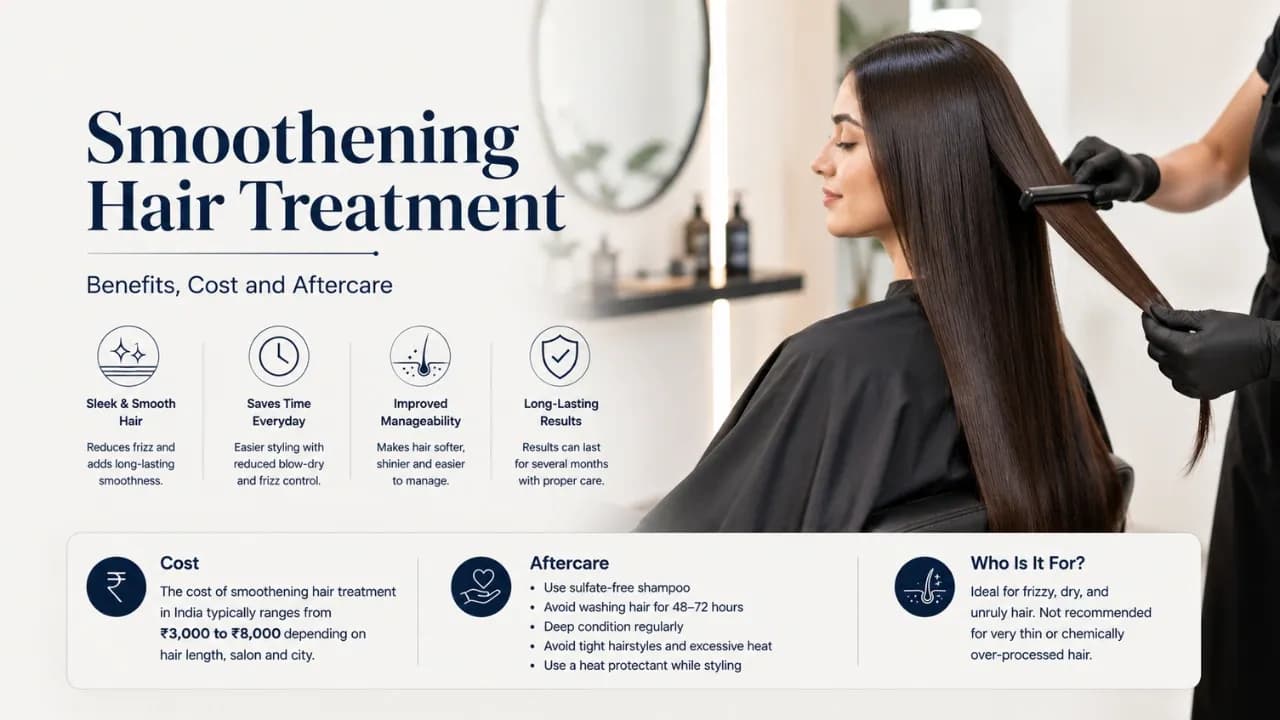
Who This Is For: Anyone thinking about a smoothening, keratin, or straightening service who wants to know what it really does, what to ask the salon, and how to tell hair damage from hair loss.
Smoothening may make the hair shaft look less frizzy and easier to style, but it does not treat hair loss at the follicle. Because "smoothening" can refer to different chemical systems, risk depends on the exact product, heat, processing, ventilation, previous damage, and scalp condition. Ask for the ingredient list and Safety Data Sheet (SDS), avoid home use, and stop if you develop burning, rash, breathing symptoms, or severe breakage.
What Does Smoothening Mean?
Smoothening is a category of salon services, not one standard treatment. Names such as keratin, Brazilian blowout, cysteine, rebonding, permanent straightening, and "organic" do not tell you which chemistry is in the bottle or how risky it is. Two services sold under the same name can use different formulas. The product label and its SDS, the safety document that manufacturers supply for hazardous ingredients, are what tell you what you are actually getting.
What Can It Change, and What Can It Not?
A smoothening service can change the feel, appearance, frizz, alignment, and shape of the hair shaft, for a time that depends on the product and your hair. It cannot create follicles, reverse androgenetic alopecia, cure telogen effluvium, or treat scalp disease. If your concern is thinning rather than texture, our overview of the types of hair loss is a better place to start than a salon menu.
Main Chemical Categories
At a high level, services fall into four groups. This is a guide to the vocabulary, not a safety ranking, because concentration, application, heat, exposure time, ventilation, and the condition of your hair all matter as much as the ingredient class.
| Category | What It Does, in Broad Terms | What to Know |
|---|---|---|
| Thioglycolate systems | Alter the disulfide bonds in the hair, usually followed by a neutralising step | A review reports one study in which ammonium thioglycolate straightening reduced tensile (pulling) strength in all hair types tested |
| Keratin, cysteine, or carbocysteine systems | Coat or bond into the hair, usually sealed with heat; some pair keratin with a formaldehyde derivative, others use ingredients such as glyoxyloyl carbocysteine | Often marketed as gentler, but a 2024 review says studies are still needed to compare hair damage and risk to the stylist |
| Acid-based systems (glyoxylic or glycolic acid) | Cross-link the hair using an acid and heat | Glycolic acid derivatives can release formaldehyde at high temperatures, and case reports and reviews have raised a kidney-injury concern for some formulations |
| Formaldehyde-related ingredients | Formaldehyde, formalin, and methylene glycol act as a fixative; heat can release formaldehyde gas | FDA says to look for these three names on the label |
Benefits, With Realistic Wording
Possible cosmetic effects include less frizz, a smoother feel, easier detangling, and hair that may look shinier. Results vary with the formula, your hair type, and how you style and wash afterwards, and none of this amounts to biological repair. Shine in particular can mislead. One review notes that studies have found shine after treatment alongside evidence of harm to the hair shaft, so a glossy result does not show that the fibre is unharmed.
Who Should Be Cautious?
Take extra care if your hair is bleached, highly porous, gummy, visibly breaking, repeatedly processed, or recently treated with another chemical. A review of the research found that using straighteners together with other hair treatments seems to increase vulnerability to damage. Caution is also sensible if you have scalp dermatitis, open sores, an allergy history, or sensitive airways. FDA says that people who are sensitive to formaldehyde should not use this type of product, and that some people react strongly to the same exposure that does nothing to others.
If you are pregnant, or a clinician has advised you to avoid chemical exposure, ask that clinician before booking. We cannot give a general answer, because it depends on the specific product and your circumstances. If your hair is already breaking, our guide to hair breakage explains what is happening, and it is usually worth sorting that out before adding another process.
Formaldehyde and Salon Safety
In some products formaldehyde appears under the names formalin or methylene glycol. FDA explains that when a solution containing it is heated, formaldehyde is released into the air as a gas. Its consumer update says that most hair smoothing or straightening products release formaldehyde gas during the process, and also says that not all of them contain it, which is why the label matters. Those statements describe products as FDA assessed them, and formulas differ by brand, country, and year, so we do not claim that any particular product contains it.
FDA lists reactions that people exposed to formaldehyde have described: irritation of the eyes, headaches and dizziness, a sore or scratchy throat, cough, wheezing, nausea, chest pain, vomiting, and rashes. It also notes that formaldehyde is classified as a known human carcinogen by the International Agency for Research on Cancer, and that the greater the exposure, in both time and concentration, the higher the potential health risk. If the salon is poorly ventilated, the stylist and everyone nearby can breathe it in as well.
A label saying "formaldehyde-free" is not proof. OSHA's background page records NIOSH test results in which a smoothing product labelled "Formaldehyde Free" contained 11% formaldehyde, and FDA found that it contained methylene glycol, the liquid form of formaldehyde. A 2014 study by Maneli and colleagues tested the seven Brazilian keratin type brands sold in South Africa in 2012. Six contained between 0.96% and 1.4% formaldehyde, roughly five times the level recommended by the US Cosmetic Ingredient Review panel, and five of those six were labelled formaldehyde-free. The study covered one market at one point in time and cannot be applied to every product sold today, and the OSHA case was likewise a single product. They show that a label alone is not enough, not that every product behaves this way.
FDA's advice is practical. Do not apply these products yourself at home. Go to a licensed, trained professional, read the ingredient list, and look for formaldehyde, formalin, or methylene glycol. Ask whether the product contains formaldehyde, ask to see the SDS, ask whether the salon is properly ventilated, and ask whether the stylist has been trained on this product. If you have a bad reaction, stop and tell a health professional. One more caveat is that these are US sources. FDA has had a rule to ban formaldehyde and formaldehyde-releasing chemicals in hair smoothing products on its regulatory agenda since 2023, and reporting in January 2026 said it had still not been proposed. We have not verified how these products are regulated in India, which is one more reason to read the label and the SDS yourself.
The acid-based group deserves a separate, measured word. A 2024 review describes growing concern about acute kidney injury linked to some formaldehyde-free straightening products containing glycolic acid derivatives, including glyoxylic acid, based on case reports, a case series, and animal data. That is a reason for caution and for seeking medical care if you feel systemically unwell after a service. It is not evidence that every acid-based product causes kidney injury.
Hair-Shaft Damage and "Hair Fall"
A review of twenty years of research found that chemical straightening can cause scalp inflammation, damage to the hair, and hair loss through breakage, and it states that the long-term effects are still unknown. Breakage and true shedding are different problems, and it helps to tell them apart.
| What You See | What It Usually Points To | What to Do |
|---|---|---|
| Shorter pieces, split ends, rough or snapping hair, reduced length | Breakage of the hair shaft | Cut back on heat and overlapping chemical processes, trim, and ask a dermatologist if it persists |
| Full-length hairs with a small bulb at the root coming out | Shedding from the follicle, which may be unrelated to the service | Have new or persistent shedding assessed instead of assuming the cause |
| Pain, burning, redness, blistering, crusting, or oozing | Scalp inflammation or a chemical burn | Seek medical assessment, not salon aftercare |
A treatment can make hair look thinner through breakage, but new or persistent shedding deserves its own assessment and should not be blamed on smoothening automatically. Our pages on shedding versus breakage and straighteners and curling irons explain the difference, heat styling covers the blow-dry and flat-iron steps, and a dermatologist or trichologist can examine your scalp if you are unsure.
Smoothening Versus Keratin: A Fair Comparison
Neither word is a formula, so the comparison is mostly about what they have in common.
| Question | Smoothening | Keratin or Brazilian-Type Service |
|---|---|---|
| Is it one standardised formula? | No; salon terminology covers multiple chemistries | No; products and formulations vary |
| Main cosmetic aim | Reduce frizz and alter manageability and shape | Reduce frizz and alter feel and shape |
| Does the name prove safety? | No | No |
| Formaldehyde risk | Product-dependent | Product-dependent; check ingredients and SDS |
| Does it regrow hair? | No | No |
| Biggest safety variables | Formula, heat, time, overlap, prior damage, scalp condition | Formula, heat, time, ventilation, exposure, prior damage |
We would not assume that smoothening is permanent or that keratin is always temporary. Duration depends on the chemistry, your hair growth, washing, heat, and the product instructions.
A Pre-Treatment Checklist
Ask these before you book, and be wary of a salon that cannot or will not answer.
- What is the exact product name and ingredient list?
- Does it contain formaldehyde, formalin, or methylene glycol?
- Can I see the SDS?
- What heat and processing time will be used?
- Has the stylist assessed previous bleach, colour, relaxer, or damage?
- Will a strand test be performed?
- What ventilation and protective measures are used?
- What should I do if my scalp burns or my eyes or throat become irritated?
- What aftercare is required, and what is the realistic duration for this product?
- Is there a less chemically intensive alternative?
Aftercare
We do not publish one shampoo, waiting period, or washing schedule, because the right answer depends on the product, and the manufacturer and your stylist should give you instructions for it. A few low-risk principles hold in general: handle the hair gently, avoid repeated heat and overlapping chemical treatments, and watch for breakage. Our pages on frequent washing and scalp buildup cover everyday routine questions. If your scalp is burned or inflamed, getting it assessed matters more than keeping the cosmetic result.
Cost Factors
Cost depends on hair length and density, the salon, the product, the city, the stylist, any pre-treatment assessment, and repeat services. We have not put a rupee figure on it, because a fair one needs a dated, verifiable local source and the product named. When you compare quotes, separate the initial price from maintenance and from any corrective care you may need later, and ask which product the price covers.
Red Flags After Treatment
Stop the exposure and seek medical advice for any of these:
- Severe or persistent burning
- Blistering
- Facial swelling
- An eye injury
- Breathing difficulty, wheezing, or chest pain
- Vomiting
- An extensive rash
- Marked scalp pain
See a dermatologist for persistent scalp inflammation, new patchy hair loss, or ongoing shedding. For severe breathing difficulty or severe symptoms affecting the whole body, call emergency services (112 in India). Tell the doctor which product was used, and keep the label and SDS to show them.
Not sure whether your thinning is breakage or something happening at the follicle? A scalp and hair assessment can tell the difference.
Kibo Clinics' Perspective on Hair Smoothening
Most people who ask us about smoothening are not asking about chemistry. They want their hair to look and behave better, and that is a reasonable thing to want. The trouble starts when a pleasant-sounding name is treated as a safety guarantee.
At Kibo Clinics, we believe the useful habit is to read the label, ask for the SDS, and keep a clear line between how the hair shaft looks and what the follicle is doing underneath.
If your hair seems to be thinning and you are not sure whether it is damage or loss, a Kibo Clinics hair specialist can examine your scalp and tell you which one you are dealing with.
Frequently Asked Questions
Does hair smoothening cause hair fall?
It can damage the hair shaft and cause breakage, which may make hair look thinner. It does not automatically explain true follicle shedding. New, persistent, patchy, painful, or rapidly worsening loss needs diagnosis.
Is hair smoothening safe?
Safety depends on the formula, heat, exposure, ventilation, application, previous hair damage, and scalp condition. Some products can release formaldehyde when heated. Ask for ingredient information and the SDS, and do not rely on "formaldehyde-free" marketing alone.
Does every keratin treatment contain formaldehyde?
No. Products differ. Some contain or release formaldehyde-related chemicals and some do not. Check the exact label and SDS.
Can I smoothen bleached or damaged hair?
Possibly, but severe bleaching, high porosity, gummy texture, or active breakage increases concern for further shaft damage. A qualified stylist should assess the hair and perform a strand test where appropriate.
Is hair smoothening permanent?
Do not assume so. Duration and regrowth pattern depend on the chemistry, hair growth, washing, heat, and product instructions. Ask the salon for product-specific evidence rather than a generic promise.
Can smoothening repair split ends?
It may temporarily make the surface look smoother, but it does not biologically repair a split fibre. Trimming and reducing ongoing damage address the shaft more directly.
What should I do if my scalp burns?
Stop the exposure, rinse only as instructed by a health professional or product guidance, and seek medical advice for persistent or severe burning, blistering, swelling, pain, or discharge. Breathing difficulty, chest pain, or severe systemic symptoms require urgent care.
Is an organic or formaldehyde-free label enough?
No. Review the exact ingredient list and SDS. FDA and OSHA have documented that product labels may not always make exposure risk obvious.
Related Articles & Services
Hair Transplant
FUE Hair Transplant | Sapphire FUE Hair Transplant | Real-Time FUE Hair Transplant | Bio FUE Hair Transplant | Unshaven Hair Transplant | Direct Hair Transplant (DHT) | Body Hair Transplant | Corrective Hair Transplant | Hairline Correction
Hair Regrowth
Exosomes Therapy | GFC Therapy | IV Hair Boosters | Low-Level Laser Therapy | Mesotherapy for Hair Regrowth | Microneedling for Hair Regrowth | PDO Threads for Hair Regrowth | PRP Therapy
Must Read
Sulfate-Free vs Regular Shampoo | Hair Density vs Strength | Tension-Based Hair Damage From Styling | Hair Loss in Mumbai
Relevant Blogs
Humidity, Hair Texture, and Breakage | Hair Fall in Monsoon | Chlorine and Swimming Hair Damage | The Dangers of DIY Hair Masks | Hair Elasticity and Stress Resistance | Dermatologist-Recommended Shampoo for Hair Loss
Medical Disclaimer : Information from Kibo Hair Clinics is for educational purposes only. It does not replace diagnosis, trichoscopy, blood test interpretation, prescription treatment, procedure advice, or side-effect counselling from a qualified dermatologist or hair restoration doctor.