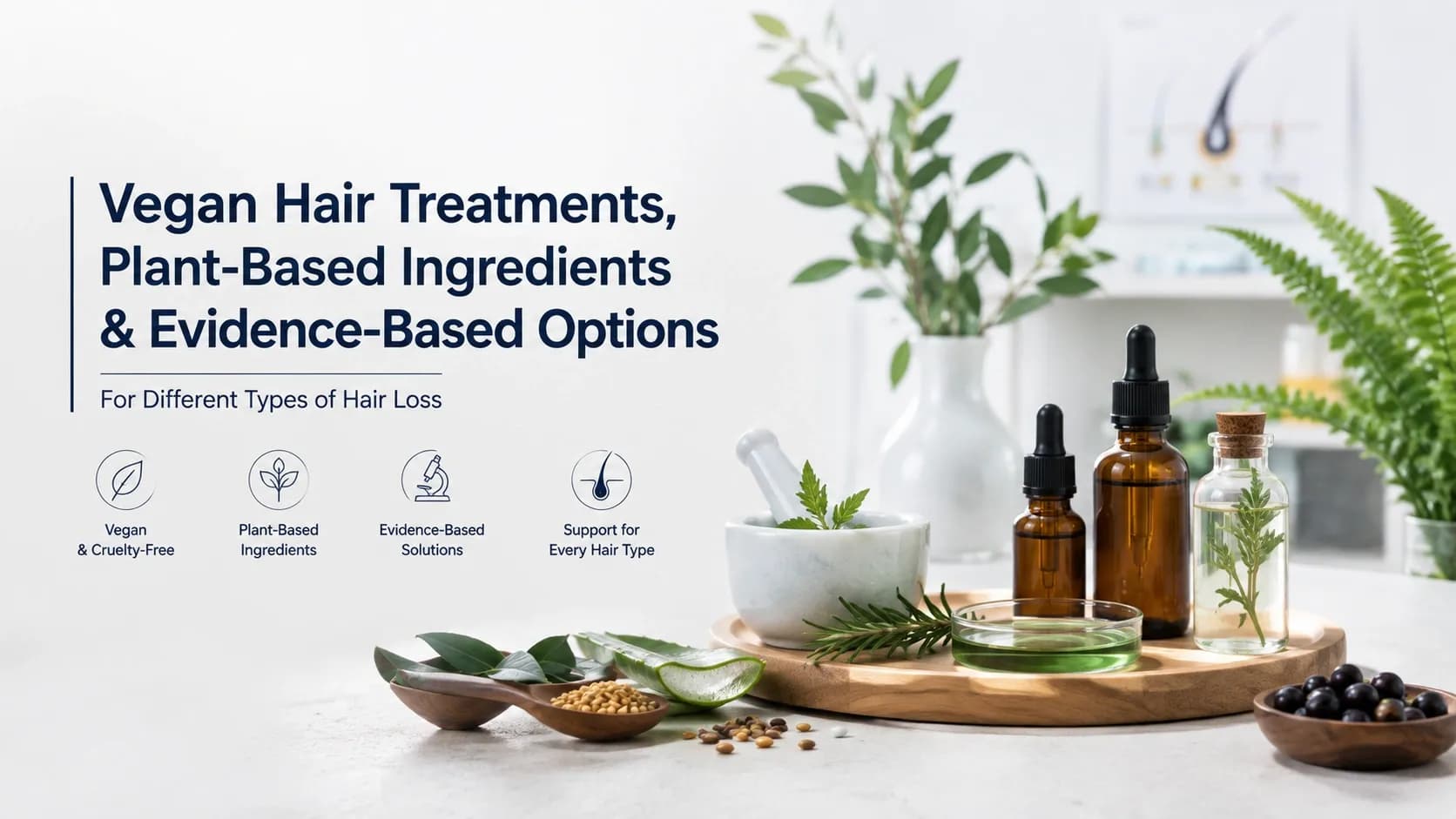
A vegan hair treatment is a product, salon service, supplement, or medical formulation made without animal-derived ingredients. While some vegan treatments improve hair quality, support scalp health, or help correct a confirmed nutritional deficiency, they do not automatically treat medical hair loss.
Vegan, cruelty-free, and plant-based are not the same. Vegan refers to the ingredients, cruelty-free refers to animal testing, and plant-based describes the ingredient source. None of these terms guarantees that a product is clinically proven for hair growth.
The right vegan hair treatment depends on the cause of your hair loss. Cosmetic products can reduce breakage and improve hair appearance; nutritional supplements help only when a deficiency is confirmed, and medical hair loss requires diagnosis-specific treatment.
What Is a Vegan Hair Treatment?
A vegan hair treatment is a product, salon service, supplement, or medical formulation made without animal-derived ingredients or by-products.
The term describes how a treatment is formulated rather than how effective it is. Depending on the product or service, it may refer to:
- Hair care products: Vegan shampoos, conditioners, oils, masks, and serums made without animal-derived ingredients.
- Salon services: Vegan keratin treatments, protein smoothing treatments, vegan hair botox, nanoplastia, and other vegan-compatible hair treatments.
- Supplements: Plant-based vitamins and minerals used to help correct confirmed nutritional deficiencies linked to hair shedding.
- Medical formulations: Hair loss treatments that may be available in vegan-compatible formulations, depending on the product, brand, and ingredients used.
How Is a Vegan Hair Treatment Different From Cruelty-Free and Plant-Based Hair Care?
A vegan hair treatment is not the same as cruelty-free or plant-based hair care. These terms describe different aspects of a product, such as its ingredients, testing methods, sourcing, or certification, and they should not be used interchangeably.
The table below compares the most common terms used on hair care products.
| Term | What It Describes |
|---|---|
| Vegan | No animal-derived ingredients or by-products. |
| Cruelty-free | Not tested on animals but may contain animal-derived ingredients. |
| Plant-based | Mainly plant-derived ingredients, but not necessarily vegan. |
| Natural | Ingredients of natural origin; not a guarantee of safety, effectiveness, or vegan status. |
| Organic | Ingredients produced using organic farming standards; not necessarily vegan or cruelty-free. |
| Clean beauty | A marketing claim, not a regulated standard. |
| Vegan-certified | Verified by a recognised third-party vegan certification. |
When choosing a vegan hair treatment, look beyond marketing claims. Third-party certification can help verify vegan standards, but you should also review the ingredient list, intended use, and evidence supporting the product's claims.
Which Animal-Derived Ingredients Can Be Hidden in Hair Products?
A product labelled as plant-based or natural is not always vegan. Some hair care products may contain animal-derived ingredients or formulation excipients, so checking the ingredient list or a recognised vegan certification is important before purchasing.
Some animal-derived ingredients that may be found in your hair products include:
- Keratin: Commonly sourced from animal materials unless specifically labelled as vegan.
- Collagen: Often derived from animal tissues and not typically vegan.
- Silk proteins: Usually obtained from silkworm cocoons.
- Beeswax: Produced by honeybees and used in some styling products.
- Lanolin: Derived from sheep's wool and commonly used as an emollient.
- Shellac: A resin produced by lac insects and used in some cosmetic formulations.
- Gelatin: Derived from animal collagen and used in selected formulations.
- Formulation excipients: Some inactive ingredients or processing aids may also be animal-derived, depending on the manufacturer.
Not every hair product contains these ingredients, and ingredient sources can vary between brands and formulations. If a product does not clearly state its vegan status, review the ingredient list or look for recognised third-party vegan certification.
What Are the Four Types of Vegan Hair Treatments?
Not all vegan hair treatments work in the same way. Some improve the condition of your hair, while others support your scalp, help address nutritional deficiencies, or complement medical treatment for hair loss.
Understanding what each type is designed to do can help you choose a treatment that matches your hair concerns rather than relying on the vegan label alone.
Vegan hair treatments generally fall into four categories:
- Hair Shaft Care: Helps improve the appearance, strength, smoothness, and manageability of the hair fibre, but does not treat hair loss at the follicle.
- Scalp Care: Helps maintain a healthy scalp environment by supporting scalp comfort and reducing dryness or irritation where appropriate.
- Nutritional Support: Helps correct confirmed nutritional deficiencies that may contribute to hair shedding when a deficiency is present.
- Medical Follicle Care: Supports evidence-based medical management of hair loss using vegan-compatible formulations where available, depending on the product and diagnosis.
Each category serves a different purpose, and you may need more than one approach depending on the cause of your hair loss. The most appropriate vegan hair treatment depends on an accurate diagnosis rather than whether a product is labelled vegan.
Which Plant-Based Ingredients Have Evidence for Hair Loss?
Some plant-based ingredients have shown potential benefits for hair loss, but not all are supported by the same level of scientific evidence.
While certain ingredients may support hair growth or reduce breakage, others mainly improve the condition of the hair shaft or scalp.
Understanding the strength of the evidence can help you choose a vegan hair treatment based on realistic expectations rather than marketing claims on vegan or cruelty-free products.
Which Plant-Based Ingredients Show Promising but Limited Evidence?
Some plant-based ingredients have shown encouraging results for hair loss, but the available research is still limited. These ingredients may support hair growth in some people, but they should be viewed as supportive options rather than proven treatments for medical hair loss.
The following ingredients have shown promising but limited evidence for supporting hair growth:
- Rosemary oil: May support hair growth in pattern hair loss based on a small human study, but larger, high-quality clinical trials are still needed.
- Pumpkin seed oil: May help improve hair growth in some people, although results vary depending on the formulation, dose, and method of use.
- Saw palmetto: May reduce androgen-related hair thinning in some individuals, but the evidence remains less consistent than established medical treatments.
- Topical caffeine: May improve hair growth or reduce shedding, but study methods and formulations differ, limiting the overall evidence.
Which Cosmetic Actives Have Product-Specific Evidence?
Some cosmetic actives used in vegan hair treatments have been studied, but the evidence is often based on specific products or proprietary formulations rather than the ingredient alone. Before choosing a product, consider the research supporting the finished formulation instead of relying solely on marketing claims.
- Redensyl: May support hair density in some formulations, but the available evidence is largely product-specific.
- Procapil: May help reduce hair shedding in certain products, although independent clinical evidence remains limited.
- Capixyl: May improve hair appearance or density in proprietary formulations, but the findings cannot be applied to all products.
- AnaGain: May support hair density in specific formulations, but the current evidence remains limited and product-specific.
- Proprietary blends: Should be evaluated based on evidence for the complete formulation rather than individual ingredients alone.
Which Ingredients Mainly Support the Hair Shaft?
Some vegan hair treatment ingredients mainly improve the condition of the hair shaft rather than treating hair loss. These ingredients can help reduce breakage, dryness, and friction, making your hair look and feel healthier, but they do not treat hair loss at the follicle.
The following ingredients are primarily used to support the hair shaft:
- Coconut oil: May help reduce protein loss from hair fibres and protect the hair shaft, but it does not treat follicular hair loss.
- Conditioning oils: May help reduce dryness, friction, and breakage, improving the appearance and manageability of the hair.
- Plant proteins: May temporarily strengthen and smooth the hair fibre, supporting healthier-looking hair.
- Humectants: May help attract and retain moisture, improving softness and reducing dryness in the hair shaft.
What Vegan Salon Treatments Are Available for Hair Care?
Vegan salon treatments can help improve the appearance and manageability of your hair, but they are not designed to treat medical hair loss. Depending on the treatment, you may notice smoother, softer, or less frizzy hair, while the effects are usually cosmetic and temporary.
Before choosing a vegan salon treatment, it's important to understand what the treatment is designed to do and what it cannot do. You should also consider the ingredients used, the amount of heat applied during the procedure, and whether the formulation contains formaldehyde or formaldehyde-releasing chemicals, as these factors can affect both safety and hair health.
If you're comparing vegan and cruelty-free products, remember that these labels do not guarantee a treatment is clinically proven for hair loss. The following sections explain how common vegan salon treatments work, what ingredients they typically contain, and their limitations for treating hair loss.
What Does Vegan Keratin Usually Mean?
Vegan keratin usually refers to a hair-smoothing treatment made with plant proteins or amino-acid blends instead of animal-derived keratin.
It is designed to improve the appearance and manageability of the hair rather than treat hair loss or repair hair follicles. A vegan keratin treatment may help by:
- Smoothing the hair shaft to reduce frizz.
- Improving manageability for easier styling.
- Providing temporary softness and shine rather than permanent hair repair.
Although labelled as vegan, these treatments are not always formaldehyde-free. Some formulations may still involve high heat, acids, fragrances, or formaldehyde-releasing chemistry, so reviewing the ingredient list before treatment is important.
Can Vegan Hair Botox or Nanoplastia Treat Hair Loss?
No, vegan hair botox and vegan nanoplastia are cosmetic hair-smoothing treatments and do not treat hair loss. They can make your hair look smoother, softer, and fuller, but they do not repair hair follicles or promote new hair growth.
Here's what each treatment is designed to do:
- Vegan hair botox: May coat the hair shaft to improve softness, shine, and the appearance of fuller hair, but it does not repair hair follicles or treat alopecia.
- Vegan nanoplastia: May smooth and straighten the hair for weeks or months, but repeated heat and chemical exposure can increase the risk of hair breakage or scalp irritation.
If your concern is ongoing hair thinning or excessive shedding, cosmetic salon treatments should not replace a medical assessment to identify the underlying cause of hair loss.
Can a Vegan Diet Cause Hair Loss?
No, a well-planned vegan diet does not automatically cause hair loss. However, nutritional deficiencies, restrictive eating, or rapid weight loss may contribute to increased hair shedding if your diet does not meet your body's needs.
Hair loss should not be attributed to a vegan diet alone. Identifying and correcting a confirmed nutritional deficiency may help reduce shedding, but it will not treat genetic, autoimmune, or scarring forms of hair loss.
Which Nutritional Deficiencies Can Affect Hair Health?
Several nutritional deficiencies can affect hair health, but supplements are most helpful when a deficiency has been confirmed. Before starting any supplement, it's important to identify the underlying cause through an appropriate clinical assessment.
The following nutrients may affect your hair health when they are deficient:
- Protein and calories: Ensure you consume enough protein and calories, as inadequate intake or rapid weight loss can increase hair shedding.
- Iron: Test and correct iron deficiency when clinically confirmed, as low iron stores may contribute to hair shedding.
- Vitamin B12: Check your vitamin B12 status if you are at risk of deficiency, and supplement only when needed.
- Vitamin D: Correct a confirmed vitamin D deficiency under appropriate clinical guidance.
- Zinc: Replace zinc only if testing confirms a deficiency, as unnecessary supplementation is not recommended.
- Iodine: Maintain adequate iodine intake, but avoid excessive supplementation without medical advice.
- Selenium: Meet your daily selenium requirements without exceeding recommended amounts.
- Omega-3 fatty acids: Ensure adequate intake as part of a balanced diet, while recognising that supplementation is not a proven treatment for hair loss.
Why Can Routine Biotin or Supplement Stacking Be Misleading?
Routine biotin supplements or taking multiple hair supplements together is not recommended unless a deficiency has been confirmed. More supplements do not necessarily lead to better hair growth, and unnecessary supplementation may increase the risk of excessive nutrient intake.
Before taking hair supplements, keep these points in mind:
- Use biotin only when needed: Supplement biotin if a deficiency has been confirmed rather than taking it routinely.
- Avoid supplement stacking: Taking multiple hair supplements together can increase the risk of consuming excessive amounts of certain nutrients.
- Treat confirmed deficiencies: Choose supplements based on appropriate testing and your individual nutritional needs rather than marketing claims.
Can Vegan Hair Treatments Treat Medical Hair Loss?
Vegan hair treatments may support overall hair care, but they are not a substitute for diagnosis-specific medical treatment. Whether they can help depends on the underlying cause of your hair loss.
Some botanical ingredients may provide supportive benefits, while others primarily improve hair appearance rather than treat the condition itself. The table below explains the role and limitations of vegan hair treatments for common types of hair loss.
| Hair Loss Condition | What You Should Know |
|---|---|
| Pattern hair loss | Established medical treatments have stronger evidence than most botanical ingredients. Vegan hair treatments may provide supportive care but should not replace evidence-based treatment. |
| Telogen effluvium | The priority is identifying and treating the underlying trigger or nutritional deficiency. Cosmetic vegan hair treatments do not shorten every episode of hair shedding. |
| Alopecia areata and scarring alopecia | These conditions require prompt medical assessment. Relying only on cosmetic or botanical products may delay appropriate treatment. |
Can Evidence-Based Hair Loss Treatments Fit Vegan Preferences?
Evidence summarised in the Journal of the American Academy of Dermatology (JAAD) supports choosing hair loss treatments based on the underlying diagnosis rather than cosmetic claims. If you prefer vegan-compatible options, check the formulation and procedure with your board-certified hair transplant surgeon before treatment.
How Can You Evaluate Vegan Hair Growth Claims?
Not every vegan hair treatment marketed for hair growth is supported by strong clinical evidence. Before choosing a product, use the checklist below to separate evidence-based claims from marketing messages.
Before buying a vegan hair treatment, ask yourself:
- Check the diagnosis: Does the product state which type of hair loss it is intended to support?
- Check the evidence: Are the claims supported by published human clinical studies rather than testimonials?
- Check the formulation: Is the evidence based on the finished product or only on individual ingredients?
- Check the certification: Is the vegan claim backed by a recognised third-party certification or a transparent ingredient list?
- Check the expectations: Does the product claim to support hair health rather than promise guaranteed hair regrowth?
- Check the safety: Are the ingredients and directions clearly disclosed, including any precautions or potential risks?
- Check professional advice: If you have persistent hair loss, have you consulted a board-certified hair transplant surgeon to identify the underlying cause before relying on cosmetic products?
How Do You Choose the Right Vegan Hair Treatment?
The right vegan hair treatment depends on your main hair concern, not the product label alone. Use the table below to match your symptoms with the type of care that may be most appropriate.
| Your Concerns | What You Should Consider |
|---|---|
| Hair breakage or dryness | Hair shaft treatments with conditioning ingredients that help reduce breakage and improve manageability. |
| Scalp dryness or irritation | Scalp care products that support the skin barrier and scalp comfort. |
| Sudden hair shedding | Assessing possible triggers or nutritional deficiencies before relying on cosmetic products. |
| Progressive hair thinning | Seeking a medical diagnosis and considering evidence-based treatments, with vegan-compatible options where appropriate. |
Kibo's Perspective on Vegan Hair Treatments
Choosing a vegan hair treatment should depend on the underlying cause of your hair loss, not the product label. While vegan products can support hair and scalp health, they do not replace evidence-based treatment for medical hair loss.
At Kibo Clinics, we recommend personalised treatment based on your hair loss diagnosis, scalp condition, and long-term hair restoration goals.
If you're unsure which treatment is right for you, a Kibo Clinics board-certified hair transplant surgeon can help identify the cause of your hair loss and recommend a personalised treatment plan.
Frequently Asked Questions
Can vegan hair treatments help reduce hair breakage?
Yes. Some vegan hair treatments help reduce breakage by conditioning and protecting the hair shaft, but they do not treat hair loss.
Is a vegan hair treatment the same as a cruelty-free product?
No. Vegan refers to ingredients, while cruelty-free refers to animal testing. A product can be cruelty-free without being vegan.
Can a vegan diet support healthy hair growth?
Yes. A well-planned vegan diet can support healthy hair, provided it supplies adequate nutrients and corrects confirmed nutritional deficiencies.
Does vegan keratin repair damaged hair?
It can temporarily smooth and improve hair manageability, but it does not permanently repair hair or treat hair loss.
When should you see a hair specialist for hair loss?
If your hair thinning is persistent, progressive, or unexplained, seek a medical assessment to identify the underlying cause before relying on cosmetic treatments.
If you are unsure whether your hair concern needs cosmetic care, medical treatment, or a hair restoration plan, speak with the Kibo Clinics team.
Fact-checked by the Content and Fact-Checking Team at Kibo Clinics
Related Articles & Services
Hair Transplant
FUE Hair Transplant | Sapphire FUE Hair Transplant | Direct Hair Transplant DHT
Hair Regrowth
PRP Therapy | GFC Therapy | Low Level Laser Therapy | Microneedling for Hair Regrowth | Mesotherapy for Hair Regrowth
Must Read
Hair Breakage Causes and Treatments | Hair Density vs Strength | Hair Myths: Fact vs Fiction | Why Scalp Hygiene Matters
Relevant Blogs
Vitamin D and Hair Follicles | Iron Deficiency and Hair Thinning | Stress-Induced Hair Loss and Telogen Effluvium | Gut Health and Hair Density
Medical Disclaimer : Information from Kibo Hair Clinics is for educational purposes only. It does not replace diagnosis, trichoscopy, blood test interpretation, prescription treatment, procedure advice, or side-effect counselling from a qualified dermatologist or hair restoration doctor.