
Traction Alopecia Recovery: How to Safely Transition From Tight Hairstyles
Published on Fri Apr 03 2026
Quick Summary
Traction alopecia recovery is possible in most early cases because the follicles remain intact the hair loss is from sustained mechanical stress, not follicle destruction. When you remove tight hairstyles after months or years of daily wearing, the accumulated telogen-phase hair that was already loosened by the traction sheds together, making the shedding appear sudden and dramatic even though it was building gradually.
The critical variable is whether follicle scarring has begun early-stage traction responds to tension removal and supportive care within 3 to 6 months, while advanced scarring with smooth shiny scalp patches needs clinical assessment before any recovery timeline can be estimated.
A Story Many Women and Men Relate To
Riya, 29, from Mumbai, wore tight high ponytails and sleek buns almost daily for work. For years, it felt neat and manageable. Slowly, she noticed thinning near her temples but ignored it.
After a vacation, she decided to leave her hair open. Within weeks, she saw increased shedding while washing. The temple area looked more visible. She panicked, thinking she had permanent hair loss.
A scalp evaluation showed early traction-related thinning. With gradual style changes, scalp care, and supportive treatments, her shedding reduced over three months. The baby hairs near her hairline slowly began to return because the follicles were not permanently damaged.
Why Does Hair Shed After Stopping Tight Hairstyles?
Hair shedding after removing tight styles follows a predictable biological chain reaction.
Traction reduces scalp blood flow — Constant tension creates low-grade inflammation around follicle openings and reduces proper micro-circulation. Follicles in compressed zones receive less oxygen and nutrient delivery over the months or years of sustained pulling.
Follicles shift into telogen prematurely — The follicle under stress exits the anagen growth phase earlier than its natural timeline and enters the telogen resting phase. Hair in telogen is loosely anchored and ready to shed.
Removal triggers simultaneous shedding — When tension is finally removed, the accumulated telogen hairs that were being held in place by the hairstyle itself shed around the same time. This looks like sudden heavy hair fall but represents weeks or months of gradually weakened anchoring being released at once.
Hormonal and nutritional compounding — Cortisol from workplace stress, nutritional deficiencies, and sleep disruption amplify this response. In someone with genetic thinning, the traction has been accelerating miniaturisation that continues after the styles stop.
Understanding traction alopecia from tight hairstyles explains the full damage mechanism — from the first week of sustained pulling to the follicle scarring that determines whether recovery is possible.
What Is Traction Alopecia?
Traction alopecia is hair loss caused by repeated pulling or sustained tension. It most commonly affects the hairline, temples, behind the ears, and nape. If caught early, follicles recover. If tension continues for years, follicle scarring develops and regrowth becomes limited or absent in the scarred zones.
Traction Alopecia Recovery — Stage by Stage
| Stage | Scalp Signs | Follicle Status | Recovery Potential |
|---|---|---|---|
| Early — weeks to months of tension | Small bumps or pimples at hairline; mild tenderness when styling; no visible recession | Inflamed but intact; shifted into telogen prematurely | Excellent — full recovery likely within 3 to 6 months of tension removal |
| Moderate — months to 1–2 years of tension | Visible hairline recession; thinning at temples; baby hair stubs present in affected zone | Miniaturising but not scarred; follicle openings still visible | Good — partial to full recovery with tension removal, scalp care, and possibly PRP support over 6 to 12 months |
| Advanced — years of sustained tension | Shiny smooth patches without visible follicle openings; clear hairline loss without baby hairs | Scarred — follicles permanently closed | Limited — clinical assessment determines whether transplant is viable in stable scarred areas |
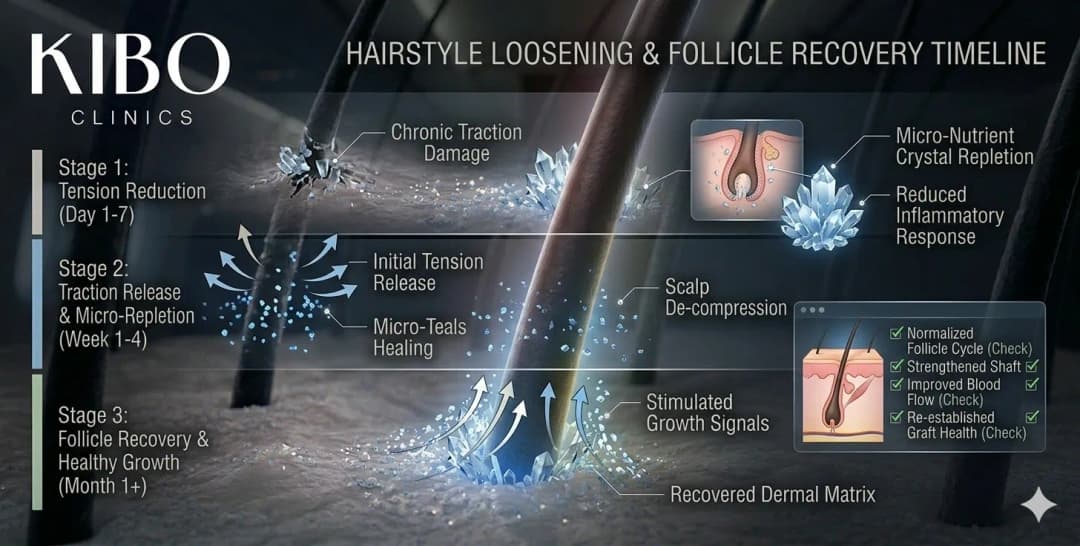
| Shock shedding phase — first 6–8 weeks after removing tight styles | Dramatic increase in visible shedding during washing and combing | Accumulated telogen hairs releasing simultaneously — follicles are intact | Normal part of recovery — shedding reduces in 6 to 8 weeks as telogen queue clears |
| Early regrowth — 3 to 4 months post-tension | Fine baby hairs emerging at hairline and temples | Follicles re-entering anagen; new growth fragile and requires protective handling | Strong — new growth must be protected from heat and tight styles to avoid repeating the damage cycle |
How Can You Transition Safely Without Triggering Excess Shedding?
A gradual approach consistently produces better outcomes than a sudden switch from tight styles to fully loose hair.
Reduce tension step by step — Move from ultra-tight braids to looser braids, then to soft buns, then to open styles over 4 to 6 weeks. Abrupt removal allows all accumulated telogen hair to shed simultaneously.
Shorten wearing time — If you wore tight styles daily, limit them to two to three times weekly first, then progressively reduce.
Avoid heavy extensions during transition — Extra weight adds downward follicle stress on roots that are still recovering from the traction damage.
Trim damaged ends — Weak shaft ends break easily and add to the visible shedding count. Trimming removes the most breakage-prone length.
Gentle scalp massage 3 to 4 times weekly — Improves micro-circulation to follicles that have been under chronic compression. The principle is the same as recovering from weak hair root anchoring — restored blood flow is the primary recovery mechanism.
How Does Transitioning Show in Men and Women?
In women, the most commonly affected zones are the edges, temples, and hairline — where tight ponytails, braids, and buns create the highest and most sustained traction. Post-braid shedding can look dramatic during the first few wash sessions after removal. Women with hormonal conditions like PCOS or thyroid imbalance face compounded vulnerability — the hormonal thinning and traction damage reinforce each other.
In men, tight man buns worn daily create tension at the front and crown. If male pattern baldness from DHT is already present, the tension accelerates what would otherwise be slower genetic recession — making it appear as though the man bun caused hair loss that was actually a combination of traction plus DHT working on already-susceptible follicles.
What Daily Habits Make It Better or Worse?
Habits that worsen traction recovery:
- Continuing tight styles even on "lighter" days — follicles cannot recover between sessions if tension is reapplied before healing completes
- Sleeping with tight hair — extends traction duration to 6 to 8 consecutive hours on follicles already in recovery
- Crash dieting during the recovery period — reduces protein supply to follicles at the moment when they need structural input most to re-enter anagen
- Skipping scalp cleansing — product and sebum buildup clogs follicle openings and delays re-entry into the growth phase
Habits that support traction recovery:
- Rotating hairstyles — distributes the remaining styling stress across different follicle zones rather than reloading the same damaged zones
- Soft scrunchies instead of elastic bands — reduces friction and concentrated pressure at the tie point
- Protein, iron, zinc, and vitamin D — the nutritional inputs most directly linked to follicle re-entry into anagen growth
- Stress management — lower cortisol reduces the hormonal compounding that was pushing even more follicles into telogen on top of the traction damage
The fine hair and traction stress risk guide applies directly to recovery — the same structural vulnerability that made fine hair more susceptible to traction damage also means the new baby hairs emerging during recovery are fragile and need the same protective handling.
What Helps First — Practical Relief Steps
Stop high-tension styles immediately and completely for 8 to 12 weeks. This is the non-negotiable starting point — no recovery is possible while the primary stressor continues.
Gentle shampoo and avoid aggressive towel rubbing. Scalp inflammation from months of traction does not need the additional irritation of harsh cleansers or friction during drying.
Light scalp massage 3 to 4 times a week with fingertip pads — not nails. This improves follicle circulation without creating the micro-trauma that aggressive massage on an inflamed scalp produces.
If inflammation is present, a dermatologist may suggest topical anti-inflammatory solutions to calm the follicle environment and create the conditions for re-entry into anagen.
Visible shedding reduction typically appears within 6 to 8 weeks. Early baby hair regrowth may appear in 3 to 4 months if follicles are not scarred. Full visible improvement in density takes 6 to 12 months depending on how long tension was sustained and whether any scarring is present.
When to See a Hair Specialist
Do not wait if you notice:
- Hairline recession that continues even after stopping tight styles for 3 months
- Shiny, smooth scalp patches without follicle openings — scarring has likely occurred
- Persistent pain, burning, or redness suggesting active inflammation requiring clinical treatment
- Shedding lasting more than 3 to 4 months despite complete tension removal and lifestyle correction
- Severe dandruff, hormonal imbalance symptoms, or family history of baldness alongside traction damage
The window for reversible recovery is directly tied to how early intervention begins. Professional assessment at the moderate stage produces significantly better outcomes than waiting for visible recession to become established.
Common Myths About Tight Hairstyles and Shedding
Myth 1: Shedding after removing braids means permanent baldness. Early-stage traction shedding is often fully reversible if managed quickly. The shock shedding phase of 6 to 8 weeks is a normal biological response, not evidence of permanent follicle loss.
Myth 2: If it does not hurt, it is not damaging. Even mild, constant tension without pain weakens follicles progressively. The absence of acute pain does not mean the chronic low-grade traction is not moving follicles toward permanent scarring.
Myth 3: Oiling heavily fixes traction hair loss. Oil improves scalp surface condition and circulation at the skin level but cannot reverse follicle scarring or restore anchoring structures damaged by sustained mechanical stress.
Myth 4: Only women face traction-related hair loss. Men with tight buns, top knots, or culturally specific styling practices develop traction alopecia at the front and crown — particularly when DHT sensitivity is also present.
Why Kibo Clinics
Many patients choose Kibo Clinics for traction-related hair concerns because our approach addresses both current shedding and long-term hairline planning. We begin with comprehensive scalp assessment, hair and follicle analysis, and thorough lifestyle and environmental review — determining whether shock shedding reflects temporary telogen release from recoverable follicles or has progressed to scarring that limits the recovery ceiling.
Our No Ghost Surgery pledge ensures the consulting surgeon personally performs your entire procedure, maintaining consistent quality throughout the session. We do not delegate critical steps to technicians.
The Kibo Hair Analysis (scalp and follicle assessment) is the first step in understanding your specific condition. We provide education, guidance, and support without guarantees, exaggerated claims, or miracle cure promises.
For patients needing structured support, we offer PRP therapy and GFC therapy to support follicle recovery in non-scarred zones, 12-month monitoring with periodic scalp reviews, and hair transplant planning conservatively in stable scarred cases where medical options have been exhausted.
If you are noticing temple thinning or hairline changes after years of tight styling, a structured scalp evaluation at Kibo Clinics can clarify whether the follicles are stressed or permanently damaged.
Frequently Asked Questions
Q: Is shedding normal after removing braids? Yes. Mild to moderate shedding after removing tight braids or hairstyles is normal and expected. Weakened hairs that were held in place by the tension shed together once the restraint is removed — this is the shock shedding phase. It typically settles within 6 to 8 weeks. If shedding continues beyond 3 months despite complete tension removal, professional evaluation is needed.
Q: How long does traction alopecia take to recover? If follicles are not scarred, early recovery signs — fine baby hairs — may appear in 3 to 4 months. Full visible improvement in density takes 6 to 12 months. Long-standing cases with follicle scarring may not regrow naturally and require clinical assessment for transplant candidacy.
Q: Can traction alopecia be reversed? Early and moderate stage traction alopecia is often fully or partially reversible with complete tension removal, scalp care, and sometimes clinical support like PRP therapy. Advanced traction alopecia with follicle scarring — identifiable by shiny smooth patches without follicle openings — cannot be reversed without surgical intervention.
Q: Can men get traction alopecia from man buns? Yes. Tight man buns worn daily create tension at the front and crown. Combined with genetic DHT sensitivity, thinning may appear significantly faster than either factor alone would produce. Reducing tension early improves recovery chances before scarring develops.
Q: Does hair grow back after traction alopecia? In early and moderate stages, yes — follicles that are stressed but not scarred resume growth after tension is removed and scalp health is restored. In advanced stages where smooth shiny scalp patches appear, regrowth is limited without medical or surgical support.
Q: Should I cut my hair short during the transition? Shorter hair reduces weight and pulling force, which can help follicle recovery. However, cutting alone does not reverse follicle damage. Scalp care and complete tension removal are the primary interventions — shorter hair supports but does not substitute them.
Key Takeaways
- Traction alopecia recovery is possible in most early cases because follicles are stressed, not permanently destroyed — the key diagnostic sign separating recoverable from scarred is whether follicle openings are still visible in the thinning zone
- Hair shedding after removing braids is normal for 6 to 8 weeks — it is accumulated telogen hair releasing, not new follicle damage; the panic most people feel at this stage is the most common reason they return to tight styles and extend the damage
- Shock shedding after braids peaks in the first 2 to 4 weeks after removal and subsides progressively; shedding continuing beyond 3 months signals either scarring or a concurrent hormonal or nutritional cause
- The transition from tight to loose styles should be gradual — 4 to 6 weeks of progressively lower tension — not abrupt; sudden removal causes simultaneous shedding of all accumulated telogen hair at once
- Traction alopecia hairline recovery timeline: shock shedding reduces in 6 to 8 weeks, baby hairs emerge in 3 to 4 months, visible density improvement in 6 to 12 months — only if tension is completely removed and follicles are not scarred
- Shiny smooth scalp patches without visible follicle openings indicate scarring — at this point professional assessment is not optional; further delay reduces transplant candidacy
Disclaimer
This content is for informational purposes only and does not substitute personalized medical advice. Hair shedding and recovery vary based on duration of tension, hormonal health, genetics, and scalp condition. Treatment responses differ from person to person. Professional evaluation is recommended before starting any medical or surgical intervention.
Hair Transplant
FUE Hair Transplant | Sapphire FUE Hair Transplant | Bio FUE Hair Transplant | Realtime FUE Hair Transplant | Direct Hair Transplant (DHT)
Hair Regrowth
PRP Therapy | GFC Therapy | IV Hair Boosters | Mesotherapy for Hair Regrowth | Microneedling for Hair Regrowth
Must Read
Hair Loss Types Symptoms Causes | Hair Breakage Causes Treatments | DHT Blockers Hair Loss Guide | Hair Transplant Good Or Bad | Understanding The Language Of Natural Hairline
Relevant Blogs
Hair Brushes Combs Scalp Stress | Hair Dryer Heat Follicle Safety | Straighteners and Curling Irons Hair Stress | Pollution Build Up Weakening Hair Roots | Scalp Oil Reducing Hair Friction