
Reviewed By:
Shritej Mali
Independent Research Reviewer
Reviewing peer-reviewed studies and medical literature for evidence-based accuracy.
Written By: Kibo Clinics Content Team
Last Updated: July 9, 2026, 2:42 PM IST
Reading Time: 13 minutes
֎ Show Quick Answer AI Quick answer summary
- Androgenetic alopecia is pattern hair loss: it is driven by inherited follicle sensitivity to androgens, especially DHT, rather than one shampoo, oil or recent stress event alone.
- The core process is miniaturisation: thick terminal hairs slowly become thinner, shorter and less visible over repeated hair cycles.
- Men and women show different patterns: men often notice temple recession and crown thinning, while women commonly see widening parting and reduced top density.
- Early treatment protects more hair: medicines and procedures work best when follicles are still active, not after an area has become long-standing smooth bald skin.
- Diagnosis matters: sudden shedding, patchy loss, scalp pain, flakes, thyroid issues, iron deficiency or PCOS can overlap with androgenetic alopecia and change the treatment plan.
What Is Androgenetic Alopecia?
Androgenetic alopecia is the medical name for genetic pattern hair loss. In men, it is commonly called male pattern baldness. In women, it is often called female pattern hair loss. The word “androgenetic” points to two main drivers: androgen hormones and inherited sensitivity of specific scalp follicles.
This is not the same as temporary shedding after fever, stress, crash dieting or childbirth. In androgenetic alopecia, the follicle itself gradually changes. A follicle that once produced a thick terminal hair starts producing a thinner, shorter, softer strand. Over many cycles, that visible hair can become so fine that the scalp looks less covered.
The important point is that androgenetic alopecia is progressive, but progression is not identical for everyone. Some people thin slowly over years. Some notice a clear change in their twenties or thirties. Some women first notice it after PCOS, postpartum shedding or menopause brings attention to an underlying pattern. For a broader map of causes, Kibo’s guide to hair loss types and causes explains how pattern hair loss differs from other forms of alopecia.
Why Androgenetic Alopecia Is the Most Common Cause of Hair Loss
Androgenetic alopecia is common because it sits at the intersection of genetics, hormones and ageing. The follicles at the front, temples, crown and upper scalp can be more sensitive to androgen signalling. The donor zone at the back and sides is usually more resistant, which is why pattern hair loss often keeps a rim of hair even when the top thins.
The condition can start any time after puberty because androgen activity becomes biologically relevant after puberty. Family history helps, but it is not a perfect predictor. A person can inherit risk from either side of the family, and the pattern can still vary between siblings. That is why the common idea that baldness comes only from the mother’s side is too simplistic. Kibo’s article on the hair loss inheritance myth covers this misconception in detail.
From an EEAT perspective, this topic needs caution because people often search for quick cures. A shampoo can support scalp hygiene. Supplements can help only when there is a relevant deficiency. But genetic follicle miniaturisation usually needs diagnosis-based treatment, realistic timelines and long-term monitoring.
How DHT Causes Follicle Miniaturisation
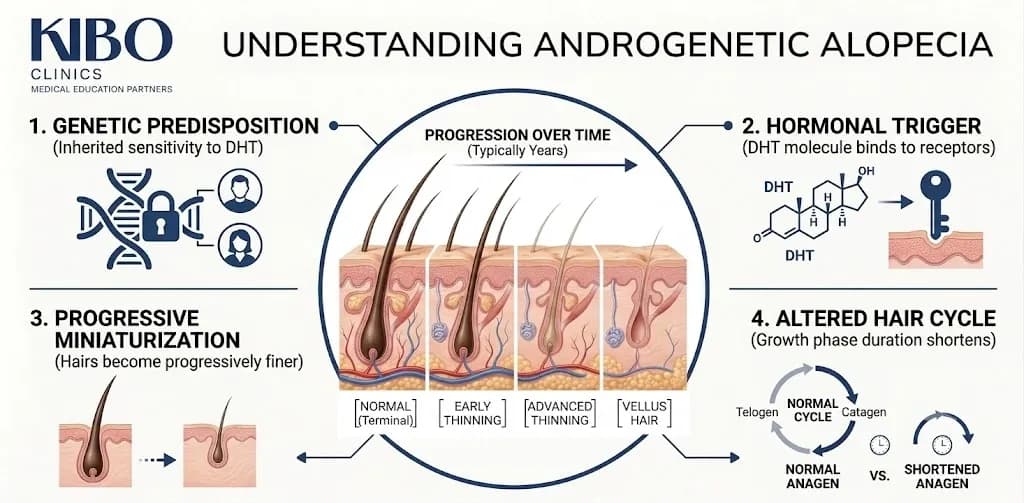
DHT, or dihydrotestosterone, is made from testosterone by the 5-alpha reductase enzyme. DHT is not “bad” in every part of the body. The problem happens when genetically sensitive scalp follicles respond strongly to DHT. Over time, the affected follicles spend less time producing thick hair and more time producing thinner hair.
This shrinking process is called follicle miniaturisation. The hair shaft diameter reduces. The anagen or growth phase shortens. The visible strand becomes shorter, weaker and less pigmented. Eventually, the follicle may still exist but produce hair that is almost invisible to the eye.
This is why androgenetic alopecia is not just “hair fall.” Many people do not lose dramatic handfuls of hair. Instead, the scalp becomes more visible because each cycle produces smaller hair. Kibo’s guide on DHT blockers for hair loss explains the treatment side of this hormone pathway.
| Process | What Happens | Visible Result |
|---|---|---|
| Genetic sensitivity | Follicles in specific scalp zones respond strongly to androgen signalling. | Patterned thinning rather than equal thinning everywhere. |
| DHT exposure | DHT binds to sensitive follicle pathways and changes hair-cycle behaviour. | Gradual crown, temple or upper-scalp density loss. |
| Miniaturisation | Terminal hairs become thinner, shorter and weaker over repeated cycles. | Scalp visibility increases even when daily shedding is not extreme. |
Early Signs of Androgenetic Alopecia
The earliest sign is often not a bald patch. It may be a change in shape, density or hair quality. You may notice that your hairline photographs differently, your crown reflects more light, your centre part looks wider, your ponytail feels thinner, or your scalp shows more under harsh lighting.
- In men: temple recession, an M-shaped hairline, crown thinning, reduced frontal density or miniaturised short hairs near the hairline.
- In women: widening centre part, diffuse thinning over the top, reduced ponytail volume, visible scalp under light or thinning linked with PCOS/menopause.
- In both: slow progression, family history, thinner new growth and areas that do not regain density after a shedding episode settles.
A useful difference is pattern. Sudden all-over shedding after illness may suggest telogen effluvium. Round patches may suggest alopecia areata or another scalp condition. Flakes, itching or redness can point to inflammation. If you are unsure whether your concern is shedding, breakage or pattern loss, Kibo’s guide on why shampoo is not stopping hair fall explains why products often fail when the root cause is follicle miniaturisation.
Male vs Female Androgenetic Alopecia
Men and women can both have androgenetic alopecia, but the visible pattern often differs. Men commonly lose density at the temples, frontal hairline and crown. Women more often keep the frontal hairline but thin over the top and centre part. However, overlap is possible, especially when hormonal conditions such as PCOS are present.
| Factor | Men | Women |
|---|---|---|
| Common pattern | Hairline recession, temples and crown thinning. | Widening parting and reduced top density. |
| Progression tool | Norwood scale is commonly used for staging. | Ludwig or Sinclair patterns may be used clinically. |
| Hormonal clues | Family history and early crown/temple loss are common clues. | PCOS signs, acne, excess facial hair or menstrual changes may matter. |
| Treatment caution | DHT blockers may be discussed if medically suitable. | Pregnancy risk and hormone history must be reviewed before anti-androgen treatment. |
If the pattern is more classically male, read Kibo’s guide to male pattern baldness explained. If the concern is widening parting, reduced ponytail thickness or female-pattern thinning, Kibo’s article on hair loss in women is the better next read.
How Androgenetic Alopecia Progresses
Progression usually happens over repeated hair cycles. A follicle does not disappear overnight. It produces a normal hair, then a slightly thinner one, then a shorter and finer one, until coverage reduces. This is why early photos often show subtle change long before the person feels they are “balding.”
The speed depends on genetics, age of onset, androgen sensitivity, scalp health, inflammation, smoking, metabolic health, stress load, nutrient status and whether treatment is started early. For tracking, monthly photos in the same light are more reliable than checking the mirror daily. Kibo’s guide to the hair growth cycle explained helps make sense of why visible improvement takes months.
| Stage You Notice | What It May Mean | Why Timing Matters |
|---|---|---|
| Early thinning | Follicles are miniaturising but still active. | Medical treatment has a better chance to stabilise and improve density. |
| Moderate density loss | Many follicles are producing finer hair. | Combination plans may be needed and expectations should be realistic. |
| Smooth bald areas | Some follicles may no longer produce visible hair. | Surgical planning may become more relevant than expecting medicines alone to fill the area. |
How Doctors Diagnose Androgenetic Alopecia
A proper diagnosis starts with the pattern. Your doctor checks where thinning is happening, whether the hairline is changing, whether miniaturised hairs are present and whether the scalp has inflammation, flakes, redness, pain or scarring. Trichoscopy can help detect hair shaft variation and miniaturisation that may not be obvious in normal light.
Blood tests are not required for every person with classic pattern loss, but they become useful when the story is mixed. Sudden shedding, fatigue, heavy periods, acne, irregular cycles, weight changes, thyroid symptoms, low protein intake or diffuse hair fall can point to overlapping causes. Kibo’s article on blood tests for hair fall explains why testing should be targeted rather than random.
If there are flakes or itching, do not assume DHT is the only issue. Scalp inflammation can worsen shedding and reduce hair quality. Kibo’s guide on whether dandruff causes hair loss explains the inflammation angle.
Not sure whether it is pattern hair loss, shedding or scalp inflammation?
Treatment Options for Androgenetic Alopecia
The best treatment is based on stage, sex, age, pregnancy plans, side-effect risk, scalp condition, density goals and whether the follicles are still active. The goal is not always full regrowth. In many people, the first win is slowing progression and keeping existing hair stronger for longer.
Minoxidil
Minoxidil can support the growth phase and strengthen existing hairs in suitable patients. It is used in male and female pattern hair loss, but it needs consistent use and realistic timelines. Some people shed more in the first weeks as follicles shift cycles. Kibo’s comparison of 5 percent versus 10 percent minoxidil explains why a higher concentration is not automatically better.
DHT-directed treatment
For selected men, doctors may discuss finasteride or other DHT-directed medicines. These are prescription decisions, not cosmetic product choices. Women need extra caution because pregnancy risk, PCOS, menstrual history and hormone profile change the safety discussion.
Procedural support
Procedures may be considered when follicles are still active and the diagnosis supports them. At Kibo Clinics, doctor-led options such as PRP therapy, GFC therapy and low-level laser therapy may be discussed as supportive options for selected cases. They are not substitutes for diagnosis, but they can support density planning when matched correctly.
For advanced areas where follicles no longer produce visible hair, the discussion may shift toward FUE hair transplant planning. A transplant can restore hair in selected areas, but it does not stop native hair from continuing to thin. That is why long-term maintenance matters.
What Results Timeline Is Realistic?
Androgenetic alopecia treatment is slow because hair growth is slow. Follicles need time to shift behaviour, produce new fibres and create visible coverage. Judging a plan after a few weeks can lead to unnecessary switching.
| Timeline | What You May Notice | How To Interpret It |
|---|---|---|
| 0 to 8 weeks | Shedding may continue; scalp may not look different yet. | Too early to judge most treatment outcomes. |
| 3 to 6 months | Shedding may reduce and short regrowth may appear. | Early response window for many non-surgical plans. |
| 6 to 12 months | Density and coverage are easier to judge in photos. | A better window to decide whether the plan is stabilising hair. |
| Beyond 12 months | Maintenance becomes the focus. | Genetic sensitivity continues, so stopping effective treatment may restart progression. |
For comparisons between ingredients and non-prescription growth claims, Kibo’s minoxidil versus Redensyl comparison is useful. For density tracking, read hair density and the hair growth cycle.
What Can Make Androgenetic Alopecia Look Worse?
Genetics may be the base, but other problems can make hair look worse. Telogen shedding can overlap with pattern thinning. Dandruff and seborrhoeic dermatitis can increase scalp irritation. Iron deficiency, thyroid imbalance, low protein intake, PCOS, medication changes or rapid weight loss can add diffuse shedding on top of miniaturisation.
For women with acne, irregular periods, facial hair or weight changes, PCOS hair thinning in women should be considered. For scalp-product confusion, Kibo’s review of DHT blocking shampoos helps separate scalp support from true DHT treatment.
When Should You See a Hair Doctor?
See a qualified hair doctor or dermatologist if thinning is patterned, progressive, starting early, affecting confidence or not improving after obvious triggers are corrected. Also seek help quickly if there are bald patches, scalp pain, redness, scaling, pus, intense itching or sudden heavy shedding.
A good consultation should separate genetic pattern loss from temporary shedding and scalp disease. It should include a scalp examination, history, pattern mapping, treatment suitability and timeline explanation. If you are confused about which expert to meet, read Kibo’s guide on dermatologist versus trichologist.
Ready to confirm your stage and treatment options?
Frequently Asked Questions
What is androgenetic alopecia?
Androgenetic alopecia is genetic pattern hair loss caused by inherited follicle sensitivity to androgens, especially DHT. It causes gradual follicle miniaturisation and patterned thinning on the scalp.
Is androgenetic alopecia the same as male pattern baldness?
Male pattern baldness is the male pattern of androgenetic alopecia. Women can also have androgenetic alopecia, usually as female pattern hair loss with widening parting and reduced top density.
Can androgenetic alopecia be reversed?
It can often be slowed or partially improved when follicles are still active. Long-standing bald areas may not regrow with medicines alone and may need hair transplant evaluation.
What are the early signs of androgenetic alopecia?
Early signs include temple recession, crown thinning, widening parting, reduced ponytail thickness, increased scalp visibility and fine miniaturised hairs around the affected area.
Does DHT always cause hair loss?
No. DHT has normal roles in the body. Hair loss happens when scalp follicles are genetically sensitive to DHT and gradually miniaturise over time.
How is androgenetic alopecia diagnosed?
Doctors diagnose it using history, pattern examination, scalp evaluation and sometimes trichoscopy. Blood tests may be added when shedding is sudden, diffuse or linked with symptoms of deficiency, thyroid imbalance or hormonal conditions.
What is the best treatment for androgenetic alopecia?
The best treatment depends on stage, sex, age, medical history and goals. Options may include minoxidil, prescription DHT-directed treatment, PRP or GFC support, low-level laser therapy and hair transplant planning for advanced loss.
How long does treatment take to show results?
Most treatment plans need months. Shedding may stabilise first, then density changes become easier to judge around 3 to 6 months and more meaningfully around 6 to 12 months.
Can women get androgenetic alopecia?
Yes. Women can develop androgenetic alopecia, usually as female pattern hair loss. It may appear as widening parting, reduced top density or thinner ponytail volume.
When is hair transplant needed?
Hair transplant may be considered when the area has advanced density loss and medical treatment alone cannot restore coverage. A doctor must assess donor strength, future loss pattern and long-term maintenance before planning surgery.
Sources referenced: American Academy of Dermatology Association, “Hair loss: Diagnosis and treatment”; American Academy of Dermatology Association, “What is male pattern hair loss, and can it be treated?”; American Academy of Dermatology Association, “Could it be female pattern hair loss?”; Cleveland Clinic, “Male Pattern Baldness”; DermNet NZ, “Male pattern hair loss” and “Female pattern hair loss”; Ho CH et al., NCBI Bookshelf StatPearls, “Androgenetic Alopecia,” updated 2024; Asfour L et al., NCBI Bookshelf Endotext, “Male Androgenetic Alopecia,” 2023; MedlinePlus Genetics, “Androgenetic alopecia,” 2023; Kaiser M et al., “Treatment of Androgenetic Alopecia: Current Guidance and Unmet Needs,” 2023.
For a personal assessment, consult a Board Certified Doctor at Kibo Clinics. The doctor who conducts your consultation is the same doctor who handles your treatment through every stage.
Talk to a Board Certified DoctorExplore Kibo Clinic Services
Hair Transplant: Sapphire FUE Hair Transplant | Direct Hair Transplant DHT | Bio FUE Hair Transplant | Real Time FUE Hair Transplant | Corrective Hair Transplant | Hairline Correction | Unshaven Hair Transplant | Body Hair Transplant
Non-Surgical: IV Hair Boosters | PDO Threads Hair Regrowth | Exosomes Therapy | Mesotherapy for Hair Regrowth | Microneedling for Hair Regrowth
Related Articles
Hair Loss Science: DHT Hormone and Hair Loss | Dutasteride vs Finasteride | DHT Blockers for Women
Diagnosis and Tracking: Norwood Scale | Track Hair Growth Progress | Telogen Effluvium Explained
Hair Restoration: GFC Therapy vs PRP | PRP vs PRF for Hair Growth | LLLT Hair Helmet Therapy
Medical Disclaimer : Information from Kibo Hair Clinics is for educational purposes only. It does not replace diagnosis, trichoscopy, blood test interpretation, prescription treatment, procedure advice, or side-effect counselling from a qualified dermatologist or hair restoration doctor.