
Does Dandruff Cause Hair Loss? Causes, Treatment and Prevention Explained
Published on Fri May 08 2026
Article Information
Reviewed By: Shritej Mali
Written By: Kibo Clinics Content Team
Sources Referenced: Journal of the European Academy of Dermatology and Venereology (JEADV), peer-reviewed research on Malassezia and scalp inflammation on PubMed, AAD guidelines on seborrheic dermatitis
Last Updated: May 2026
Reading Time: 14 minutes
Who This Is For: Anyone experiencing dandruff alongside hair fall and wondering whether the two are connected
This article is for education only. For persistent dandruff or hair fall, consult a qualified dermatologist for proper diagnosis.
Dandruff not improving despite trying multiple products? Board Certified Dermatologists can identify the exact cause and prescribe the right treatment.
Priya had been dealing with dandruff since college - the flaking, the itching, the constant brushing of white specks off her shoulders before meetings. She tried every shampoo on the shelf. Some worked for a few weeks, then the flakes came back. She learned to live with it. But about four months ago, something changed. She started noticing more hair in the shower drain. More on her pillow. More wrapped around her comb. Her first thought was that the dandruff was destroying her hair. Her second thought was that she was developing pattern baldness. Both thoughts kept her up at night.
When she finally saw a dermatologist, the answer surprised her: the dandruff was not killing her follicles, and she did not have pattern baldness. What she had was a chronically inflamed scalp that was pushing her follicles into the shedding phase faster than normal. The follicles were alive. The hair loss was temporary. And it was fixable - once she treated the right problem. If that sounds familiar, this guide will walk you through exactly what is happening and what to do about it.
What Is Dandruff and Why It Happens
Dandruff is a common scalp condition characterised by flaking of the skin along with itching. It is often caused by an overgrowth of a yeast-like fungus called Malassezia, which naturally exists on the scalp. When this fungus grows excessively, it leads to irritation, inflammation, and rapid shedding of skin cells.
Factors like oily scalp, humidity, poor hygiene, stress, and sensitivity to hair products can worsen dandruff. In more severe cases, it may develop into seborrheic dermatitis, a chronic inflammatory condition. Understanding why scalp hygiene matters as much as hair hygiene is fundamental to preventing dandruff from escalating.
Does Dandruff Cause Hair Loss? The Real Answer
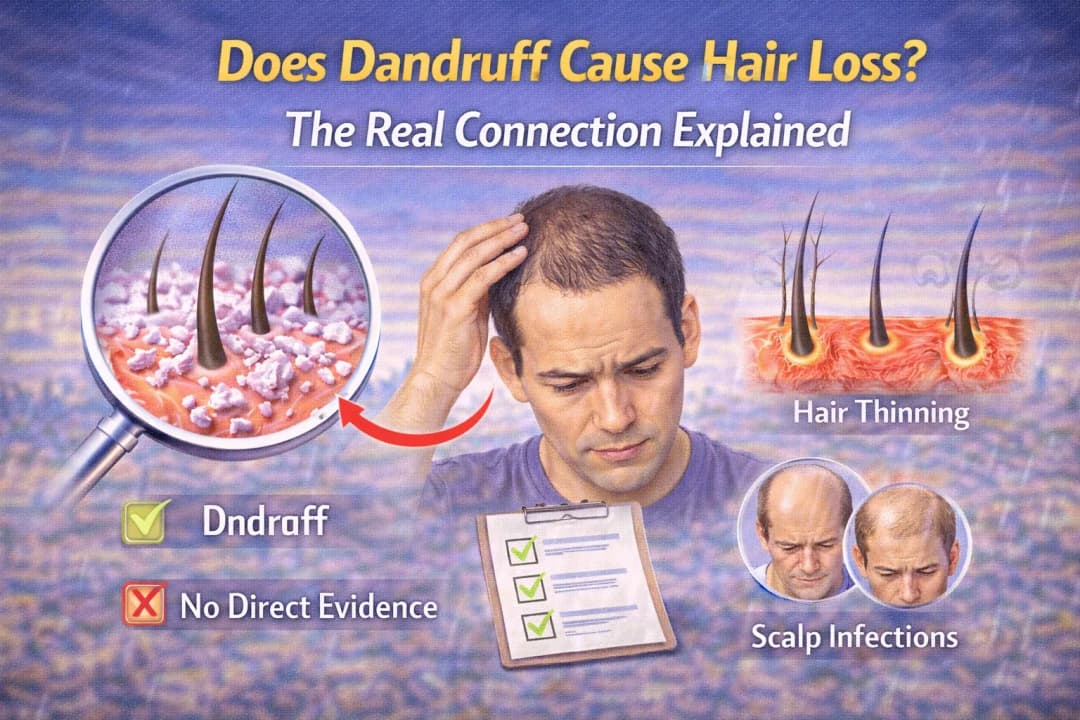
Dandruff does not destroy hair follicles - which means it cannot cause permanent hair loss on its own. What it does is create an inflamed scalp environment that forces hair follicles to enter the telogen (shedding) phase earlier than their natural schedule, resulting in more hairs falling out over the same period.
This type of hair shedding is called secondary telogen effluvium - a well-documented dermatological response to scalp inflammation. Because the follicles are alive and structurally intact, they resume normal hair production once inflammation is resolved. The hair loss is the symptom; the dandruff is the cause.
Two things determine how much hair you lose and how quickly you recover. First, the severity of inflammation - mild dandruff causes a mild increase in shedding; severe seborrheic dermatitis with significant redness and persistent irritation causes more pronounced, sustained hair fall. Second, the duration of untreated inflammation - the longer dandruff goes unaddressed, the more follicles accumulate in the telogen phase and the more pronounced the eventual shed becomes.
Treat the dandruff, and in the vast majority of cases, the hair fall resolves within 8 to 12 weeks.
The Mechanism: Why Dandruff Disrupts Your Hair Growth Cycle
Your hair grows in a four-stage cycle: anagen (active growth, lasting 2 to 7 years), catagen (transition, 2 to 3 weeks), telogen (resting, 3 months), and exogen (shedding). At any given time, roughly 85 to 90 percent of your scalp hairs are in the anagen phase and 10 to 15 percent are in telogen. Understanding the hair growth cycle helps explain why dandruff creates the shedding pattern it does.
Dandruff disrupts this balance through a specific biological pathway:
Step 1 - Fungal proliferation: Malassezia globosa overgrows when scalp sebum production is elevated, humidity is high, or the skin's natural microbiome is disturbed. The fungus breaks down triglycerides in sebum into oleic acid.
Step 2 - Barrier disruption: Oleic acid penetrates the scalp's lipid barrier, triggering an innate immune response. This is why even people without a compromised immune system develop dandruff - the trigger is chemical, not immune deficiency.
Step 3 - Cytokine release: The immune response activates keratinocytes (scalp skin cells) to release pro-inflammatory signals including interleukin-1 alpha (IL-1 alpha). IL-1 alpha is a known telogen-inducing agent - it directly signals hair follicles to exit anagen and enter the resting phase early.
Step 4 - Premature telogen shift: More follicles than normal enter telogen simultaneously. Because hair in telogen sheds approximately 3 months later, the visible hair fall appears weeks after the peak of scalp inflammation - which is why many people are confused about the cause.
Step 5 - Mechanical damage from scratching: Persistent itching leads to scratching, which physically weakens the follicle-shaft junction and causes traumatic hair breakage - separate from the biological shedding mechanism above.
How Dandruff Leads to Hair Fall: The Four Mechanisms
Dandruff does not damage hair follicles directly. Instead, it creates a cascade of scalp conditions that together push more follicles than normal into the shedding phase simultaneously:
- Scalp inflammation - chronic irritation from Malassezia byproducts signals follicles to leave the growth phase early, causing diffuse shedding weeks later
- Mechanical damage from scratching - persistent itching leads to scratching, which physically weakens hair at the root and causes breakage separate from the biological shedding process
- Follicle-blocking buildup - oily flakes and sebum accumulation can physically block follicle openings, restricting proper hair emergence and weakening new growth. Regular scalp detox helps prevent this buildup
- Disrupted scalp microbiome - the shift from a balanced scalp microbiome to Malassezia-dominant overgrowth undermines the environment healthy hair follicles depend on. Monsoon conditions in Mumbai can accelerate this shift
Each of these mechanisms is reversible. Resolving the dandruff resolves the mechanism - which is why dandruff-related hair fall improves reliably with correct treatment.
Seborrheic Dermatitis and Hair Loss: The Condition Behind Severe Dandruff
Seborrheic dermatitis is not just "bad dandruff" - it is a distinct chronic inflammatory skin condition that affects the scalp, face, and chest. Understanding the difference matters because seborrheic dermatitis causes more significant and sustained hair shedding than ordinary dandruff.
What Makes Seborrheic Dermatitis Different from Regular Dandruff
| Feature | Regular Dandruff | Seborrheic Dermatitis |
|---|---|---|
| Flake appearance | Dry, white, powdery | Oily, yellow, adherent |
| Redness | Minimal | Visible, often widespread |
| Inflammation level | Mild | Moderate to severe |
| Hair shedding risk | Low to moderate | Moderate to high |
| Areas affected | Scalp only | Scalp, face, chest |
| Treatment needed | OTC anti-dandruff shampoo | Often prescription-strength antifungal |
| Recovery timeline | 4 to 8 weeks | 8 to 16 weeks with consistent treatment |
The key biological difference is that seborrheic dermatitis involves a stronger immune response to Malassezia globosa, producing a cascade of pro-inflammatory cytokines that can persistently disrupt the hair growth cycle. It is important to distinguish seborrheic dermatitis from scalp psoriasis, which looks similar but has a different underlying mechanism and treatment approach.
Is Seborrheic Dermatitis Hair Loss Permanent?
In the vast majority of cases, no. Because the follicles remain structurally intact, hair regrows once the inflammation is controlled. A 2019 study in the Journal of the European Academy of Dermatology and Venereology found that patients with seborrheic dermatitis who adhered to antifungal scalp treatment showed measurable reduction in hair shedding within 8 weeks.
However, in rare cases where seborrheic dermatitis has been severely untreated for years, persistent inflammation may cause localised follicular scarring - a condition called cicatricial (scarring) alopecia - which can result in patches of permanent hair loss. This is the exception, not the rule.
What Causes Both Dandruff and Hair Loss at the Same Time?
If you have both dandruff and significant hair loss, one of three scenarios is happening. Identifying which one applies to you determines your treatment path.
Scenario 1: Dandruff is the primary cause of your hair fall. You notice increased shedding that started around the same time as worsening dandruff. Hair loss is diffuse (spread across the scalp), not concentrated at the temples or crown. Itching and flaking are significant. This is the most straightforward scenario - treat the dandruff and the shedding resolves.
Scenario 2: Dandruff and hair loss share a common root cause. Certain conditions cause both independently. Hormonal changes (thyroid dysfunction, postpartum shifts, PCOS) dysregulate sebum production while simultaneously disrupting the hair cycle. Nutritional deficiencies (zinc, biotin, essential fatty acids) impair both the skin barrier and hair follicle function. Chronic stress elevates cortisol, allowing Malassezia overgrowth while also triggering stress-induced shedding. In these cases, treating dandruff alone helps but does not fully resolve the hair loss.
Scenario 3: Dandruff co-exists with androgenetic alopecia (pattern hair loss). Genetic pattern hair loss - the type driven by DHT sensitivity - frequently co-exists with dandruff because both are more common in individuals with oily scalps. They do not cause each other, but dandruff can worsen the appearance of thinning in someone already experiencing pattern loss.
How to Tell Which Scenario Applies to You
| Sign | Points to Dandruff as Primary Cause | Points to Other Cause |
|---|---|---|
| Hair loss location | Diffuse, all over scalp | Concentrated at temples or crown |
| Onset timing | Started with dandruff worsening | Predated or unrelated to dandruff |
| Scalp condition | Active flaking and itching | Minimal flaking, smooth scalp |
| Family history | No significant family baldness | Parent or sibling with pattern loss |
| Response to treatment | Shedding improves within 8 weeks | Shedding continues despite dandruff resolving |
Getting the right blood tests for hair fall can help identify whether nutritional or hormonal factors are contributing alongside the dandruff.
Is Dandruff-Related Hair Loss Permanent or Temporary?
Dandruff-related hair loss is almost always temporary. The critical factor is whether the hair follicles have been permanently damaged - and in dandruff-driven shedding, they almost never are. Here is the typical recovery timeline:
Month 1 (Weeks 1 to 4): Scalp inflammation begins to reduce. Itching decreases. You may not notice less shedding yet - in fact, some people experience a brief increase in fallout as the scalp adjusts.
Month 2 (Weeks 5 to 8): Flaking reduces significantly. Hair shedding rate begins to normalise. Fewer hairs lost in the shower or on the pillow.
Month 3 (Weeks 9 to 12): Most people with dandruff-related hair fall see clear improvement by this point. Shedding returns to the normal range of 50 to 100 hairs per day.
Month 4 to 6: Hair that entered the telogen phase during peak inflammation begins to regrow. New growth is visible at the roots, particularly along the hairline and parting. Understanding what shedding looks like at one month helps you differentiate normal progress from concern.
When Hair Loss from Dandruff May Not Be Temporary
Three situations can complicate recovery. Co-existing androgenetic alopecia means that once dandruff is treated, shedding improves but genetic thinning remains. Chronic, severe seborrheic dermatitis untreated for years can, in rare cases, cause follicular scarring. And incorrect treatment - using the wrong shampoo or inconsistent use - means inflammation persists and the follicle-stress cycle continues.
The rule of thumb: if hair fall has not improved meaningfully within 3 months of consistent, correct anti-dandruff treatment, consult a dermatologist. A separate root cause is likely involved.
Treating Dandruff-Related Hair Loss: What Actually Works
The Core Active Ingredients
Ketoconazole (1% or 2%): The most clinically studied antifungal ingredient for scalp dandruff. It disrupts the cell membrane of Malassezia, reducing fungal load and the resulting oleic acid irritation. A 2019 meta-analysis found ketoconazole 2% shampoo significantly more effective than placebo in reducing scalp flaking and inflammation within 4 weeks. Ketoconazole 2% also has a mild anti-androgenic effect on the scalp, which may offer additional benefit in people whose dandruff co-exists with pattern hair loss. For a deeper look at how dermatologist-recommended shampoos work, our dedicated guide covers what to look for.
Zinc Pyrithione (1 to 2%): Antibacterial and antifungal. Reduces Malassezia population through cell membrane disruption. Gentler than ketoconazole - well suited for mild-to-moderate dandruff and maintenance use.
Selenium Sulfide (1 to 2.5%): Slows skin cell turnover and reduces Malassezia growth. Effective for stubborn or oily dandruff. Not recommended for colour-treated hair.
Salicylic Acid: A keratolytic (skin-exfoliating) agent that removes scale and reduces buildup. Does not directly target the fungus - best used in combination with an antifungal ingredient.
Ciclopirox: A broad-spectrum antifungal available in some prescription formulations. Effective for seborrheic dermatitis that does not respond to ketoconazole.
How to Use Anti-Dandruff Shampoo Correctly
Most people use anti-dandruff shampoo incorrectly - which is why they do not see results:
- Apply to wet scalp, not hair. The active ingredient needs to contact the scalp directly.
- Leave it on for 3 to 5 minutes before rinsing. Most people rinse immediately, reducing contact time and effectiveness.
- Use 3 times per week during active treatment (not daily - this can dry the scalp). Reduce to 1 to 2 times per week once dandruff is controlled.
- Alternate between two actives (e.g., ketoconazole one wash, zinc pyrithione the next) to prevent Malassezia resistance.
- Do not follow with heavy conditioner on the scalp - this adds oils that feed the fungus. Apply conditioner to hair lengths only. Understanding the difference between sulfate-free and regular shampoos helps you choose the right complementary products.
What Does Not Work (Common Mistakes)
- Scratching before shampooing to "loosen" flakes - this causes mechanical hair damage and introduces bacteria into micro-wounds
- Skipping washes to preserve natural oils - oily scalp is the primary fuel for Malassezia growth; skipping washes worsens dandruff
- Applying coconut or heavy oils to an actively inflamed scalp - while oils have benefits for normal scalp maintenance, applying them to an active dandruff scalp can feed Malassezia and worsen inflammation
- Expecting results in 1 to 2 washes - meaningful reduction in inflammation takes 4 to 6 weeks of consistent use
Dandruff vs Hair Loss: Key Differences
| Factor | Dandruff-Related Shedding | Pattern Hair Loss |
|---|---|---|
| Cause | Fungal overgrowth and scalp inflammation | Genetics, DHT hormone sensitivity |
| Pattern | Diffuse, spread across scalp | Receding hairline, crown, widening part |
| Effect on follicles | Temporary disruption | Progressive miniaturisation |
| Reversibility | Fully reversible with treatment | Requires ongoing medical management |
| Hair quality | Regrown hair same thickness | Each cycle produces thinner hair |
Understanding this distinction is crucial. If your hair is getting finer and shorter over several years alongside dandruff, an underlying genetic hair loss condition is likely involved alongside the scalp issue. The Norwood scale can help you assess whether your pattern matches genetic recession.
What This Means for You: Next Steps
If you are losing hair and have dandruff, here is what the evidence says: your shedding is almost certainly temporary and will improve once scalp inflammation is brought under control. Most people see meaningful reduction in hair fall within 6 to 8 weeks of consistent anti-dandruff treatment, and visible regrowth follows within 3 to 5 months.
- Start with a ketoconazole or zinc pyrithione shampoo used correctly - 3 to 5 minute contact time, 3 times per week
- Track your shedding week by week; expect improvement by weeks 6 to 8, not days 1 to 2
- Photograph your scalp monthly to monitor flaking and redness
- If you also notice thinning specifically at the temples, crown, or parting - not just diffuse shedding - raise the question of androgenetic alopecia with a dermatologist
- Support your scalp with good nutrition for hair density and adequate vitamin D and iron levels
- Book a dermatology consultation if dandruff does not meaningfully improve after 8 weeks of OTC treatment, or if hair fall has not stabilised after 3 months
For hair loss that persists despite treating dandruff, treatments like PRP therapy, GFC therapy, or mesotherapy can support follicles that have been stressed by prolonged inflammation. For more advanced support, microneedling and low-level laser therapy are additional options your dermatologist may recommend based on your specific situation.
Dandruff not responding to OTC products? Hair fall continuing despite treatment? Get it assessed properly.
Frequently Asked Questions
Can severe dandruff cause hair loss that does not grow back?
In almost all cases, severe dandruff causes temporary - not permanent - hair loss. The follicles remain intact even under significant scalp inflammation, so regrowth is expected once the condition is treated. The rare exception is chronic, untreated seborrheic dermatitis lasting several years, which can occasionally lead to localised follicular scarring. If your hair has not regrown within 6 months of successful dandruff treatment, consult a dermatologist to rule out scarring alopecia or a co-existing genetic cause.
How long does it take for hair to stop falling after treating dandruff?
Most people notice a meaningful reduction in shedding within 6 to 8 weeks of consistent anti-dandruff treatment. Full stabilisation - where daily hair fall returns to the normal 50 to 100 strands - typically takes 10 to 12 weeks. New regrowth from follicles pushed into the telogen phase becomes visible around 3 to 5 months after inflammation resolves.
Is dandruff hair loss different from pattern baldness?
Yes - the pattern, mechanism, and reversibility are entirely different. Dandruff-related hair loss is diffuse, caused by scalp inflammation, and fully reversible. Androgenetic alopecia follows a predictable pattern - receding hairline and crown thinning in men, widening parting in women - is driven by DHT hormone sensitivity and genetic follicle miniaturisation, and is not reversible without medical treatment. Both conditions can co-exist.
Can I use minoxidil for hair loss caused by dandruff?
Minoxidil is not the appropriate first-line treatment for dandruff-related hair loss. Because dandruff-driven shedding is caused by scalp inflammation - not follicle miniaturisation - the correct approach is to resolve the dandruff first with antifungal treatment. If hair loss persists after 3 to 4 months of successful dandruff control, a dermatologist may assess whether androgenetic alopecia is co-existing, at which point minoxidil may be relevant. Using minoxidil on an actively inflamed scalp can worsen irritation.
Does dandruff cause hair thinning or just increased shedding?
Dandruff primarily causes increased diffuse shedding rather than true hair thinning. Shedding means more hairs fall out than usual - but the hairs that grow back are the same thickness. True thinning (miniaturisation) - where each new hair grows progressively thinner and shorter - is a sign of androgenetic alopecia, not dandruff. Understanding the difference between hair density and thickness helps clarify this distinction.
Does scratching your scalp from dandruff cause permanent hair loss?
Scratching causes mechanical hair breakage and can damage the follicle opening, but it does not typically cause permanent follicle death. The hair that breaks will regrow once the mechanical damage stops. However, severe repeated scratching can introduce bacteria into scalp micro-wounds, causing folliculitis - which, if left untreated, can occasionally lead to localised scarring. The practical takeaway: treat the itch with antifungal treatment rather than scratching.
Should I see a dermatologist or a trichologist for dandruff-related hair loss?
For most people, a dermatologist is the right first step. Dermatologists can diagnose the type of dandruff (standard vs seborrheic dermatitis vs scalp psoriasis), prescribe prescription-strength antifungals if OTC treatments have failed, and rule out co-existing conditions like androgenetic alopecia, thyroid dysfunction, or nutritional deficiency. A trichologist specialises specifically in hair and scalp health and may be more appropriate if hair loss persists despite successful dandruff treatment.
Medical Disclaimer
This article is published by Kibo Clinics for education only. It is not medical advice. Dandruff and hair loss can have multiple causes including fungal overgrowth, seborrheic dermatitis, hormonal changes, nutritional deficiencies, genetics, and medical conditions. Always consult a qualified dermatologist for proper evaluation and treatment, especially if dandruff does not respond to OTC treatment within 8 weeks or if hair fall persists beyond 3 months.
Sources Referenced: Journal of the European Academy of Dermatology and Venereology (JEADV) 2019 study on antifungal treatment and hair shedding; peer-reviewed research on Malassezia, scalp inflammation, and IL-1 alpha telogen induction on PubMed; AAD guidelines on seborrheic dermatitis and dandruff management; Cleveland Clinic dermatology resources on scalp conditions.
For a personal assessment, consult a Board Certified Doctor at Kibo Clinics. The doctor you meet in your consultation is the same doctor who handles your treatment through every stage.
Explore Kibo Clinic Services
Hair Transplant Services:
FUE Hair Transplant | Sapphire FUE | Direct Hair Transplant | Hairline Correction | Corrective Hair Transplant
Non-Surgical Regrowth:
IV Hair Boosters | PDO Threads | Body Hair Transplant | Unshaven Hair Transplant
Related Articles
Scalp Health:
Hard Water and Hair Loss in Mumbai | Pollution and Scalp Health | Seasonal Weather and Shedding | Gut Health and Hair Density
Hair Loss Basics:
DHT Blocker Side Effects | Menopause and Hair Density | Hair Myths Busted | Sugar, Diet, and Hair Thinning
Treatments:
GFC Therapy vs PRP | Microneedling for Hair Growth | Minoxidil vs Redensyl | Saw Palmetto as DHT Blocker