
Onion Juice for Hair Growth: Does It Really Work?
Published on Mon Jul 20 2026
֎ Show Quick Answer AI Quick answer summary
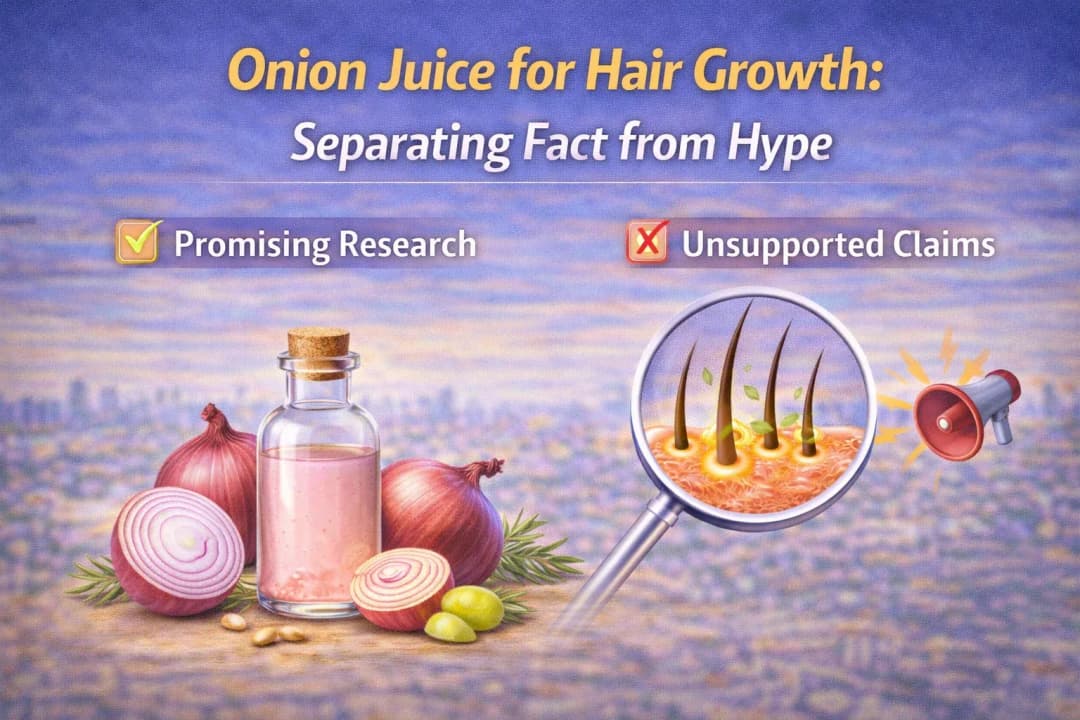
- Onion juice is not a proven general hair-growth treatment: the evidence comes mainly from one small 2002 study in patchy alopecia areata, not from strong trials in male or female pattern hair loss.
- The study result is often overstated: it reported regrowth in many treated participants, but the sample was small, the control was tap water and the result has not been confirmed by large modern trials.
- It may irritate the scalp: burning, redness, itching, contact dermatitis, watery eyes and a persistent smell are common practical problems.
- It cannot revive scarred follicles or reverse advanced baldness: shaft conditioning and scalp freshness are different from medically proven follicular regrowth.
- Diagnosis comes first: patchy, sudden, rapidly worsening or long-lasting hair loss should be assessed before relying on a home remedy.
Not sure whether your hair loss is patchy, genetic or caused by another condition?
Does Onion Juice Really Help Hair Growth?
Onion juice may help some people with patchy alopecia areata, but there is not enough evidence to say that it reliably grows hair in the general population. The most cited human study was small, tested crude onion juice twice daily for two months and involved people with alopecia areata. It did not prove benefit for male pattern baldness, female pattern hair loss, post-pregnancy shedding, nutritional hair loss or advanced bald areas.
That distinction matters. Alopecia areata is an autoimmune condition in which follicles often remain capable of regrowth. Pattern hair loss involves progressive follicle miniaturisation. Breakage affects the shaft rather than the follicle. A remedy that appears useful in one condition should not be assumed to work in all three.
What Did the Onion Juice Study Actually Find?
The 2002 study compared crude onion juice with tap water in people with patchy alopecia areata. Participants were advised to apply the assigned liquid twice daily for two months. The onion group showed substantially more visible regrowth than the control group during the short study period.
The result is interesting, but it is not the same as strong proof. The study was small, used a basic control, relied on a short follow-up and has not been replicated in large, high-quality trials. It also studied a specific autoimmune condition, not routine thinning or genetic baldness. The safest interpretation is possible benefit in patchy alopecia areata, with low certainty for other types of hair loss.
Which Types of Hair Loss Might Respond?
| Hair-loss situation | What onion juice may do | Evidence limit |
|---|---|---|
| Patchy alopecia areata | May support regrowth in some people | One small older human study |
| Male or female pattern hair loss | No reliable evidence that it reverses follicle miniaturisation | No strong clinical trials |
| Telogen effluvium | Does not remove the trigger causing shedding | Diagnosis and trigger correction matter more |
| Hair breakage | May not repair a damaged shaft | Conditioning effects are not follicular regrowth |
| Scarring alopecia | Cannot restore destroyed follicles | Needs urgent medical assessment |
Why Is Onion Juice Believed to Work?
Sulfur-containing compounds
Onions contain sulfur-containing compounds, and hair keratin contains sulfur-rich amino acids. This biochemical fact does not prove that putting onion juice on the scalp supplies follicles with usable building material or produces new growth. The popular claim is plausible in theory but clinically under-tested.
Irritation and temporary blood-flow changes
Fresh onion juice can irritate the skin. Mild irritation may temporarily increase local redness and blood flow, but irritation is not evidence that dormant follicles have restarted. Strong burning is a warning to wash it off, not a sign that the remedy is working.
Antimicrobial activity
Onion compounds show antimicrobial activity in laboratory settings. That does not mean raw juice treats dandruff, fungal infection or inflammatory scalp disease safely. Persistent flaking, pain, pus or hair loss needs diagnosis rather than repeated home applications.
Antioxidants
Onions contain flavonoids such as quercetin. Laboratory antioxidant activity is different from demonstrated hair regrowth in people. The mechanism remains a hypothesis, not a confirmed treatment pathway.
Onion Juice for Alopecia Areata
This is the condition for which onion juice has the most direct human evidence. Even here, it should not replace a medical assessment. Alopecia areata can improve spontaneously, recur after regrowth or spread to new areas. Current treatment plans may include topical corticosteroids, carefully placed steroid injections or other options based on age, extent and activity.
A smooth round patch, eyebrow loss, beard patches or nail pitting should prompt evaluation. Read the detailed guide on alopecia areata regrowth before deciding whether a home remedy is enough.
Can Onion Juice Treat Genetic Hair Loss?
There is no strong evidence that onion juice reverses androgenetic alopecia. Genetic hair loss is driven by inherited follicle sensitivity and progressive miniaturisation. A temporary scalp sensation, stronger smell or less oiliness does not show that miniaturised follicles are recovering.
Evidence-based options may include minoxidil, prescription treatment for suitable patients, low-level laser devices, selected regenerative procedures and hair transplantation when loss is stable and donor hair is adequate. Compare this with male pattern baldness and hair loss in women.
Can Onion Juice Stop Hair Fall from Stress or Deficiency?
Onion juice does not correct fever-related shedding, thyroid disease, low iron stores, rapid weight loss, medication effects or postpartum hormonal change. In these situations, the useful step is finding and correcting the trigger. Read about telogen effluvium, blood tests for hair fall, iron deficiency and hair thinning and vitamin D and hair follicles.
How to Use Onion Juice More Safely
- Confirm that the scalp is intact: do not apply it over cuts, infection, severe inflammation or recently treated skin.
- Prepare a small fresh amount: grate or blend onion, then strain the liquid through clean cloth.
- Patch test first: apply a small amount behind the ear or on the inner arm and observe for irritation.
- Use a small scalp area initially: avoid flooding the scalp or letting juice run into the eyes.
- Limit contact time: wash it off promptly if there is burning, swelling or marked itching.
- Rinse with a gentle shampoo: do not scrub aggressively to remove the smell.
- Stop if symptoms develop: continuing through irritation can worsen dermatitis and shedding.
The original study used twice-daily application, but that does not establish a safe general home protocol. Frequent raw-onion exposure can be difficult to tolerate. A dermatologist may advise against it when the scalp barrier is sensitive.
How Often Should You Apply It?
There is no standard dermatology guideline for frequency because onion juice is not an established general hair-loss treatment. Online schedules vary from daily use to a few times per week. More frequent application may increase irritation without increasing benefit.
A cautious approach is to start with a patch test and limited exposure rather than copy the most intensive online routine. Do not apply onion juice and another irritating topical at the same time unless a clinician has reviewed the combination.
Onion Juice Side Effects
- Burning or stinging
- Redness and itching
- Contact dermatitis
- Dryness, flaking or worsening sensitivity
- Watery or irritated eyes
- Strong odour that persists after washing
- Extra breakage from repeated rubbing and washing
People with eczema, psoriasis, seborrhoeic dermatitis, an onion allergy or a recently injured scalp should be especially cautious. Persistent symptoms need assessment. Compare common inflammatory conditions in scalp psoriasis versus dandruff and seborrhoeic dermatitis.
Can You Mix Onion Juice with Oil, Aloe Vera or Lemon?
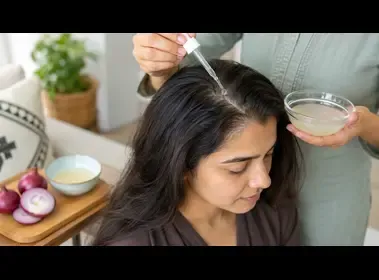
Mixing onion juice with oil or aloe vera may reduce the sting for some people, but it also changes the concentration and has not been proven to improve regrowth. Lemon can increase irritation and should not be used on sensitive or broken skin. Essential oils can also cause dermatitis if undiluted.
A mixture that feels soothing may condition the shaft or scalp surface. That is different from reversing follicle miniaturisation or autoimmune hair loss.
Onion Juice vs Better-Studied Options
| Option | Best-supported use | Evidence position |
|---|---|---|
| Onion juice | Possible support in patchy alopecia areata | Limited, one small human trial |
| Minoxidil | Pattern hair loss in suitable patients | Substantially better studied |
| Corticosteroids | Alopecia areata | Guideline-supported treatment |
| PRP or GFC | Selected diagnosed hair-loss cases | Evidence varies by condition and protocol |
| Hair transplant | Stable permanent pattern loss with adequate donor hair | Surgical redistribution, not a cure for active disease |
For comparisons, see minoxidil versus Redensyl, PRP versus PRF, GFC versus PRP and the guide to non-surgical hair-loss treatments in India.
When Onion Juice Will Not Help
- Advanced shiny bald areas with long-standing follicle loss
- Scarring alopecia where follicles have been destroyed
- Untreated iron, thyroid or nutritional problems
- Active fungal or bacterial scalp infection
- Traction alopecia caused by continued pulling
- Ongoing genetic miniaturisation without appropriate treatment
- Hair shaft breakage from bleach, heat or tight styling
What This Means for You
Onion juice is neither a miracle nor completely without evidence. The most defensible conclusion is narrow: one small study suggests possible benefit in patchy alopecia areata, while evidence for routine thinning and genetic hair loss is weak.
Trying it on an intact scalp after a patch test may be reasonable for some adults who understand the uncertainty. It should not delay diagnosis, replace guideline-supported treatment or be continued through irritation. The commercial decision should come after identifying the condition, not before it.
Need to know whether a home remedy fits your type of hair loss?
Frequently Asked Questions
Does onion juice regrow hair?
It may support regrowth in some people with patchy alopecia areata, but it is not proven to grow hair reliably in all forms of hair loss.
How long does onion juice take to show results?
The small alopecia areata study reported visible regrowth within weeks, but this cannot be treated as a guaranteed timeline for general hair loss.
Can onion juice be used every day?
Daily use may increase irritation. There is no standard guideline recommending daily onion juice for hair growth.
Is onion juice effective for male pattern baldness?
There is no strong clinical evidence that onion juice reverses genetic follicle miniaturisation or advanced male pattern baldness.
Can onion juice help female hair thinning?
Evidence is insufficient for female pattern hair loss. Women with persistent thinning should be assessed for pattern loss, iron deficiency, thyroid disease, PCOS and other causes.
Does onion juice help alopecia areata?
One small older study found better regrowth than tap water in patchy alopecia areata. The finding is promising but has not been confirmed by large modern trials.
Can onion juice cause hair fall?
It can indirectly worsen shedding or breakage if it causes dermatitis, scratching or repeated aggressive washing.
Should onion juice be diluted?
Dilution may reduce irritation, but there is no clinically established dilution that preserves benefit. Patch testing remains important.
Can I mix onion juice with coconut oil?
You can mix them, but the mixture has not been proven to regrow hair better. Coconut oil may mainly reduce dryness and friction on the shaft.
Can onion juice and minoxidil be used together?
Using both on the scalp can increase irritation. A clinician should review timing and scalp tolerance before combining topical products.
Does onion juice treat dandruff?
Laboratory antimicrobial activity does not prove that raw onion juice safely treats dandruff. Persistent flaking may be seborrhoeic dermatitis, psoriasis or infection.
When should I see a dermatologist for hair loss?
Seek assessment for sudden patches, rapidly worsening thinning, eyebrow loss, scalp pain, pus, scarring, nail changes or shedding lasting several months.
Want a diagnosis-led plan instead of trial-and-error remedies?
Why Kibo Clinics
Kibo Clinics begins with the pattern, scalp findings, medical history and likely diagnosis. This helps separate shaft damage from follicular hair loss and avoids recommending the same procedure for every person.
The doctor who conducts your consultation is the same doctor who handles your treatment through every stage.
Medical Disclaimer
This article is for educational purposes only. Onion juice is not a proven treatment for all forms of hair loss and can irritate the scalp. Hair loss may be autoimmune, genetic, hormonal, nutritional, inflammatory, infectious or mechanical. Consult a qualified medical professional for diagnosis and treatment.
Sources referenced: Sharquie KE and Al-Obaidi HK, “Onion Juice (Allium cepa L.), a New Topical Treatment for Alopecia Areata,” Journal of Dermatology, 2002; Paiewonsky B et al., “Hairfluencer Social Media Trends Every Dermatologist Should Know,” International Journal of Women’s Dermatology, 2023; American Academy of Dermatology, clinical hair-loss guidance; National Institute of Arthritis and Musculoskeletal and Skin Diseases, alopecia areata information; current dermatology guidance on alopecia areata assessment and treatment.
For a personal assessment, consult a Board Certified Doctor at Kibo Clinics. The doctor you meet in your consultation is the same doctor who handles your treatment through every stage.
Talk to a Board Certified DoctorExplore Kibo Clinic Services
Hair Transplant: FUE Hair Transplant | Sapphire FUE | Direct Hair Transplant | Bio FUE | Real Time FUE | Corrective Hair Transplant | Hairline Correction | Unshaven Hair Transplant | Body Hair Transplant
Non-Surgical: PRP Therapy | GFC Therapy | Mesotherapy | Microneedling | Low-Level Laser Therapy | IV Hair Boosters | PDO Threads | Exosome Therapy
Explore More
Natural Remedies: Rosemary Oil for Hair Growth | Castor Oil for Hair Growth | Amla for Hair Growth | Rice Water for Hair Growth
Diagnosis and Causes: DHT Blockers Guide | PCOS Hair Thinning | Postpartum Hair Loss | Dermatologist vs Trichologist
Scalp Care: Does Dandruff Cause Hair Loss? | Scalp Detox and Buildup | Frequent Washing and Hair Loss | Sulfate-Free vs Regular Shampoo
Treatment Decisions: Mesotherapy for Hair Loss | LLLT Hair Helmet Therapy | Microneedling for Hair Growth | Hair Transplant Side Effects