
Can Wearing a Hat Cause Baldness? Debunking the Myth
Published on Mon May 11 2026
Article Information
Reviewed By: Shritej Mali
Written By: Kibo Clinics Content Team
Sources Referenced: British Journal of Dermatology (2018), Journal of the American Academy of Dermatology (2019), AAD Hair Loss Resource Centre, Dermatology and Therapy (2021), Journal of Investigative Dermatology
Last Updated: May 2026
Reading Time: 16 minutes
Who This Is For: Anyone who wears hats, helmets, or head coverings daily and is concerned about hair loss
This article is for education only. If your hair loss is progressive, consult a qualified dermatologist.
Hairline changing and not sure if it is your hat or something else? Board Certified Dermatologists can assess it properly.
A Common Story: The Cap and the Receding Hairline
Rohit, 28, from Pune, started wearing a cap daily during his long bike rides to work. A year later, he noticed his hairline slowly moving back. Friends joked that his "cap habit" had made him bald. Over time, he became anxious. He stopped wearing caps, changed shampoos, and even avoided helmets for short distances. But the hair fall continued. That is when he realised the thinning pattern was similar to his father's.
After a proper scalp assessment, he learned he had early male pattern hair loss. The cap did not cause it. His genetics and hormone sensitivity did. The delay in diagnosis, however, cost him valuable early treatment time.
Why Do People Think Hats Cause Baldness?
The belief comes from a few common observations. First, when you remove your cap and see hair inside, it feels like the hat "pulled" it out. In reality, you normally shed 50 to 100 hairs daily. The hat simply collects strands that were already in the shedding phase.
Second, people assume hair needs "air" to grow. While scalp health matters, hair follicles get oxygen and nutrients from blood supply, not from outside air. Covering your head does not suffocate hair roots.
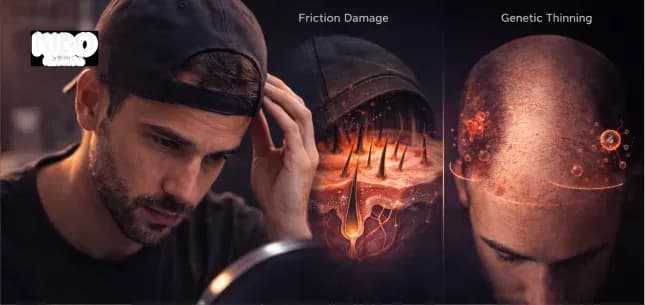
Third, tight hats can cause discomfort. Repeated friction may break hair shafts, which looks like thinning. But breakage is not the same as follicle death or permanent baldness.
How Hair Loss Actually Works: The Biology Behind Baldness
Step 1: DHT binds to follicle receptors. In people genetically predisposed to androgenetic alopecia, hair follicles carry androgen receptors that are unusually sensitive to dihydrotestosterone. DHT is produced when the enzyme 5-alpha-reductase converts testosterone.
Step 2: Follicle miniaturisation begins. When DHT binds to a sensitive receptor, it shortens the hair's anagen (growth) phase and lengthens the telogen (resting) phase. Over repeated cycles, the follicle physically shrinks - producing progressively finer, shorter hairs. Understanding hair density versus thickness helps clarify what miniaturisation looks like.
Step 3: The hairline recedes in a predictable pattern. In men, this typically follows the Norwood Scale - beginning at the temples and crown. In women, it manifests as diffuse thinning across the central parting.
Step 4: Without intervention, the process is progressive. Androgenetic alopecia does not reverse on its own. Early medical intervention can slow, stop, or reverse early-stage loss. Delaying treatment by blaming a hat costs valuable follicle-preservation time. According to data published in the Journal of Investigative Dermatology, androgenetic alopecia affects approximately 50% of men by age 50 and up to 40% of women by age 70.
A hat is not part of this pathway at any step.
What Actually Causes Baldness?
Scalp health influences how well follicles function. Inflammation, excess oil, fungal infections, or dandruff can disturb the scalp environment. Follicle function depends on blood supply and hormonal signals. Hormones and stress play a major role - thyroid imbalance, PCOS in women, postpartum changes, and chronic stress can trigger shedding. Lifestyle factors like poor diet, smoking, pollution, crash dieting, and lack of sleep weaken hair quality over time.
A hat does not change your hormone levels or genetic sensitivity. That is why it cannot directly cause baldness.
How Can Wearing a Hat Affect Your Hair Indirectly?
While hats do not cause baldness, certain habits can affect hair condition. Wearing very tight hats daily can cause traction stress - continuous pulling at the same area may lead to traction alopecia over time, especially along the hairline. Using unwashed caps repeatedly can trap sweat, oil, and dirt, increasing scalp irritation or fungal growth. Not drying your hair properly before wearing a hat creates a damp environment where fungal infections thrive - the same principle behind wet hair vulnerability. Helmets worn for long hours without scalp care can worsen dandruff or itching.
These factors do not cause genetic baldness, but they can worsen scalp problems that increase shedding. Understanding how headgear impacts follicle health helps you separate real risks from myths.
Traction Alopecia: The One Real Hat Risk - And How to Reverse It
Traction alopecia is the one hair loss condition that hats can genuinely cause - but only under specific conditions. When a hat, helmet, or headband applies constant pressure along the hairline for hours each day over months or years, the repeated pulling stress damages the follicle's dermal papilla.
Traction alopecia from hats most commonly appears along the frontal hairline, at the temples, and in a band-like pattern matching the hat's contact zone. It is more common in people who combine tight hairstyles underneath a hat.
| Stage | What Is Happening | Reversal Timeline |
|---|---|---|
| Early (0 to 6 months) | Follicle inflamed, hair thin but present | Full regrowth in 3 to 6 months after stopping tension |
| Intermediate (6 to 24 months) | Some follicle scarring beginning | Partial regrowth in 6 to 12 months; may need treatment |
| Advanced (2+ years) | Permanent follicle scarring | Regrowth unlikely without surgical intervention |
How to prevent it: choose hats with a band that sits loosely, avoid tight hairstyles underneath, alternate hat types, give your scalp at least 6 to 8 hat-free hours daily, and if you wear a helmet daily, ensure proper sizing and use a moisture-wicking liner.
Hat Type Risk Guide
| Hat Type | Traction Risk | Sweat/Hygiene Risk | Verdict |
|---|---|---|---|
| Loose baseball cap (adjustable) | Low | Low-Medium | Safe for daily use; wash weekly |
| Tight-fitted baseball cap | Medium | Medium | Avoid if wearing 8+ hours daily |
| Beanie / woolly hat | Medium-High | High | High moisture retention; use liner |
| Helmet (motorcycle/cycling) | Medium | High | Use liner; wash hair after long rides |
| Turban / tight head wrap | Medium-High | Medium | Depends on tension; loose is fine |
| Sun hat / wide-brim (loose) | Very Low | Low | Safest for long outdoor wear |
Common Myths About Hats and Baldness
Myth 1: Hats stop oxygen from reaching hair roots. False. Follicles receive oxygen through blood capillaries, not from outside air.
Myth 2: Helmets cause permanent baldness. False. Helmets increase sweating and can worsen dandruff, but they do not alter DHT levels or any biological process involved in permanent hair loss.
Myth 3: Hair found inside your cap proves the cap caused hair loss. False. You shed 50 to 100 hairs naturally every day. The hat collects them in one place.
Myth 4: Wearing hats daily weakens hair roots. False. Hair roots weaken due to hormonal signals, chronic inflammation, nutritional deficiencies, or genetic programming - not because fabric rests on the skin.
Myth 5: Bald men wore too many caps when young. False. Male pattern baldness is a genetic condition. Population genetics research identifies androgen receptor gene variants as the primary determinant. Cap use has never appeared as a significant variable in any large-scale baldness study. For more hair myths debunked, our dedicated guide covers the most common misconceptions.
How to Wear a Hat Every Day Without Damaging Your Hair
Step 1: Choose the right fit. Your hat should sit comfortably without leaving a visible red line after removal. Adjustable straps or stretch-fit designs work best.
Step 2: Never wear a hat over wet or damp hair. Wet hair is structurally weaker. A damp scalp under a hat creates conditions where Malassezia thrives.
Step 3: Wash your hat at least once a week. A cap worn daily accumulates sweat, sebum, and dead skin cells within 2 to 3 wearings. Buildup can trigger scalp imbalance.
Step 4: Rotate your headwear. Wearing the same hat applies consistent friction to the same contact points. Rotating between 2 to 3 hats distributes pressure.
Step 5: Use a breathable liner for helmets. For daily motorcycle or cycling helmet use, a moisture-wicking liner keeps the inner surface dry and reduces friction. Sweatbands and headband liners serve the same purpose.
Step 6: Wash your hair on a schedule that matches your hat use. If you wear a hat 5+ days a week and sweat moderately, 3 to 4 washes per week with a gentle sulfate-free shampoo is appropriate. Understanding whether frequent washing causes hair loss helps you find the right balance.
Step 7: Watch for early warning signs. Persistent itching, flaking, a hairline shifting symmetrically backward, or visible crown thinning are signs to consult a specialist - not signs to stop wearing hats.
What This Means for You
If you have been worrying about your hat habit, you can stop. Your cap is not the reason your hairline is changing. The real takeaway: hats are safe, but hair loss - when it is happening - is not a waiting game.
- If your hat is clean and fits loosely and you have no thinning: no action needed
- If you notice a band-pattern recession along your hat line: remove tension for 4 weeks and observe. If it improves, traction alopecia is likely and reversible
- If your hairline is receding in a Norwood pattern or your crown is thinning: this is androgenetic alopecia. Book a scalp assessment now
- If you have scalp itching or persistent dandruff under your hat: treat the scalp condition first with a medicated shampoo
- If you have a family history of early baldness: proactive assessment is valuable even before visible thinning. Getting the right blood tests helps identify contributing factors early
For cases where the thinning pattern suggests androgenetic alopecia, a clinical assessment covers scalp health, follicle density, and treatment planning - including non-surgical options like PRP or GFC therapy, and surgical options like FUE hair transplant for cases where follicle restoration is appropriate.
Hat not the problem? Find out what actually is.
Frequently Asked Questions
Is it safe for men with a family history of baldness to wear hats every day?
Yes - wearing a hat does not accelerate androgenetic alopecia in men who are genetically predisposed. The progression is driven by DHT and genetic follicle sensitivity, not headwear. If your father or maternal grandfather lost hair early, monitoring your hairline with a specialist is worthwhile, but your hat is not making it worse.
How long does traction alopecia take to reverse after stopping tight hats?
In early-stage cases (under 6 months of chronic tight hat use), most people see regrowth within 3 to 6 months. Intermediate cases (6 to 24 months) may take 6 to 12 months and sometimes benefit from PRP therapy. Cases with scarring after 2+ years of chronic tension may not fully reverse without surgical intervention.
Can wearing a helmet cause permanent hair loss in motorcycle riders?
A properly fitted motorcycle helmet does not cause permanent hair loss. The main risks are increased sweating, hair shaft breakage from friction, and - in a very tight helmet worn 5+ hours daily - early traction stress at the hairline. Wearing a moisture-wicking liner, keeping hair dry before fitting, and washing hair after long rides eliminates virtually all risks.
Do women who wear hijabs, turbans, or tight head wraps risk hair loss?
Women who wear head coverings regularly face a specific risk of traction alopecia along the frontal hairline if the covering is tied tightly for many hours daily. Loose-fitting styles and breathable fabrics significantly reduce this risk. Hormonal and nutritional causes - such as hormonal changes, iron deficiency, and thyroid imbalance - remain far more common than traction from head coverings.
Why does my scalp itch more when I wear a hat?
Scalp itching under a hat is most commonly caused by sweat and sebum buildup creating warm, moist conditions that favour Malassezia yeast overgrowth - the organism responsible for dandruff and seborrhoeic dermatitis. If itching persists beyond 2 weeks with visible flaking, a ketoconazole-based antifungal shampoo used 2 to 3 times a week typically resolves it within 4 weeks.
I stopped wearing hats but my hair is still falling out. Why?
Because hats are not the cause of most hair loss. If shedding continues after removing hats, the cause is almost certainly androgenetic alopecia, a nutritional deficiency (vitamin D, zinc, biotin), a hormonal imbalance, or stress-triggered telogen effluvium. A blood panel and scalp assessment will identify which applies.
Is it true that bald men went bald because they wore caps too much when young?
No. Androgenetic alopecia is a polygenic inherited condition influenced by androgen receptor gene variants and 5-alpha-reductase enzyme levels. The strongest predictor is family history, not lifestyle habits. Many men who never wore a cap develop significant pattern hair loss; many who wear hats daily keep full heads of hair into their 60s.
At what point should I see a specialist instead of managing hat hygiene on my own?
If correcting hat hygiene and fit does not reduce shedding within 6 to 8 weeks, or if you notice a hairline change that follows the Norwood or Ludwig pattern rather than matching your hat band's contact zone, the cause is clinical rather than habitual. A scalp assessment becomes necessary - the earlier, the more options remain available.
Medical Disclaimer
This content is published by Kibo Clinics for informational purposes only and does not substitute personalised medical advice. Hair loss causes vary from person to person, and responses to treatments differ. Wearing hats alone does not determine baldness risk. Always consult a qualified professional for accurate diagnosis and tailored treatment recommendations.
Sources Referenced: Heilmann-Heimbach S et al. British Journal of Dermatology (2018); Callender VD et al. Journal of the American Academy of Dermatology (2019); AAD Hair Loss Resource Centre; Trueb RM. Dermatology and Therapy (2021); Journal of Investigative Dermatology - androgenetic alopecia prevalence data.
For a personal assessment, consult a Board Certified Doctor at Kibo Clinics. The doctor you meet in your consultation is the same doctor who handles your treatment through every stage.
Explore Kibo Clinic Services
Hair Transplant Services:
Sapphire FUE | Direct Hair Transplant | Bio FUE | Corrective Transplant | Hairline Correction
Non-Surgical Regrowth:
Mesotherapy | Microneedling | IV Hair Boosters | Low Level Laser Therapy | PDO Threads
Related Articles
Hair Loss Basics:
Complete Hair Transplant Guide | FUE Complete Guide | Results Timeline | DHT Blocker Side Effects
Mechanical Hair Damage:
Tension-Based Hair Damage | Hair Ties vs Scrunchies | Transition from Tight Hairstyles | Helmet After Hair Transplant
Scalp Care:
Hard Water and Hair Loss | Summer Scalp Protection | Winter Scalp Dryness | Sweat and Hair Root Damage